
He Drank Water for 20 Days.
What happened to his brain, his kidneys, and his will — and why a yellow vial brought him back.
He must have gone a long time without really looking at his own hands when he dialed 120.
Those hands braced the floor when he fell. But without enough sugar and salt to maintain muscle tension, his elbows failed to lock. He went down sideways, his hip hitting the tile. He lay there. The ceiling didn't spin — his vestibular system was too exhausted even to bother producing dizziness. All that remained was silence.
The operator asked for his address. He gave the name of a housing complex. She asked for the building and apartment number.
He opened his mouth. His lips were stuck together. When they tore apart, he tasted blood.
That was day twenty-one.
The first ten days, he still had crackers. Days eleven through twenty — only water.
There's a detail about those ten days of drinking water that never made it into any news report. It showed up on his lab sheet: low serum sodium. He had drunk enough water to dilute his blood. Not because he was trying to fill his stomach — he just woke up each morning to a stomach that felt like a dry well, went to the kitchen, turned on the tap, filled a glass, drank it, set it down. Woke up the next day, did it again.
There was no trace of food in the apartment. After he threw out the snack wrappers, nothing remained. In the fridge there was half a bottle of oyster sauce and a bag of dried wood ear mushrooms. He didn't touch them.
Not out of moral restraint. Not because he was saving them for someone. Just "forget it."
Forget it. He never said it out loud. It made no sound.
The diagnosis of acute kidney failure came fast. The ER doctor saw his creatinine level and admitted him straight away. Creatinine is a byproduct of muscle breakdown — when the body gets no outside energy, it tears down its own muscle for fuel. After twenty days of burning himself, the waste piled up in his bloodstream. His kidneys couldn't process it. Like a building's garbage chute getting completely clogged.
His parents came from Jiangxi. Hard-seat train tickets, nine and a half hours.
By his bedside, his mother didn't cry. She sat on the folding chair and, every now and then, moistened his lips with a cotton swab dipped in water. The last time she'd done that was when he was six and had a fever.
After three rounds of hemodialysis, he started losing his sight.
His visual world became like a newspaper soaked in water. The ink smeared, outlines still there, but nothing was recognizable. He could tell light from shadow — the window was brighter than the wall — but he couldn't count whether his mother's hair was black or white.
When he was transferred to the First Affiliated Hospital of Zhejiang University, the neurologist on duty asked three questions: What have you eaten lately? What have you drunk? Have you been drinking alcohol?
The first two answers were already on his chart. For the third, his mother answered for him: He doesn't drink. Never has.
That left only one possibility.
Vitamin B1.
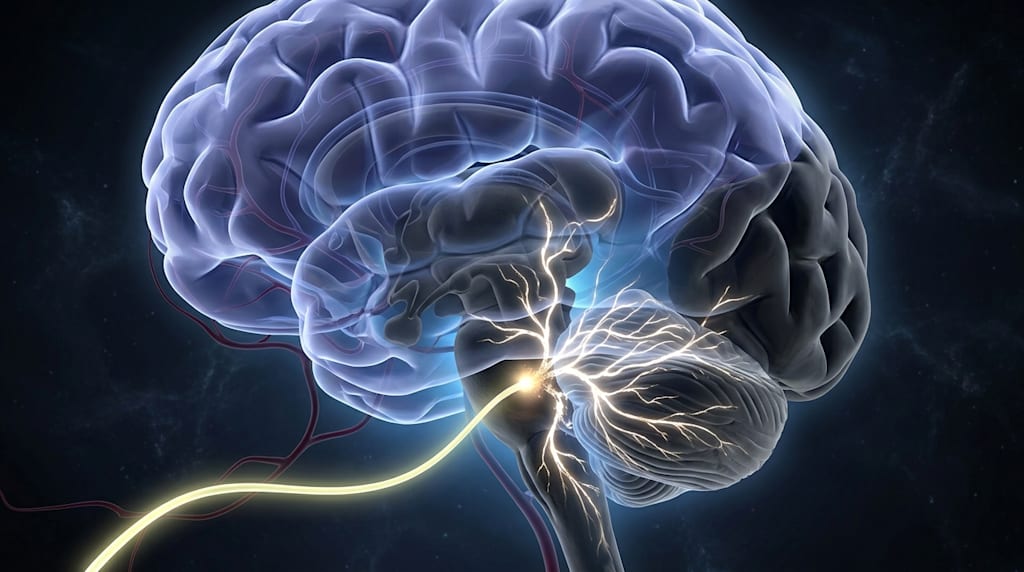
Neurologists call it "the spark plug of the engine." For glucose to enter the mitochondria and be burned for energy, it has to pass through a step catalyzed by B1. Without it, the brain's most energy-hungry regions shut down first: the nuclei that control eye movement, the cerebellum that maintains balance, the hippocampus that holds memory.
He had taken in no B1 for twenty days. His body's stores were depleted around day fifteen. Dialysis accelerated the clearance. By the time he arrived at the Zhejiang University hospital, his brain was running on backup circuits just to keep breathing and his heart beating. All the "non-essential" functions — seeing a face clearly, standing steady, forming new memories — had been power-cycled off.
The B1 replacement fluid was pale yellow, 50 milliliters, given by IV push.
The next morning, he told the nurse: "The light is on."
The nurse said it had been on all along.
He said: "I can see it now."
On Weibo, someone commented: "He had it coming." Someone else wrote: "Survival of the fittest."
Those words aren't dirty by themselves. But when they're launched in a pack at a man lying in a hospital bed who just regained light perception, the pressure they generate is greater than any exclamation mark in a debt-collection text.
The supporters of the 19th-century English Poor Laws said almost the same thing: the poor are poor because they're lazy; relief encourages laziness; let them go hungry and they'll go find work. That logic is seductive in its simplicity — it compresses industrial structure, intergenerational trauma, luck, and illness into two words: you deserve it.
The man in the bed doesn't argue back.
Not because he's afraid. Because "forget it."
He had practiced that word for twenty days. Every stomach cramp, every time he stood up and his vision went dark, every time his phone lit up with a collection notice — he was practicing "forget it." By the end it was no longer a choice; it was muscle memory. His quadriceps had atrophied by the third week to the point where he couldn't squat. His will to resist had shrunk to the same size.
Psychology has a word for it: learned helplessness. After repeated inescapable blows, even when the door opens, a dog will lie down and whimper instead of running.
He was a dog lying down and whimpering. That sentence is hard to read. But it's more honest than "his psychological defenses completely collapsed" — the latter is an explanation; the former is an image.
During rounds, a doctor said: "Two more days and the pathway between the retina and brainstem would have been permanently severed."
He heard that. Then his mother brought over a bowl of congee. Plain congee, with a few leaves of green vegetable floating on top. He sat up to eat it, his hands shaking — not from emotion, but from hyperexcitability of nerve endings after prolonged malnutrition. Medicine calls it tremor.
He finished it.
The day before discharge, he walked a lap down the corridor. A nurse supported him. His steps were slow; he looked down at his feet with each one — his cerebellum had recovered only about seventy percent of its balance function.
He stopped in front of the "Rehabilitation Bulletin Board" across from the nurses' station. On it was a chart illustrating the vitamins the body needs. Under B1, it read: grains, beans, lean meat, nuts.
He stared at that chart for a long time.
The nurse said: "You've walked enough. Go back and lie down." So he went back.
On the day he left, his mother, while packing, pulled a piece of paper from the bedside drawer. A single sheet of A4, folded into four. On it, in his handwriting, from some late night — not a suicide note. More like a list: his debts, the monthly due dates, the penalty interest calculations.
The back of the paper was blank.
His mother folded it again and put it in her own bag. She didn't show him.
He put on his shoes at the door of the ward. The lace on the left shoe was broken; he had tied it into a single tight knot. As he crouched down, his knee made a cracking sound — the sound of bone surfaces grinding directly, without enough muscle support.
He tied it. Stood up. Walked into the elevator.
The floor number changed from six to one.
Outside, there was light.
About the Creator
Jin
Writer of reamstories
https://reamstories.com/jin
Enjoyed the story? Support the Creator.
Subscribe for free to receive all their stories in your feed. You could also become a paid subscriber, letting them know you appreciate their work.
Comments
There are no comments for this story
Be the first to respond and start the conversation.