
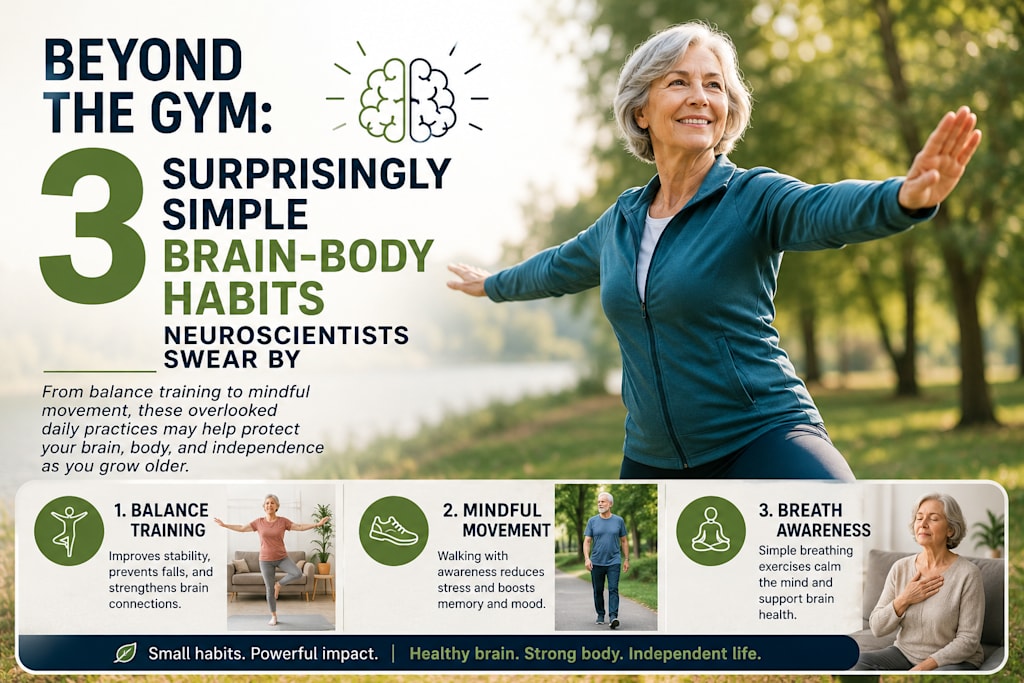
Beyond the Gym: 3 Surprisingly Simple Brain-Body Habits Neuroscientists Swear By for Healthier Aging
From balance training to mindful movement, these overlooked daily practices may help protect your brain, body, and independence as you grow older.

When most people think about aging well, they think of strict diets, expensive supplements, or hours at the gym. We hear the same advice over and over again: lift weights, do cardio, eat a healthy diet, and get good sleep. These habits are undoubtedly important, but neuroscientists are now beginning to believe that some of the most powerful strategies for aging well are surprisingly simple — and often overlooked.
Aging well isn’t just about reducing wrinkles or maintaining physical strength. The goal is to preserve the brain, maintain mental sharpness, maintain independence, and reduce the risk of memory loss. Scientists now understand that the mind and body are deeply connected. The way we move, balance, and focus can all affect our mental health.
Many people unknowingly neglect small daily habits that can have big long-term benefits. These habits don’t require expensive machines, a gym membership, or any major lifestyle changes. They’re all about strengthening the connection between the mind and body — a connection that can weaken as we age if left unchecked.
Here are three surprising yet simple habits that many mental health experts recommend incorporating into their daily lives to improve mental health, physical activity, and independence as we age.
1. Balance Exercise: The Exercise Most People Ignore
Balance exercise is probably the least of your worries when it comes to exercise. But according to mental health experts, it’s one of the most important skills you can develop as you age.
Balance isn’t just a physical thing. The brain, inner ear, vision, muscles, and nervous system all work together to maintain it. As we age, all of these systems naturally begin to weaken. This is why falls are more common in older adults, and they are considered a major cause of serious injuries.
But surprisingly, balance training benefits not only the body but also the mind. Research shows that these exercises force the brain to coordinate multiple systems at once, which can improve mental abilities.
There are simple habits you can adopt to improve your balance.
For example, try standing on one leg for 20 to 30 seconds while brushing your teeth. Or walk slowly in a straight line, one step in front of the other.
It may feel strange at first. But it’s actually a sign that your brain is learning and strengthening itself.
Experts believe that practicing balance for even a few minutes a day can help you maintain physical mobility, confidence, and independence in the future.
And the best part? It only takes a few minutes.
2. Walk — but in a different way
Walking is already one of the best exercises in the world. It improves heart health, improves mood, improves blood flow and increases energy.
But brain experts say that if you do it a little differently, walking can be even more beneficial for your mental health.
This method is called Dual-Task Walking.
This means that while walking, don't just walk, but also work your brain.
For example:
Count down by 3 while walking
Think of the names of animals alphabetically
Try to remember a shopping list
Do simple mental calculations
Why is this important?
Because as we age, the connections between different parts of the brain slow down, which makes it harder to multitask.
Dual-task walking improves the brain's ability to handle attention, memory, and physical activity at the same time.
Research has also shown that people who find it difficult to maintain mental focus while walking may be at a higher risk of falls and mental impairment.
You don't need to exercise for hours.
Just a 15- to 20-minute walk, in which you also give your brain a light workout, can be quite beneficial.
The real secret is not in intensity, but in consistency.
3. Slow and conscious movement: The secret to mental strength
In today's fitness world, hard exercise, fast movement, and excessive fatigue are often considered success.
But according to brain experts, slow movement can be just as important — especially for long-term mental health.
Activities like yoga, light stretching, breathing exercises, and Tai Chi improve an important brain ability called interoception.
Simply put, it is the brain’s ability to understand signals coming from within the body.
It plays a key role in our mental state, attention, emotional balance, sleep, and stress management.
As we age, people become less connected to these internal signals. As a result, stress increases, sleep becomes worse, and mental focus begins to decline.
Slow movement can help to re-energize these abilities.
For example, if a person spends just 10 minutes a day stretching and paying attention to their breathing and body movements, it can improve mental calm and focus.
Many mental health professionals intentionally incorporate slow movement into their daily lives because it reduces stress and helps balance the nervous system.
Tai Chi in particular has received a lot of research in recent years, and some studies suggest that it may help maintain brain function as we age.
Why are these habits so important?
These habits are often overlooked because they don’t seem particularly special or dramatic.
They don’t involve sweaty workouts, viral fitness trends, or dramatic changes.
But aging well is often the result of small, consistent habits rather than big changes.
The real goal is to preserve the abilities that people rely on every day:
Memory
Balance
Physical activity
Mental focus
Autonomy
Aging well is about how effectively the mind and body communicate.
The good news is that the brain has the ability to learn and change itself throughout life. Scientists call it Neuroplasticity.
That is, small but consistent habits can make a big difference over time.
The bottom line
Everyone wants to age better, but often people forget the basics while looking for complex solutions.
The truth is that aging better may be hidden in these simple daily habits.
Balance exercises can improve confidence and mobility.
Walking with mindfulness can strengthen memory and focus.
Slow and deliberate movement can help with mental peace and mental toughness.
None of these habits require expensive machines or strict routines.
Just consistency.
Because aging better isn’t just about living longer — it’s about living those years with better quality.
About the Creator
Mohib Ullah
I write about crime, justice, and political affairs, focusing on real cases and current events. My goal is to deliver clear, research-based content that informs readers about law, society, and government systems.
Enjoyed the story? Support the Creator.
Subscribe for free to receive all their stories in your feed.
Comments
There are no comments for this story
Be the first to respond and start the conversation.