
23,000 Gyms Closed. The Gym That Would Not Die
China lost 23,000 gyms in a year. Leke kept building. I went to Beijing to see what survival looks like.
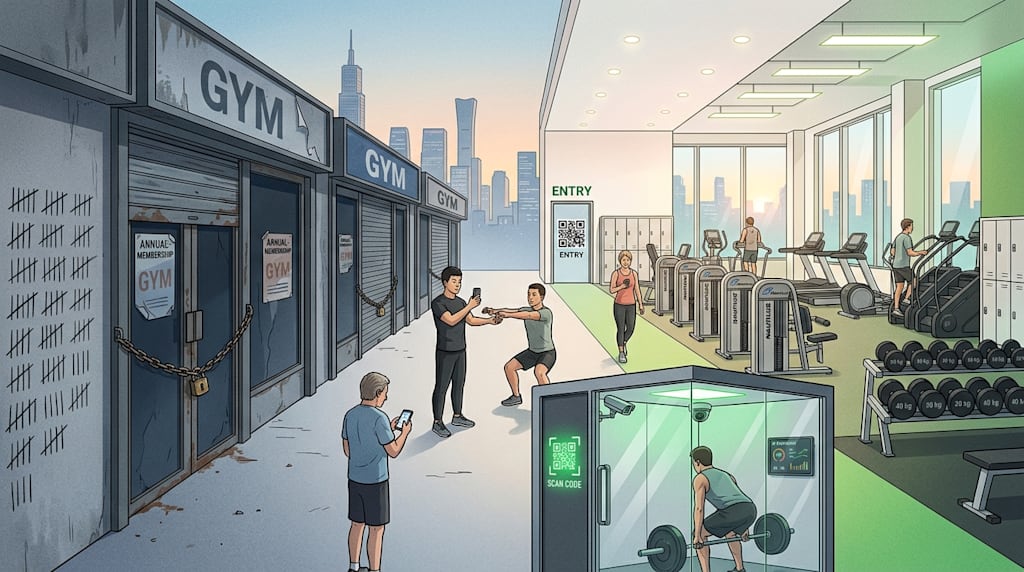
The first thing I noticed was the silence.
At the northwest corner of the fourth floor of Fangyuanli ID MALL, behind a glass door, a thousand square meters of gym equipment hummed. No one stood at the entrance. No free trial. A QR code glowed on the wall. I scanned it. A smart locker popped open.
This was Recore Infinite Nucleus, the high-end experiment from Leke. Monthly card: 499 yuan. Personal training: 300 yuan a session, minimum twelve. The store manager said a fifteen-session package with a thirty-day venue card worked out to 172 yuan per session. Traditional clubs charge 450 to 600. He said it like a man who had said it many times.
I walked through the gym. A coach filmed a client on a phone. The client, a man in his late thirties, pulled a sled. The coach said nothing. He watched the screen. When the set ended, he showed the man the video. They talked in low voices. No shouting. No counting reps out loud.
Three years ago, Leke built its name on 300-square-meter stores. Monthly payments. Twenty-four-hour access. The convenience store of gyms. This store was a thousand square meters. The core user was thirty to forty. The convenience-store label no longer fit.
I met Xia Dong, co-founder of Leke Sports, in a small office near the gym. He wore a dark jacket. He spoke in short sentences. He did not seem interested in celebrating.
I asked if the shift bothered him. He said no. The core logic was one kilometer, cost-effectiveness, wide categories, high efficiency. That logic did not require 300 square meters. As users advanced, venues grew.
The past year was brutal. The 2025 China Sports and Fitness Industry Data Report showed 23,000 fitness venues closed. Studio closure rate hit 57 percent. Commercial fitness consumption grew from 285.2 billion yuan to 382.7 billion. Fewer people, more money. People did not stop working out. The rules about who gets paid and how changed.
Leke was one of the biggest winners. In July 2025, it passed 2,000 stores. By August 2026, more than 2,300 stores, 60 cities, 20 million app users. When I asked Xia Dong to evaluate those results, he said, "Progress is too slow." He said it calmly. "If you ask whether I am satisfied, definitely not."
He kept returning to one number: 300 square meters. Leke spent seven or eight years building its single-store model around it. He compared Leke to Uniqlo. At the same price, no one was better. Anyone better was much more expensive. Three years later, he overturned that number himself. The standard area was now 400 to 500 square meters. Leke was testing 1,000-square-meter Leke Fitness Plus venues. Recore was another 1,000-square-meter experiment. It was called Infinite Nucleus. He explained the gap through Toyota and Lexus. Leke Fitness was a national gym. Could one brand cover such a wide range of price and product? Not necessarily. So Recore became an experiment. "We are also not sure this is definitely right," he said.
If Recore was Leke's move upward, Vital Tomato was its move downward. The first Vital Tomato opened in March 2026. By July, 100 were signed, more than 20 opened, more than 50 under construction. The model was light. Fully unmanned. No store manager. No front desk. Scan a code to enter. Book and pay through a mini-program. Pay per use, around a dozen yuan, invalid once you leave. Customer acquisition was entirely online.
Leke was not first. Metal Dog had more than 800 stores. Gym Monster had more than 200 stores, a 159 yuan monthly card, and a 999 yuan unlimited monthly personal training package. These players were lighter, cheaper, and more aggressive. Xia Dong did not think Leke was late. In emerging markets, he said, a 24-hour, monthly or per-use unmanned venue was quality supply. He also admitted that Vital Tomato and Metal Dog were already in close combat.
Unmanned gyms differed from unmanned billiard halls in one important way: safety. If someone deadlifted alone at two in the morning and got hurt, what happened? Xia Dong said safety was the core issue beyond the business model. Leke had spent half a year exploring in Zhejiang, using surveillance and working with internet companies.
The deeper challenge was organization. Could 50 people manage 1,000 stores? A strong customer service system would be needed behind it. Leke had 2,300 stores, about three-quarters franchised, supported by a large city operations team and store managers. If Vital Tomato could reach 50 people managing 1,000 stores, it could rewrite Leke's organizational cost structure.
Xia Dong repeatedly said Vital Tomato was not the second curve. Atour opening Atour S, Atour X, and Light Inn was not the second curve. Atour selling pillows was. Vital Tomato was part of the brand matrix. It could speed Leke's expansion from 500 stores a year to 1,000. That was not a fundamental change. He defined fundamental change differently. If unmanned operations reached a new stage, and AI reached a new stage, those were more fundamental. Vital Tomato's value might be the testing ground for Leke's AI and unmanned technology.
Xia Dong shared a view at this year's annual meeting: business might have only two bottom-layer essences, efficiency and trust. Companies that kept succeeding were either in efficiency or in trust. I asked whether he agreed with comparing Leke to Sam's Club. Both focused on renewal rates. He said yes. Costco and Sam's Club built procurement and supply chain efficiency on trust. Consumers trusted that what Sam's Club bought for them was not bad. Leke wanted to become a platform of efficiency plus trust.
Leke wanted users to trust the coaches it selected. "If one day users can trust the coaches Leke selects, that would be huge value," Xia Dong said. "Today we cannot do it. There are still layers of screening logic running." Leke had done four things in the personal training supply chain. Worry-Free Switch let users change coaches at any time, even after one session, even across cities. Coach Score ranked coaches on service, professional ability, and platform requirements. Online training plans gave each user an electronic file. Service upgrades raised personal training revenue per store by double digits. All four used platform rules to constrain and screen craftsmen, not SOPs to replace them. Xia Dong called it relative standardization centered on craftsmen. "We only guard the bottom line and raise it step by step."
Leke's expansion philosophy was to keep reserve strength, not to sprint at the limit. "If I use all my strength, I can expand 1,000 stores a year, but I expand 800 and use 80 percent of my strength. Which is more correct? Not necessarily the first. We are a service industry. We have to repeatedly balance expansion speed, service quality, and the single-store model."
Stability cost speed. Leke had 2,300 stores. China had about 50,000 gyms. Leke's share was under 5 percent. The 10,000-store goal was set in 2023: five years, 100 cities, 10,000 stores. Three years later, Leke had 2,300. Xia Dong said confidence was growing because the matrix was richer and fitness was still on the left side of the parabola. "Ten thousand stores is not a KPI. It is a goal and a direction. Whether it takes five years or eight is not the point." He said almost the same thing three years ago.
At the end, I asked Xia Dong when he last felt Leke had a qualitative change. He thought for a moment. One was 2019, when Leke shifted to asset-light operations, franchised stores reached scale, and the business model closed its loop. Another was 2022, when operating stores passed 1,000. Then he added, "Many things follow the logic of one step a day. It is possible that two years from now you look at Leke and, hey, there really has been a qualitative change. That is possible."
One step a day was one of Xia Dong's most used phrases. 2,300 stores, 20 million users, four closed-loop brand matrices, double-digit personal training revenue growth per store. Those were the results of one step a day. He did not know when the qualitative change would come, and he did not pretend to know. Vital Tomato, AI, unmanned operations. Each could be the window to that change. Each was still being explored. Xia Dong said he was not satisfied and it was too slow. He also said keeping reserve strength was better than sprinting at the limit. That pull between two emotions might be Leke's tension today.
23,000 gyms had closed. Leke survived and was doing well. After survival, the next step was still unanswered.
About the Creator
Jin
Writer of reamstories
https://reamstories.com/jin
Enjoyed the story? Support the Creator.
Subscribe for free to receive all their stories in your feed. You could also become a paid subscriber, letting them know you appreciate their work.
Comments
There are no comments for this story
Be the first to respond and start the conversation.