
Lin Sheng Says Xibei's Collapse Would Set China's Restaurant Industry Back. He's Wrong.
The Zhong Xuegao founder is defending a fellow founder. But one company's failure is not an entire industry's decline.
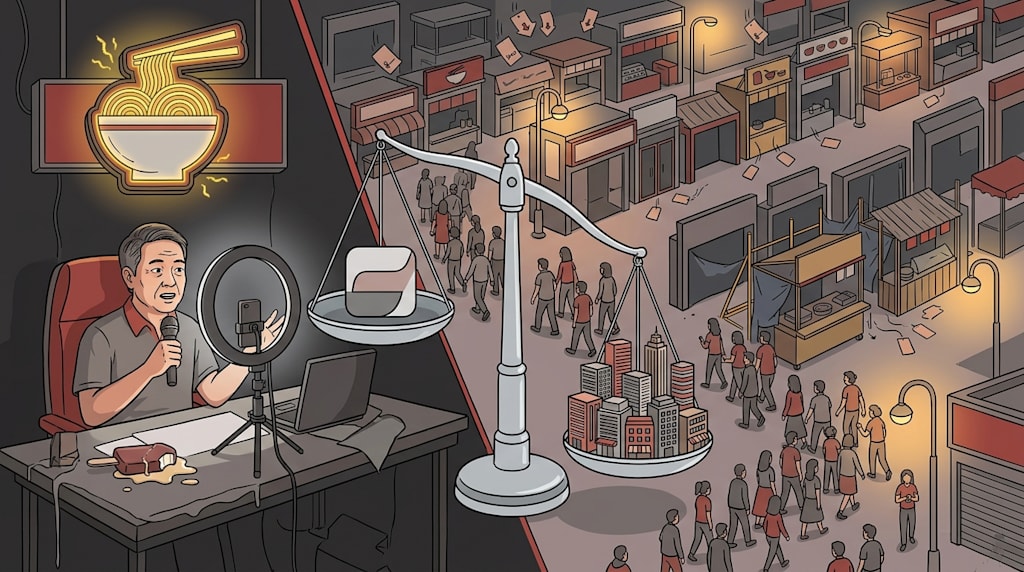
In a livestream, Lin Sheng said that if Xibei collapsed, it would be a step backward for China's restaurant industry. His reason: Xibei does well in quality, safety management, and raw material management. It is a benchmark, he said. Ask anyone in the industry.
The sentence is simple. The logic behind it is not.
Lin Sheng founded Zhong Xuegao. In 2018, the brand became famous for tile-shaped ice cream and high-end positioning. In 2021, sales passed 1 billion yuan. In 2022, a controversy over the product not melting at 31°C room temperature damaged its image. In July 2025, it entered bankruptcy review with 186 million yuan in book assets and 782 million yuan in matured debt. In May 2026, 508 intangible assets under its name sold at judicial auction for 21.1 million yuan. Lin Sheng was restricted from high consumption, and the company became a dishonest judgment debtor. In another livestream, he said the old Zhong Xuegao could no longer be tasted and that today's Zhong Xuegao had nothing to do with him or the original team.
So when Lin Sheng expresses regret for Xibei, he is first expressing regret for a fate he just lived through. A founder watches the supply chain, quality standards, and store system he built lose their footing before commercial logic. When he calls this an industry regression, he is less analyzing the industry than making a judgment born of shared suffering.
That sympathy is understandable. It cannot replace factual judgment.
I
Lin Sheng says Xibei is an industry benchmark. In a technical sense, that has some truth. Xibei can run nearly 400 directly operated stores, central kitchens, a procurement system, and a quality control process. That is organizational capability. In September 2026, the Beijing Fortune Center store, a benchmark for Xibei's third-generation stores, was where Xibei began introducing central kitchens. Scale and revenue grew quickly after that.
But the word benchmark has been switched here. Lin Sheng uses it to mean a model worth preserving. In the market, a benchmark is a case that proves a standard is feasible. Once a company proves that a quality standard can be met, its mission as a benchmark is complete. Whether the company survives depends on whether it can meet those standards and still make consumers feel the price is worth it.
Nokia was the world's largest phone maker from the 1990s to the early 2000s. Kodak invented the first digital camera in 1975. Kodak filed for bankruptcy in 2012. Nokia sold its phone business to Microsoft in 2014. Did their capabilities disappear? Kodak's 7,000 patents and digital imaging work were retained. After restructuring, the company became a B2B imaging service provider. Nokia's communications technology became the base for its later position in 5G equipment. The industry did not regress. It changed carriers.
II
The premise behind Lin Sheng's remark is that Xibei was healthy until outside forces pushed it into a corner. The data say otherwise.
Jia Guolong said Xibei lost more than 600 million yuan from September 2025 to March 2026. In the first quarter of 2026, Xibei closed 102 stores at once, about 30% of its total. By September 2026, operating stores had shrunk from nearly 400 at the peak to 226. Jia Guolong's wife pledged all her equity. Severance payments were extended to the end of 2027.
The numbers start with the pre-made dish controversy in September 2025. Luo Yonghao criticized Xibei on Weibo, saying it was "almost all pre-made dishes, and still so expensive." The post drew nationwide attention. Xibei's traffic fell off a cliff. In November 2025, revenue dropped to 265 million yuan, less than half of the same period in previous years.
Public opinion was an accelerator, not the root cause. Xibei collapsed because its original business model, built on high rent, high labor, and high per-customer spending, was extremely sensitive to traffic swings. Consumers' sense of value had changed. The company's pricing had not. One negative story was enough to become the last straw.
The problem is bigger than Xibei. Hongcan Big Data shows that in 2024, per-capita restaurant spending in China fell to 39.8 yuan, down 6.6% year-on-year. Ten years ago, the mainstream price band for full-service dining was 90 to 120 yuan. Now it is 50 to 60 yuan. Shou Wenbin, founder of Zhisheng Catering Strategy Consulting, put it directly: only the mainstream price band can support mainstream brands. When the band moves, a batch of brands gets eliminated because price determines everything.
Xibei's per-customer spending is around 100 yuan. That was the most competitive price band in full-service dining for the past decade. When the mainstream band dropped by forty or fifty yuan, Xibei's cost structure, from store model to staffing to supply chain, faced systematic revaluation. One Weibo post did not cause that.
III
The language Lin Sheng uses to defend Xibei, good quality, good safety management, good raw material management, exposes the gap between the owner's view and the consumer's view.
Owners see the supply chain, the quality control system, R&D investment, and decades of work. Consumers see three questions: Does it taste good? Is it expensive? Is it worth it?
Good quality is expected. Standard safety management is expected. Mature raw material management is expected. These are competent operating capabilities. They are not a reason consumers owe you a meal. Consumers do not enter a restaurant to attend a founder's achievement report. If the front end becomes an MBA case study and the dish on the table feels overpriced, those systems move peers, not payers.
The Zhong Xuegao trademark was later bought by another company. The new company set suggested retail prices at 6.9 yuan for Light Milk and 7.9 yuan for Velvet Cocoa and Half-and-Half Chocolate. Chen Dacheng, the new CEO, said the company would "listen to consumers' voices and respond to consumers' expectations." He added that consumers have become pragmatic and increasingly value quality for the price. The brand remains. The name remains. The pricing logic is completely different. The old Zhong Xuegao collapsed. The new Zhong Xuegao returned in a different posture. Did the industry regress? No. It continued in a different form.
IV
The danger is a narrative: if a company is large enough, old enough, and systematic enough, its business failure can be packaged as an industry tragedy. Consumers' refusal to pay can be redefined as a social loss.
If that logic holds, market discipline dissolves. Efficiency gives way to seniority. Consumers' right to choose is hollowed out by "industry interests."
Jia Guolong said in a speech that he asks regulators to clarify the speech boundaries of high-traffic online accounts. He wants a distinction between normal public opinion supervision, debate, and malicious disparagement, commercial defamation, and online soft violence. That request has reasonable parts. Online speech does have boundary issues. But when a founder attributes business trouble mainly to the external speech environment, he avoids a more basic question: at the moment consumers vote with their feet, are your products and services worth the price?
Lin Sheng says Xibei's collapse would be a regression for China's restaurant industry. Translated, that means: such a standard, hardworking, systematic company, how can consumers not pay?
The answer is simple. They can.
Consumers come to eat. They do not come to defend the dignity of industry benchmarks. A company's life and death is a commercial matter. An industry's progress is the result of competition. Confusing the two overestimates one company and underestimates an industry.
Xibei's stores shrank from nearly 400 to more than 200. Zhong Xuegao's ice cream dropped from over ten yuan to seven. The market moved away, one by one, from things that no longer matched demand. The empty space will be filled by something else. A new brand, an old brand with a new price, or a name you have not heard yet.
That is normal turnover.
About the Creator
Jin
Writer of reamstories
https://reamstories.com/jin
Enjoyed the story? Support the Creator.
Subscribe for free to receive all their stories in your feed. You could also become a paid subscriber, letting them know you appreciate their work.
Comments
There are no comments for this story
Be the first to respond and start the conversation.