History
Can War Be Painted Without Depicting War?
For centuries, artists have struggled with the problem of representing conflict. From ancient battle reliefs to Renaissance history painting, from Goya's disasters of war to contemporary documentary practices, war has generally appeared in art through images of events. We see armies, leaders, violence, destruction, and human suffering. The image becomes a witness to history.
By Daniel Varzari5 months ago in Art
America Before America: The 15,000 Years We Erased*
You were taught America starts in 1492. A ship. A flag. A “new world.” But 15,000 years before Columbus got lost, someone else was already here. They crossed ice. They built cities. They wrote laws. And most of that story never made it into your history book. *Part 1: The First Crossing, 13,000 BCE* Imagine Alaska. Not the state. A land bridge. Beringia. Sea levels were lower because ice locked up water at the poles. Asia and North America touched. Small groups followed mammoths and bison across. They weren’t “explorers.” They were families looking for food and shelter. Generation after generation moved south. Some went down the Pacific coast by boat. Shell middens and tools in Chile prove people reached the tip of South America fast. Within 2,000 years, humans lived from Arctic tundra to Amazon jungle. No maps. No compass. Just memory, stars, and stories passed down. *Part 2: Cities Without Steel, 800–1400 CE* Skip ahead. You’re standing in Cahokia, near today’s St. Louis. It’s 1050 CE. You hear drums. You smell corn roasting. You see Monks Mound, a man-made pyramid 100 feet tall, built basket by basket. No wheels. No metal tools. Just dirt, logs, and thousands of workers. 20,000 people live here. That’s bigger than London. Streets are laid out around plazas. Farmers grow the “Three Sisters” on fertile floodplains: corn, beans, squash. The beans fix nitrogen in soil. The squash leaves keep weeds down. It’s sustainable farming 800 years before the word existed. Priests track the sun with Woodhenge, a circle of posts. It works like Stonehenge. At equinox, the sun lines up perfectly. This is science, not superstition. Cahokia traded for copper from Lake Superior, shells from the Gulf, mica from the Appalachians. Then around 1350, it was abandoned. Climate shift. Floods. No one knows for sure. The mounds stayed. *Part 3: A Constitution Before the Constitution, 1400s* Go east to New York. Five nations are fighting: Mohawk, Oneida, Onondaga, Cayuga, Seneca. War exhausts them. A man called the Peacemaker walks in with a wampum belt. He proposes something radical: stop fighting, join together. Make decisions by council, not by kings. Balance power. Let clan mothers appoint and remove chiefs. The Great Law of Peace becomes the Iroquois Confederacy. It lasts centuries. In 1754, Benjamin Franklin prints their plan and tells British colonies, “We need this kind of union.” When U.S. founders wrote the Constitution in 1787, they borrowed federalism and checks on power. They forgot the part about women holding real political authority. *Part 4: Science You Eat Every Day* While Europe struggled with wheat, people in the Americas engineered food. They turned a grass called teosinte into corn. Kernels the size of peas became ears a foot long. Over 3,000 varieties. They domesticated potatoes in the Andes at 12,000 feet elevation. Tomatoes, chocolate, vanilla, pumpkins, chilies, beans, avocados. 60% of the world’s crops today came from the Americas. They also made soil. In the Amazon, people created “terra preta” by mixing charcoal, waste, and pottery shards. 2,000 years later, that black soil still grows food better than surrounding land. Modern scientists still can’t fully replicate it. *Part 5: Contact and Collapse, 1492–1600* Columbus lands. He thinks it’s India. He’s wrong about geography and about the people. Worse than swords and guns were germs. Smallpox, measles, flu. Indigenous communities had no immunity. A cough became a death sentence for whole villages. Estimates say 50 to 90 million people lived in the Americas in 1492. By 1650, disease, war, and slavery killed up to 90%. Imagine 9 out of 10 people gone in 150 years. That’s why Europeans called it “empty land.” It wasn’t empty. It was emptied. *Part 6: Nations That Refused to Vanish* Even after collapse, tribes remained nations. The Comanche built an empire on horseback across the Great Plains in the 1700s. The Cherokee wrote down their language in 1821 and launched a newspaper. The Lakota and Cheyenne defended land and treaties for decades. The U.S. government signed over 370 treaties recognizing tribes as sovereign nations. Then broke most of them. Trail of Tears in 1838 forced Cherokee west. Boarding schools in the 1800s punished kids for speaking their language. The story didn’t end. It adapted. *The Ending We Don’t Teach* Today there are 574 federally recognized tribes in the U.S. People still speak 150+ Indigenous languages. They still govern land. They’re reviving corn varieties, burning forests to prevent wildfires like ancestors did, and teaching the Great Law of Peace in law schools. So when someone says “American history starts in 1776,” ask: which America? The one with a Declaration, or the one with Cahokia’s mounds? The one with a Constitution, or the one with a Great Law of Peace? Real history isn’t a straight line. It’s layers. And the bottom layer is 15,000 years deep If you only remember one thing for your Vocal article: America wasn’t “discovered.” It was home. Long before ships. Long before flags.
By Khalil Ullah5 months ago in Art
The house that forgot it's name
Mira found the house on a Tuesday she’d rather forget. The kind of Tuesday where your phone battery dies at 7am, your boss emails “quick call?” and the rain decides to fall sideways. She was cutting through the old part of Mathura to avoid traffic, earbuds in, hood up, when the street she’d taken a hundred times just... wasn’t there. Instead there was a narrow lane, brick wet and shining, and at the end of it, a house. Two stories, blue shutters peeling, a brass knocker shaped like a koi. No number on the gate. Just a nameplate, blank where the paint had worn away. She shouldn’t have stopped. She did anyway. The gate creaked open before she touched it. The house smelled like old paper and masala chai, even though no one was there. Inside, the air was warmer. The foyer had a staircase that curved up into shadow, and on the wall, a row of hooks. One held a red umbrella she recognized. It was her mother’s. Her mother who’d died three years ago. “Okay,” Mira whispered. “Not real. Stress hallucination. Great.” But the umbrella was real when she touched it. Cold brass handle, chipped paint, the tiny tear in the fabric she’d mended at age twelve with purple thread. “Hello?” she called. Her voice didn’t echo. It got absorbed, like the house was listening. From upstairs, a floorboard sighed. Then another. Footsteps, but not walking toward her. Walking _with_ her, like someone pacing in time with her heartbeat. Mira climbed. She told herself it was to prove there was nothing there. The stairs didn’t creak under her weight. Only when she paused did they make sound. The upstairs hallway had doors. Seven of them. All closed. All had nameplates, but the names kept shifting when she wasn’t looking straight at them. She’d see “MIRA” for a second, then it’d blur into something in her grandmother’s handwriting, then blank again. The last door at the end didn’t have a nameplate. It had a keyhole and, stuck through it, a folded piece of paper. She pulled it out. It was a drawing. Her drawing. Age nine, crayon on notebook paper: a stick-figure girl holding hands with a taller stick-figure woman under a purple umbrella. The paper was soft at the edges from being folded and unfolded too many times. She didn’t remember losing it. The door clicked open. Inside wasn’t a room. It was the back room of her childhood home, the one they’d sold after the funeral. Her mother’s desk, still covered in to-do lists. The window with the crack in the corner from when Mira threw a cricket ball. On the desk, a teacup, steam still rising. Chai. The way her mother made it: too much ginger, one spoon sugar, stirred counterclockwise. “Mira beta,” a voice said. Not from behind her. From the chair. Her mother sat there, reading glasses low on her nose, looking up from a book Mira had never seen. She looked exactly like she did on the last normal morning, before the hospital. Same cotton saree, same line between her eyebrows when she was concentrating. Mira couldn’t breathe. “You’re—” “Late for tea?” Her mother smiled, patted the chair next to her. “Sit. You’ve been walking so long.” Mira sat. The chair was warm. The chai tasted like being eight years old and sick, and her mother pressing the cup into her hands saying _drink, it’ll fix everything_. “You built this,” her mother said, nodding at the room. “After. When the real house was gone. You needed somewhere to put the things you weren’t ready to lose.” “I don’t understand.” “This house forgets its name because names are for people who have to leave. You never left me, Mira. You just stopped visiting.” Her mother reached across and tucked a strand of hair behind Mira’s ear, the exact way she used to before school. “I’m not here. Not really. I’m the part of you that remembers how to make chai with too much ginger. The part that still talks to you when it rains.” Mira stared at her hands. They were nine-year-old hands holding crayons in the drawing. Then they were her hands now, with the scar on her thumb from the kitchen knife last Diwali. Both true. “I miss you,” she said. It came out small. “I know. That’s why the door opened. It only opens for people who are ready to miss someone without breaking.” They drank tea in silence. Outside the window, the rain stopped. Sun came through the crack, cutting the dust in the air into gold lines. When the cup was empty, her mother stood. “Come on. I’ll walk you out. The street will be back when you’re ready.” They walked downstairs. The hooks by the door were empty now. The red umbrella was gone from Mira’s hand. But in her pocket, the crayon drawing was dry and warm. At the gate, her mother stopped. “You’ll forget the way back. That’s good. It means you don’t need it every Tuesday anymore. But if it rains and you need ginger chai, just remember: the door opens from the inside.” Mira stepped onto the main road. Traffic, noise, her phone buzzing with “quick call?”. The narrow lane was gone. In its place, a paan shop she’d passed a thousand times. She stood there a long time. Then she pulled out her phone and typed a note: _Buy ginger. Make chai. Stir counterclockwise._ The house didn’t have a name because it wasn’t a place. It was a promise Mira made to herself three years ago, the day she packed up her mother’s things and couldn’t say goodbye properly. Some doors don’t lead out. They lead back in. And sometimes, that’s enough.
By Khalil Ullah5 months ago in Art
Andreas Szakacs Announces “Journey Beyond Limits”: A Travel Film Inspired by Adventure and Discovery
Travel has always been about more than reaching a destination. It is about the stories we collect, the people we meet, and the moments that change how we see the world. That belief is at the heart of Journey Beyond Limits, an upcoming feature film directed by Andreas Szakacs and produced by Andreas Szakacs Productions.
By Andreas szakacs5 months ago in Art
New Teeth For The Old Cog, And Traces
Introduction I got an invitation from either Mick or Michelle for this exhibition at The Biscuit Box (I thought it was The Biscuit Factory but it is two buildings down, I should really check things more carefully), this was the Facebook post with information that I should have taken on board before going.
By Mike Singleton 💜 Mikeydred 5 months ago in Art
Ms. Trim: The Rise of a Social Media Star . AI-Generated.
Ms. Trim: The Rise of a Social Media Star Introduction Ms. Trim, born Caroline du Sud, has become one of the most talked-about personalities on social networks. With a striking online presence, a bold sense of style, and a talent for connecting with audiences, she has transformed herself into a digital star. Her rise reflects the power of modern platforms, where personality, creativity, and consistency can turn an ordinary profile into a widely followed brand.
By Nivard Anna5 months ago in Art
Lady Lotus By A Strong Women
Lady Lotus by a Strong Woman The world is full of amazing and strange art, and I was fortunate enough to run into a beautiful masterpiece created by Hung Liu, Lady Lotus. I was blessed to come across this painting and photograph by Hung Liu in the Kalamazoo Institute of Arts . Though many art pieces were interesting, beautiful, and very strange, this painting caught my attention due to the intricate colors, the imagery of the background and how the painting seemed to be melting off. Hung Liu had many other art pieces besides Lady Lotus, all of which can be found on a site dedicated to her work alone. Though Liu and her art made a big commotion on American soil, that is not where Liu’s story originates nor where her art began.
By Lydia Cruz5 months ago in Art
Doodle 4 Google
Every year, Google is one of the most widely used technology companies in the world, and one of its most creative traditions is the Google Doodle. A Google Doodle is a special version of the Google logo that appears on the homepage to celebrate important holidays, famous people, scientific achievements, and cultural events. Inspired by these creative designs, Google created the Doodle for Google competition, an annual contest that allows students to redesign the Google logo using their imagination and artistic talent.
By Gladys W. Muturi6 months ago in Art
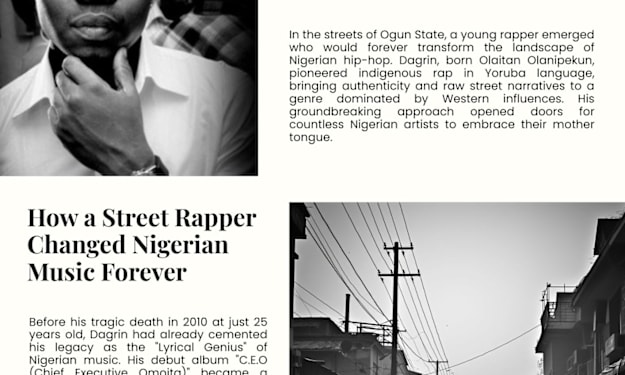
The Untold Rise of Dagrin: How a Street Rapper Changed Nigerian Music Forever
Before Nigerian rap became a global movement, before street-hop dominated clubs, playlists, and speakers across the country, there was one young man who changed the sound of Nigerian music forever.
By X One Media 6 months ago in Art