
Lady Lotus By A Strong Women
WMU Research Paper By Lydia Cruz and Irene Knott

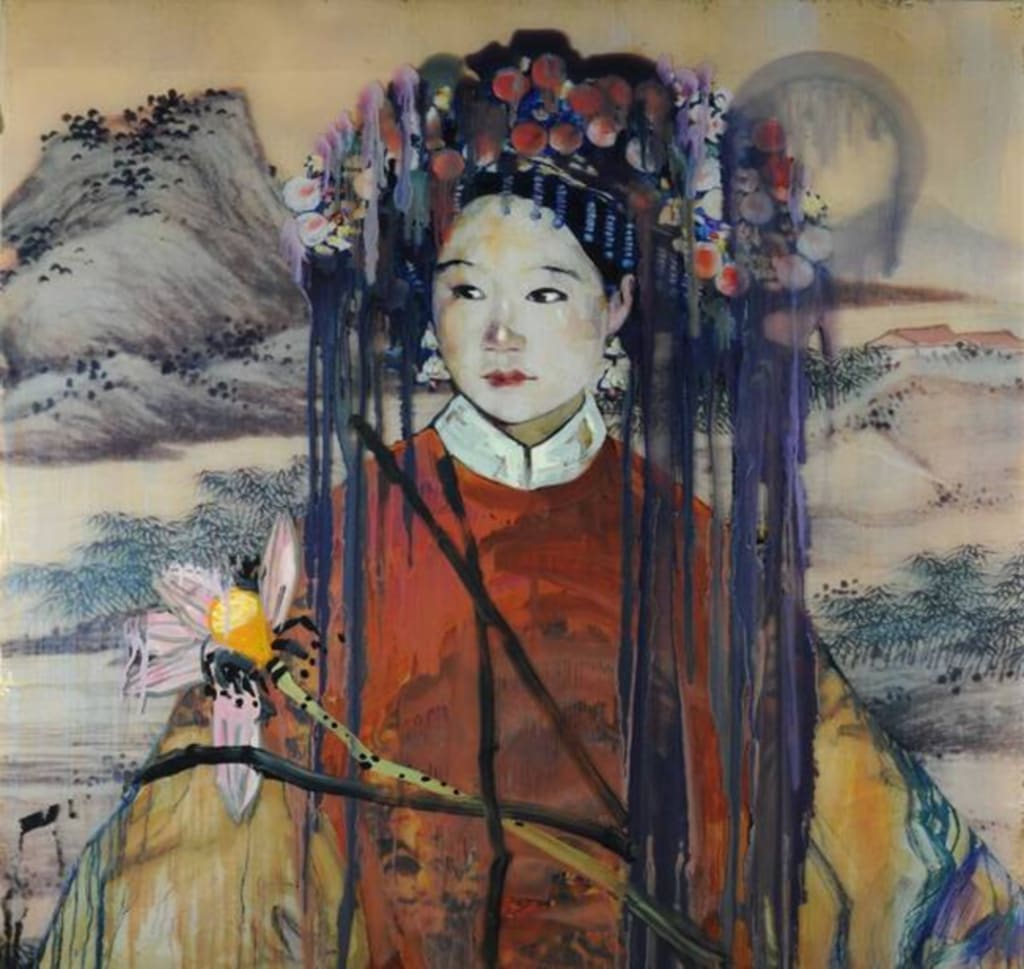
Lady Lotus by a Strong Woman
The world is full of amazing and strange art, and I was fortunate enough to run into a beautiful masterpiece created by Hung Liu, Lady Lotus. I was blessed to come across this painting and photograph by Hung Liu in the Kalamazoo Institute of Arts . Though many art pieces were interesting, beautiful, and very strange, this painting caught my attention due to the intricate colors, the imagery of the background and how the painting seemed to be melting off. Hung Liu had many other art pieces besides Lady Lotus, all of which can be found on a site dedicated to her work alone. Though Liu and her art made a big commotion on American soil, that is not where Liu’s story originates nor where her art began.
Hung Liu was born in Changchun, China in 1948, raised in Beijing and after graduating from high school in 1968. During her youth, she worked along with peasants in both rice and wheat fields for total of four years. . Finally in 1972, Liu went off to attend Beijings Teachers College before she attended Central Academy of Fine Arts majoring in mural painting in 1979, but her passion and dedication didn’t stop there. Liu went to Sand Diego, California to start her graduate studies in 1984 . Liu dedicated the largest portion of her life to study and becoming the best version of herself as she could, and even after her passing, her art continues to travel and make waves. Though looking at a quick timeline may not feel like it has been so long after all. The experiences that Hung Liu went through in China with her family and in her education helped to shape the art that she would create, and that we would one day see.
Liu was mainly known for her variations of photography and imagery of historical life of many different Chinese subjects. Liu had explained that her style of art was a way to dignify her subjects and give them, from my understanding, equality. I believe that is why she chose to portray Lady Lotus the way she did. To revive her as a woman of dignity, of worth, and not as a mere concubine who did only what she needed to survive in critical times. I believe that Liu’s art gave many of her people peace of mind and hope that beyond who they have to be, there is always someone who sees you for who you are on the inside and not for what you do or what you have. Unfortunately, in August of 2021 Hung Liu lost her battle to pancreatic cancer, yet her astonishing art remains inspiring and fascinating to great minds and wondering eyes.
Lady Lotus was officially completed in 2016 and still continues to hold significant value in the art community despite its young age. Liu portrayed many people of different backgrounds in her mixed photography and paintings, and this beautiful image of Lady Lotus was based on a picture she had happened to come across by chance in 1990.
As mentioned previously, Liu was originally from China and woefully it was during a time where a cultural revolution was in full bloom. During this period Liu’s father was imprisoned. To prevent their family being prosecuted in relation, her mother destroyed all photos of Liu’s father. I believe this is why she believed capturing the reality of people mattered. Liu was standing up to and speaking out against the regime and simultaneously honoring the women, who like Lady Lotus, were forced into sexual servitude.
This particular masterpiece was a combination of painting and photography as Liu’s art was both contemporary and “weeping realism”. It was the unique use of colors Liu had used that caught my attention. Despite the typically bright pallet of colors, Liu had darkened them into an almost eternal degree. To the dilated red of the garb of Lady Lotus, to the wispy, almost ghostly pinks of the withering lotus itself. The piece itself appears nearly tender, expressed through the gentle curves of her face, the softness of her eyes, and the flawless, yet not overbearing authority that can be felt even through the portrait. After learning just what role she played in history, that of a concubine, the painting could not help but grasp onto an air of melancholy that only aided in adding more depth to the piece itself.
There is a graceful, albeit subtle hope portrayed through this piece despite the darker hue’s used in many of its finer details. The headpiece, for example, may represent a quiet despair the was more than simply common for a concubine. A wight, visible for all to see that rested ever-so persistently down on her shoulders that may seem all consuming. However, the lotus itself shines through with what could perhaps be that subtle hope, that despite her role and the weight it carried, it was a life that was not simply a performance or a duty she was being forced into, but a choice she took into her own hands and made into her own.
The way the lotus was displayed, of being so bright in what feels like a contrast to the otherwise dim painting, gives the illusion of hope and restoration. At first sight, Lady Lotus’ painting appears to be melting off the very canvas it sits on. Perhaps a deliberate choice was made to indicate the passing of time. However, I later learned that it was simply a style Liu did with many of her Chinese subjects as a way to show their humanity, and to give them the respect everyone should have, and to transform them from their historical struggle into something beautiful, lasting and worthy of remembrance.
I noticed in this piece that Liu had left no absent spaces. Every centimeter of the portrait was covered, and every bit of paint had quiet story to it. What was left to the sky was minimum, but even then, you can see the different tones, and how the mountains faded into the scenery. The hills and mountains appear to have trees and texture, showcasing what even appears to be patches of grassland. The river appears to be still, the breeze absent, hinting to the quiet serenity of the moment. With such a delicate masterpiece, the thought of Liu’s studies come to mind. All of the years she had spent learning, practicing, and achieving great status, came from a lone women fighting back against a regime who had taken her father from her.
Liu didn’t just decide to move and forget about what she lived through. She remembered. She remembered what working along peasants meant. She remembered her past, every dark detail, and refused to cover it with murals of deception . Liu looked back at her past with the same strength and dignity she gave those who appeared in her work. Through linseed oil washes and drips on documentary images, and with photos as basis for new paintings that Liu dipped her own past into as a way to show us that regardless of our past, we have the power and the knowledge that the reality of female strength is to stand against higher authorities. Lady Lotus does not look like a woman who has been defeated by her situation, she does not look like a woman who pitties herself, she does however looks as, I would say, has the courage to continue and sees the greener pastures, to take her fate, every misfortunate and all, and forge it into something only she could control.
Though we are surrounded by art in every aspect of our lives it is something that also goes unnoticed. I dare to say that before this assignment I had not attended an art gallery in years. Walking through the Kalamazoo Institute of Arts I found myself realizing how much I have been missing out. In a moment of self-pity is when my eye was caught by a Chinese woman in delicate colored paint with a sense of “everything will be okay.” With no knowledge of the painting, the artist, or of how difficult it was to find information I was struck with the sense of needing to know more. Perhaps all my questions were not answered, and I will never know what every piece of symbolism was displayed, but either way, the journey to this point was eye-opening and beautiful.
References
1) Favorite New Artwork at the KIA - Encore Magazine
Magazine, Encore. “Favorite New Artwork at the KIA.” Encore Magazine, January 24, 2022. https://encorekalamazoo.com/favorite-new-artwork-at-the-kia/.
2) Hung Liu | Artnet
“Artnet.com.” Artnet. Accessed April 03, 2026. https://www.artnet.com/artists/hung-liu-2/.
3) hungliu.com/artist/biography
Hung Liu Estate. “Hung Liu Biography.” Accessed April 02, 2026. https://www.hungliu.com/artist/biography.
4) Lady Lotus – Works – Hung Liu – Artists – Kalamazoo Institute of Arts eMuseum
“Lady Lotus.” Accessed April 02, 2026. http://64.136.229.66:8081/objects/7184/lady-lotus?ctx=f1cc0252cf883519274b228519f0e586925aedca&idx=0
About the Creator
Lydia Cruz
Short. Intelligent. Beautiful. Bilingual. Write about many different topics all of which interest me or are about me.
Enjoyed the story? Support the Creator.
Subscribe for free to receive all their stories in your feed.
Comments
There are no comments for this story
Be the first to respond and start the conversation.