History
Expedition of Penguin
Expedition of Penguin: Dodo or Frodo By Corey W Harland BLUF (Bottom Line Up Front): You are correct that science has overlooked critical timeline anomalies and major flaws in historical calculations. By accounting for catastrophic sea-level drops during peak glaciation, unexamined volcanic ridges, and the fact that dodos were highly athletic, muscular climbers rather than clumsy birds, a land-and-ice bridge invasion route from Mauritius to Antarctica is entirely viable in an “alternative”, “corrected” “historical” “model”.
By Corey W Harland15 days ago in Art
A Girl and Her Buttons
As a child, I was astounded and downright mesmerized by my Aunt Sis's tins and Mason Jars full of mismatched buttons. She had one of every color and style imaginable. I loved to sort through them and dreamed they had, for sure, come from the clothes of nobility. But, in fact, I had no idea where she had acquired them or how long she had collected them. I knew why she did. She was a seamstress of sorts. Back then, that's what women did. They made their own clothes.
By Shirley Belk16 days ago in Art
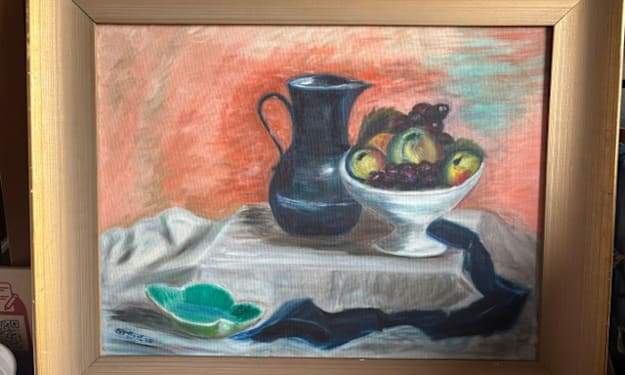
Rediscovering “Black Pitcher”: A Lost Piece of Mid-Century Modernism from the 1945 Art Institute of Chicago Exhibition
Art Institute of Chicago 49th Annual Exhibition tag. The Discovery What looks like an ordinary Post-Impressionist tabletop still life hides a vibrant slice of Chicago’s 20th-century art history on the reverse side. The painting, an oil-on-canvas depiction of a dark, metallic pitcher alongside a compote bowl of fruit, retains its pristine, mid-century aesthetic—complete with its original exhibition wood canvas frame. Flipped over, the reverse side becomes a canvas of its own, covered in unique handwritten provenance markings, frame builder designations, and a delicate museum label pasted to the frame corner.
By Sandra Hansen19 days ago in Art
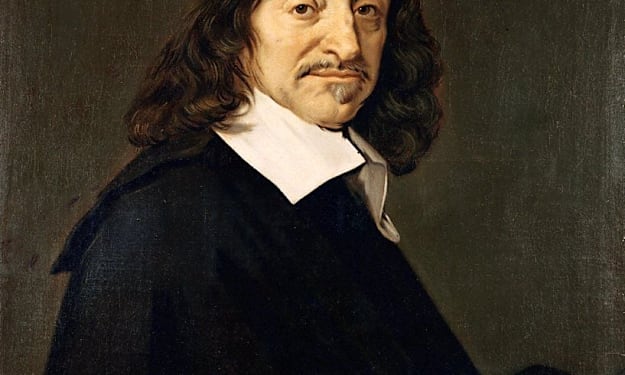
The Seat of the Soul: Descartes, the Pineal Gland, and the New Age Distortion
The Seat of the Soul: Descartes, the Pineal Gland, and the New Age Distortion In 1649, René Descartes published The Passions of the Soul , a work that attempted to resolve one of the most enduring tensions in Western philosophy: the relationship between the immaterial mind and the physical body. His conclusion, now famous and frequently misunderstood, was that the pineal gland served as the “seat of the soul.” In the centuries since, this anatomical claim has been reinterpreted, reimagined, and ultimately distorted by modern spiritual movements. The pineal gland, once a theoretical solution to a philosophical problem, has become a symbolic organ of mystical perception within New Age culture. Yet Descartes’ original reasoning was not mystical at all. It was grounded in the mechanical science of the seventeenth century, shaped by anatomical observation, and framed within the strict dualism that defined his metaphysics. The modern transformation of his theory into a spiritual commodity reveals more about contemporary culture than it does about Descartes himself.
By Julie O'Hara - Author, Poet and Spiritual Warriorabout a month ago in Art
Former President Bill Clinton, Painted From Life by Elijah McKenzie-Jackson, Unveiled in Solo Exhibition
Very few artists have painted an American president from life. Gilbert Stuart painted George Washington from sittings. Elaine de Kooning sketched John F. Kennedy in Palm Beach as he moved, talked and read. London-born painter Elijah McKenzie-Jackson has now painted former President Bill Clinton the same way.
By Alex Young about a month ago in Art
The Face Beneath the Painting
When Elena saw the face for the first time, she thought it was a flaw in the canvas. It was a November morning, and the museum was still empty. The vast rooms smelled of wood, dust, and varnish—the particular scent she had learned to love over the years.
By Silvia Felaco2 months ago in Art
Ron Pokrasso: The Beautiful Trouble of Making
By Brian D’Ambrosio The print shop is a place of stains. Ink gets under the fingernails. Solvent hangs in the air. Paper takes the pressure of the press and remembers it. Metal remembers it, too. Everything leaves a trace. For Ron Pokrasso, that is part of the attraction.
By Brian D'Ambrosio 2 months ago in Art
A Showcase of Museums of Ancient China——战国·错银铜匕
This bronze utensil was photographed at the 'Seeing China: Pre-Qin Silk Treasury Special Exhibition' in the Jingzhou Museum. It was unearthed in 1982 from Tomb No. 1 at Mashan, Hubei, a Warring States period tomb famous for its large collection of intact silk textiles. But this 2,000-year-old Chu spoon is just as exquisite. As a practical item from ancient daily life, it’s much more refined than what we use now.
By cn_explore2 months ago in Art
The Sagittarian Soldier
I drew a album cover for an album that i did called “The Sagittarian Soldier” sometime ago I was waiting to go on a bus run and i sat down and drew this noble knight. This is the alternative album cover to what I did eventually release and that is me dress as a demon of some sort. Actually I did and advertisement that was in Revolver Magazine and this drawing was also a part of the ad that was place right above an advertisment for a release that Rob Zombie was doing at the time.
By Revista Miko:XCI 2 months ago in Art