
Rediscovering “Black Pitcher”: A Lost Piece of Mid-Century Modernism from the 1945 Art Institute of Chicago Exhibition
Artist Lena Maria Sophia Barlow aka Lee Barlow

The Discovery
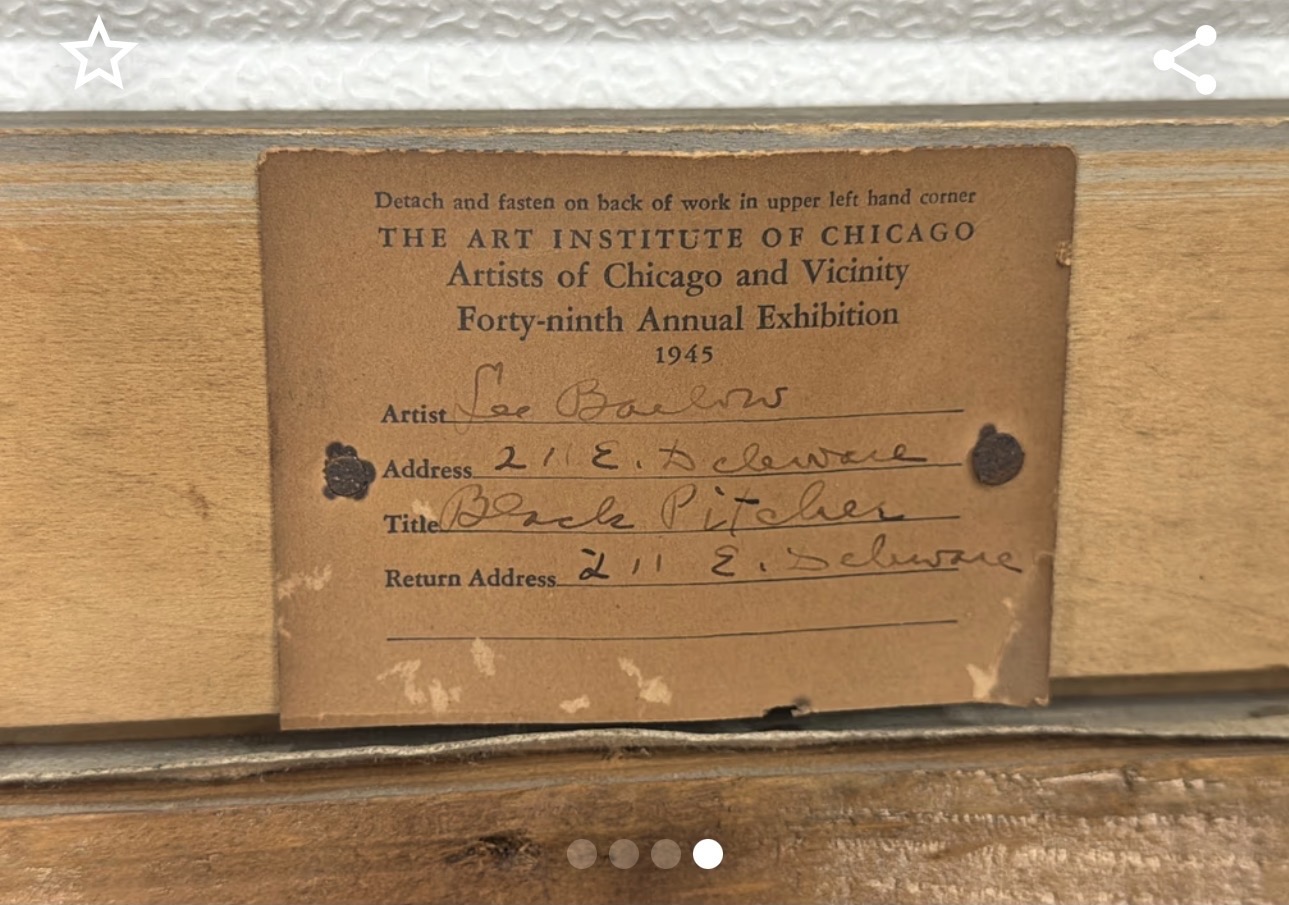
What looks like an ordinary Post-Impressionist tabletop still life hides a vibrant slice of Chicago’s 20th-century art history on the reverse side. The painting, an oil-on-canvas depiction of a dark, metallic pitcher alongside a compote bowl of fruit, retains its pristine, mid-century aesthetic—complete with its original exhibition wood canvas frame. Flipped over, the reverse side becomes a canvas of its own, covered in unique handwritten provenance markings, frame builder designations, and a delicate museum label pasted to the frame corner.
The Art Institute History & The Artist's Journey
The vintage exhibition label confirms that this painting, titled Black Pitcher, was executed by artist Lee Barlow and selected for the prestigious Forty-ninth Annual Exhibition of Artists of Chicago and Vicinity. Held at The Art Institute of Chicago between June 7 and August 19, 1945, this historic exhibition celebrated the premier regional modernists working in the shadow of the Second World War.
Born Lena Maria Sophia Sage, the artist was originally from Benton Harbor, Michigan, where she resided with her husband, Stuart Barlow, until they relocated to Chicago, Illinois, in 1940. Immersing herself in the city's vibrant creative community, she pursued her formal studies at the Art Institute of Chicago. Her immense talent did not go unnoticed; a June 14, 1947 edition of The News-Palladium of Benton Harbor highlighted her exceptional abilities, noting that by the time of her graduation, her artwork had already generated an impressive $1,200.00 in sales. On Friday afternoon, June 13, 1947, she graduated with high honors at the institution's 67th Commencement exercise, held at the historic Kenneth Sawyer Goodman Memorial Theater.
During the 1940s, women artists faced systemic barriers and were rarely afforded the same recognition for their creative and academic achievements as their male peers. In response to this challenging landscape, Mrs. Barlow deliberately adopted the professionally gender-neutral moniker of Lee Barlow—utilizing it not only to sign her vibrant canvases but also registering it directly on her academic transcripts. At the time Black Pitcher was accepted into the 1945 museum exhibition, she was working out of her studio home at 211 E. Delaware Place, an elegant residential pocket in downtown Chicago nestled just off Michigan Avenue.
Decoding the Back: The Artist's Shorthand & Material Specs
The structural reverse reveals exactly how Barlow prepared the piece for its big museum debut in 1945, measuring 18 inches from top to bottom, 2 feet from left to right, with a depth of 3/4 inches and a square check of 30 inches. Across the top wooden stretcher bar, the artist aggressively hand-painted "LEE BARLOW" in giant, black block lettering, ensuring her work could easily be identified behind the scenes by museum handlers.
The raw canvas itself bears the physical echoes of its presentation history. On the left wooden margin, vintage grease pencil markings record tracking numbers ("45" denoting the year 1945, coupled with the official museum intake inventory digits "1208"). Sweeping across the exact center of the unprimed fabric backing is a large, fluid, pencil-written cursive title "Barlow" with an elegant decorative loop beneath it. Faintly written on the inner wooden frame lip, additional workshop shorthand specifies the materials and custom molding profile details used to mount the artwork: "3 scoop rowan and 2 ivory".
The Visual Language of Lee Barlow
Black Pitcher perfectly reflects the artistic transitions of the mid-1940s. Moving away from rigid realism, Barlow embraced a soft, Post-Impressionist approach. The piece uses fluid, visible brushstrokes and a striking coral and teal background color palette to bring depth to a classic tablescape setup. The presence of a vibrant green accent leaf dish on the draped white tablecloth provides a sharp focal contrast to the heavy, dark forms of the pitcher.
Tracking a Local Legacy
Decades after it was displayed on the walls of one of America's finest museums, Black Pitcher has survived intact. Layered handwriting, historical tracking numbers, frame specifications, and a pristine paper entry tag give art historians an unedited window into the past. Scholars, regional art historians, and collectors tracking down the registered catalog lists of the 1945 Chicago and Vicinity exhibition now have a complete, verified look at a piece once considered lost to private collection history.
About the Creator
Enjoyed the story? Support the Creator.
Subscribe for free to receive all their stories in your feed.
Comments
There are no comments for this story
Be the first to respond and start the conversation.