
Ron Pokrasso: The Beautiful Trouble of Making
- Santa Fe, New Mexico
By Brian D’Ambrosio
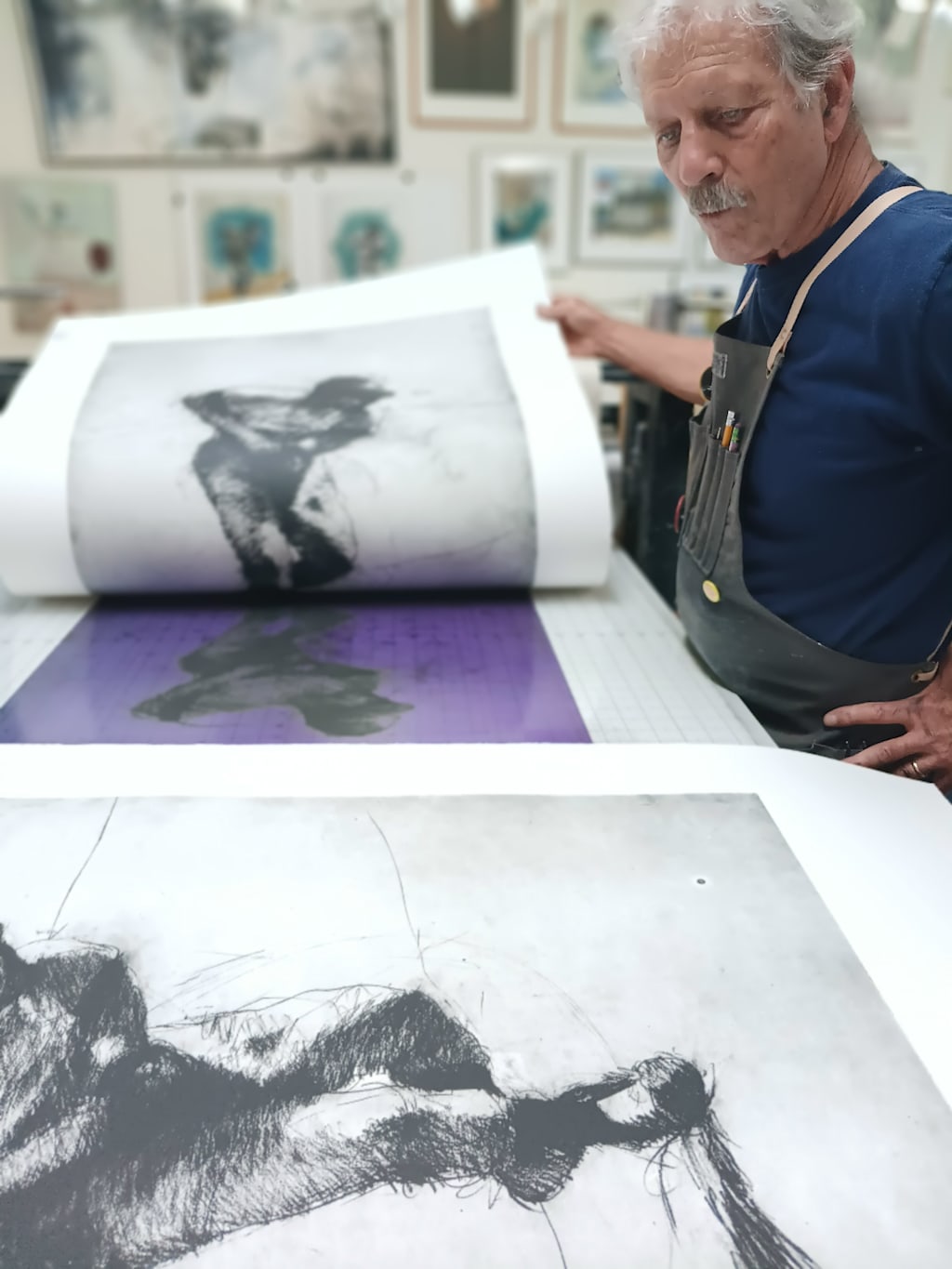
The print shop is a place of stains.
Ink gets under the fingernails. Solvent hangs in the air. Paper takes the pressure of the press and remembers it. Metal remembers it, too. Everything leaves a trace. For Ron Pokrasso, that is part of the attraction.
“The process of making to me is more important than the product,” he says. “I make art, which is a verb, not a noun. I'm a maker. I survive my getting hands into stuff.”
That last phrase may be the best key to Pokrasso's work. He has spent more than forty years getting his hands into things—printmaking, drawing, painting, collage, photography, whatever else can be persuaded to join the argument. His Galisteo Street Studio in Santa Fe is part workshop, part laboratory, part classroom. Artists come there to learn technique, but also to get themselves into trouble.
Pokrasso was born in Brooklyn, where his father was also born. His father was a psychologist; his grandfather had grown up in Ukraine. Even the family name carries an artistic inheritance. Pokrasso says the Russian name translates to “painter.”
Perhaps the bloodline was already drawing a crooked line toward the studio.
But before Santa Fe there was baseball. Pokrasso grew up playing stoopball and stickball, and he became a lifelong Yankees fan. The great Maris-Mantle home-run race of 1961 remains lodged in his imagination, that peculiar summer when Roger Maris and Mickey Mantle chased Babe Ruth's record and turned the baseball season into a national obsession.
Baseball still provides Pokrasso with a vocabulary for making art. He talks about batting averages, failure, persistence and the mathematics of trying.
“If you look at a .300 batting average, which is successful, that means that you have struck out seven out of ten times,” he says. “Art can be like that. Life can be like that.”
It is a useful philosophy for an artist who distrusts certainty.
Pokrasso discovered printmaking at SUNY Brockport after a drawing professor suggested he take a class with Robert E. Marx. He did, and intaglio caught him immediately. There was the smell of the studio, the ink, the physical transfer from plate to paper. There was the strange pleasure of watching pressure turn into an image.
Marx became more than a teacher. Pokrasso continues to credit him as the single most important person in his development as an artist.
The formal education continued at Brockport from 1969 to 1973 and Pratt Institute from 1973 to 1975, where he earned his MFA. The training was solid and academic. Then, in Queens, he began to undermine it.
During a figure-drawing session at his home in 1977, Pokrasso picked up a strip of masking tape and applied it to a graphite drawing.
It was a small act of rebellion, almost nothing.
Except that it was something.
The tape led somewhere. It became an invitation to experiment, to make the unexpected move and wait for the consequences. Pokrasso began cultivating the uncomfortable edge—the place where an artist no longer knows exactly what will happen next.
His credo remains wonderfully contrary: “If I knew where I was going I’d be lost.”
In 1978, Pokrasso came to Santa Fe to work with the original photogravure plates for Edward S. Curtis's The North American Indian. He became master printer and production supervisor at Classic Gravure, where he hand-printed more than 30,000 impressions during his years there. His official résumé dates the Classic Gravure work to 1978–1981; his own later account describes the printing as extending into 1982.
Thirty thousand impressions is a number that eventually stops being a number. It becomes a physical education: paper, ink, pressure, repetition, patience. It is also an education in difference. No matter how carefully the process is controlled, no two moments are entirely identical.
Pokrasso later owned and directed Graphics Workshop for eleven years before gifting it to the College of Santa Fe in 1993. He became an originator of Monothon, taught at universities, museums, public schools and private workshops, and led artist residencies in the United States, Scotland, Ireland and Italy. (A Monothon is a marathon-style art workshop in which artists gather timed sessions to create monotypes, one-of-a-kind prints. The word combines “monotype” and “marathon.” Monothons are often organized as community art events, workshops, or fundraisers.) In 2000, Santa Fe recognized his contributions to the visual arts with the Mayor's Recognition Award.
Teaching, however, is not an accessory to his practice. It is part of his philosophy.
“I am thrilled by the concept of being passionate,” Pokrasso says. “I call it the P word. A passion for life. A passion for things that bring us joy.”
There is nothing particularly fashionable about that word anymore. Passion has been used, polished and packaged to death. In Pokrasso's case, it sounds less like a slogan than a working condition. You have to care enough to keep your hands dirty.
And you have to pass it along.
“We have a responsibility as artists to share what we do.”
That belief explains much about the trajectory of his career. The studio is not a fortress. It is a place people enter. Students arrive with assumptions about what art ought to be, and Pokrasso's job is often to loosen those assumptions before they harden into habits.
There are rules in the print shop, naturally. Clean hands belong in clean areas. Dirty hands belong elsewhere. Tools must be respected. Solvents are not toys. The workspace gets cleaned.
But art itself is another matter.
“There are no rules,” he says.
The apparent contradiction is actually the point. Discipline creates the conditions for freedom. Know the process well enough to violate it intelligently. Understand the rules well enough to make something happen outside them.
Pokrasso's work lives in that territory. His artistic lineage includes Rembrandt, Whistler, Picasso, Rauschenberg, Jasper Johns and Robert Marx—artists who, in different ways, treated the medium as a means rather than a prison.
Pokrasso does the same. He is still making. Still teaching. Still looking for the next wrong turn.
And perhaps the baseball analogy tells us why. A .300 hitter fails far more often than he succeeds. The failure is not evidence that the player should quit. It is built into the game.
Art is built that way, too. So is life. The press waits. The paper waits. The artist gets his hands into the mess. Then he takes his swing.
Brian D'Ambrosio is the author of New Mexico Eccentrics.
About the Creator
Brian D'Ambrosio
Brian D’Ambrosio is an arts, culture, and music writer whose work appears nationally and regionally. He covers overlooked figures, musicians, artists, athletes, and eccentrics. Contact: [email protected]
Enjoyed the story? Support the Creator.
Subscribe for free to receive all their stories in your feed.
Comments
There are no comments for this story
Be the first to respond and start the conversation.