
The Branch Wukong That Looks Right Through You
Fan Lijie hollowed out the eyes, left the knots in the wood, and refused to add the golden headband. What remains feels less like a hero and more like a survivor.
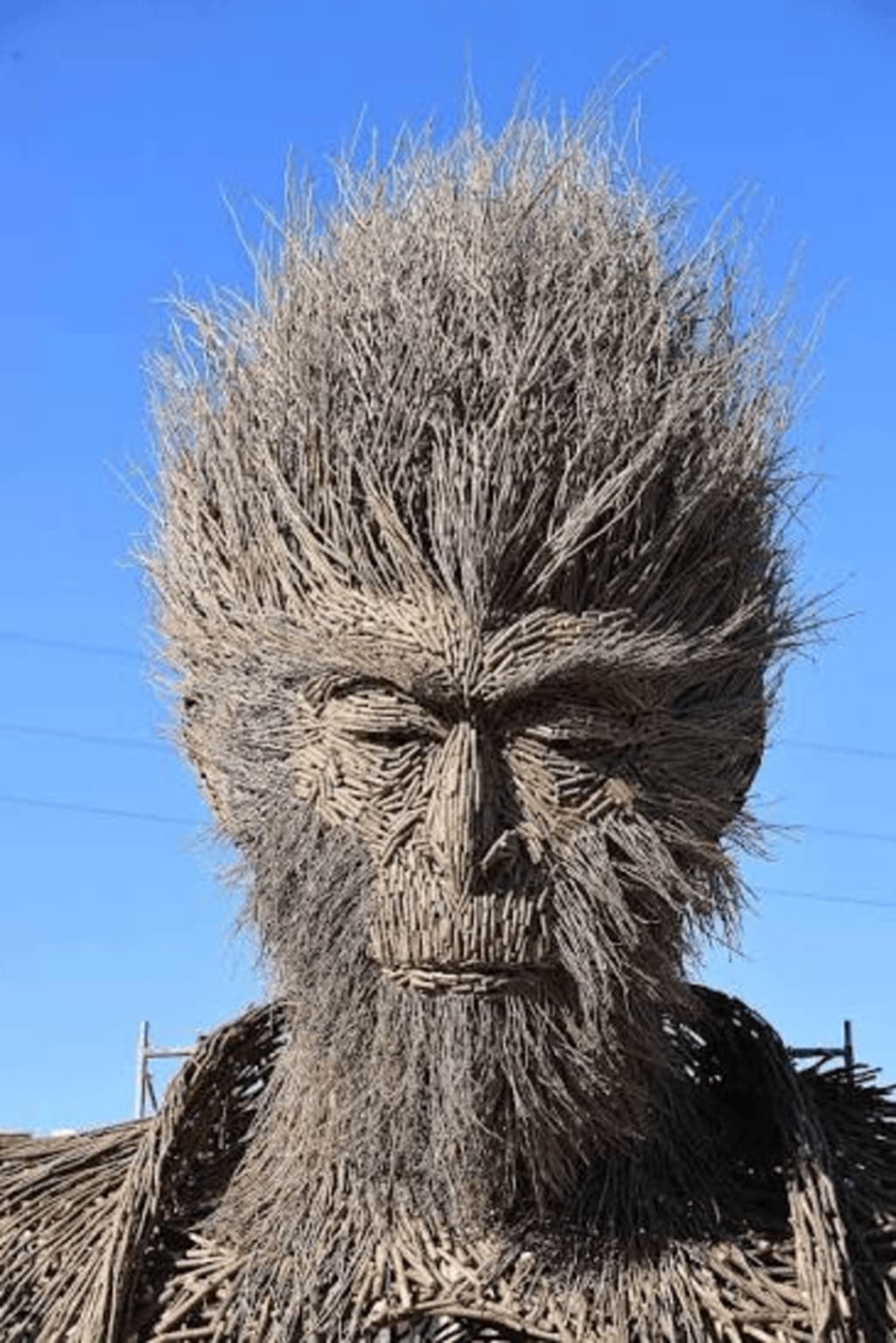
I noticed the construction of the eyes first, not their expression. In an interview, Fan Lijie said that when he made it, the eyes were hollowed out, with light inside, and that from different angles it seemed to be looking at you, and also seemed not to be looking at you. That description is accurate. If you lean a little to the left, the beam of light seems to fall on you. If you lean a little to the right, it is empty again, as if it has seen nothing. It does not feel like a specific person staring at you. It is more like the great Buddha in a temple: eyes half-open, half-closed, not chasing anyone with its gaze, yet in front of it you quiet down on your own.
This emptiness does the first piece of work. Many Wukong sculptures put their energy into looking like him: the face must be fierce, the armor bright, the staff thick, the fiery golden eyes must glow. That is a direct way of writing a hero. The audience knows at a glance that this is the Great Sage Equal to Heaven. This branch Wukong does not take that road. Its eyes do not offer emotion. They offer an entrance. Light comes through the hollows. When you look at it, it is also looking at you. When you change angles, it seems not to be looking at you. The space between looking and not looking gives the sculpture its divinity. That divinity comes from its refusal to please you.
But its body is made of branches.
We are used to Great Sages made of metal and plastic. Metal is too hard. Plastic is too light. They easily turn Wukong into a symbol: invincible, always right, always strong. Branches are different. Branches have nodes, scars, cracks, rough texture, and original wood color that varies in depth. They carry a natural sense of desolation. Looking at those branches twisted together, you think of wind blowing, rain beating, sun scorching. You think of how they were once scattered on the ground in pieces, and only later were slowly assembled into a human form.
So the humanity of this work is not in the face. It is in the material.
Its roughness makes you think of bodily experience. A monkey who has been pinned under a mountain for five hundred years and has just been released should not have a smooth body. He has had moments of high spirits and moments of helplessness. He has stood up, but the marks of having been pressed down are still on him. Some people see it and say, “One glance takes me back to childhood,” remembering the fiery golden eyes of Liu Xiaolingtong in the 1986 adaptation of Journey to the West. Others notice its expression and say, “This look is like someone who has just been let out after five hundred years under the mountain.” The same work: some see childhood, some see suffering, some see a figure that refuses to fall. The sculpture does not dictate what the audience should feel. It just puts the thing there.
Fan Lijie graduated from the Sculpture Department of Yunnan Arts University in 2009. He is professionally trained. He has always liked working with branches, and he once opened a Taobao store selling branch coat hooks. In 2015 he opened the store and sold more than two thousand orders. Later there were no orders, and his main income came from his wife. His personal creations were driven by interest. Put these facts together and you see two things: he has a professional foundation in form, structure, and proportion, and he has long dealt with branches as a material. He did not suddenly decide to ride a concept.
Professionalism plus love is what makes material language settle.
In his hands, branches are not a cheap substitute for metal. They are something he knows. He knows which branch can bend, which will break, which has scars on the surface, which has gone gray. Those two thousand-plus coat-hook orders were not sold for nothing. That was his process of dealing with material, with the market, and with orders. Later, when the orders stopped, he was still making. His wife’s income supported the household. He kept working with branches. This picture is not romantic: wood shavings on the floor, glue on the table, no new orders on the phone, and him bending down to turn a branch to another angle to see whether it can stand.
After the work went viral, netizens suggested adding a “golden headband” and a “golden cudgel” to Wukong. His response was direct: “That is my thing; it has nothing to do with them. You liking it is your business; my liking it is my business. I want to be myself, not the myself in your eyes.”
That sentence sounds hard, but it is connected to the spirit in the work. If a creator is always thinking “what do people want to see,” the work becomes a product. Only when he dares to say “this is my thing” does the work have its own gaze. The light in the hollow eyes looks like it is “looking down on all beings,” not because the technique is complicated, but because the author did not bow his head.
There is a practical reason it spread. Hollow eyes, natural wood color, and branch texture are highly recognizable in short videos and images. You remember them at a glance. Add the look of “just released after five hundred years under the mountain,” and it naturally invites remakes and projection. Viewers bring their own readings. The sculpture leaves room for that. This Wukong has a visual hook: it is not glittering gold, yet it makes you want to look twice. It is not whole, yet it makes you think of your own incompleteness.
Still, there is no need to over-romanticize “not going to work and fiddling with branches.” Fan Lijie’s path had family support, professional accumulation, and survivorship bias. The work works because long-term love, professional training, and an independent personality settled into a material language. He opened a Taobao store and sold more than two thousand branch coat hooks, which shows he dealt with both material and market. Later, when there were no orders, he relied on his wife’s income to support his creation, which shows the road was not easy. Because it was not easy, the desolation in the work is not fake.
He said that the original intention was to concretize childhood Journey to the West feelings and the life realization of “falling down and standing up again.” He wanted to use branches to entrust a view of life: “When it finally stands here, I look at it as if I were looking at another self. We are both imperfect, but we are both trying to take shape.”
This sentence and the incompleteness of the branch Wukong are the same thing. We are all imperfect. We all have knots and cracks. We have all been pressed by life, but we are still trying to stand into a human form. The work has power because the author did not hide himself. He lived himself into the material, so the work looks like another self.
After the interview, he will probably go back to the workbench. On the table is an unfinished branch, with sandpaper and glue beside it. He picks it up, looks at it, puts it down again, and turns it to another angle. That branch has not yet taken shape.
About the Creator
Jin
Writer of reamstories
https://reamstories.com/jin
Enjoyed the story? Support the Creator.
Subscribe for free to receive all their stories in your feed. You could also become a paid subscriber, letting them know you appreciate their work.
Comments
There are no comments for this story
Be the first to respond and start the conversation.