
The Untold Rise of Dagrin: How a Street Rapper Changed Nigerian Music Forever
The Short Life and Lasting Legacy of Nigeria’s Indigenous Rap King... His story continues to inspire young musicians from humble backgrounds who believe talent and authenticity can still change their lives.

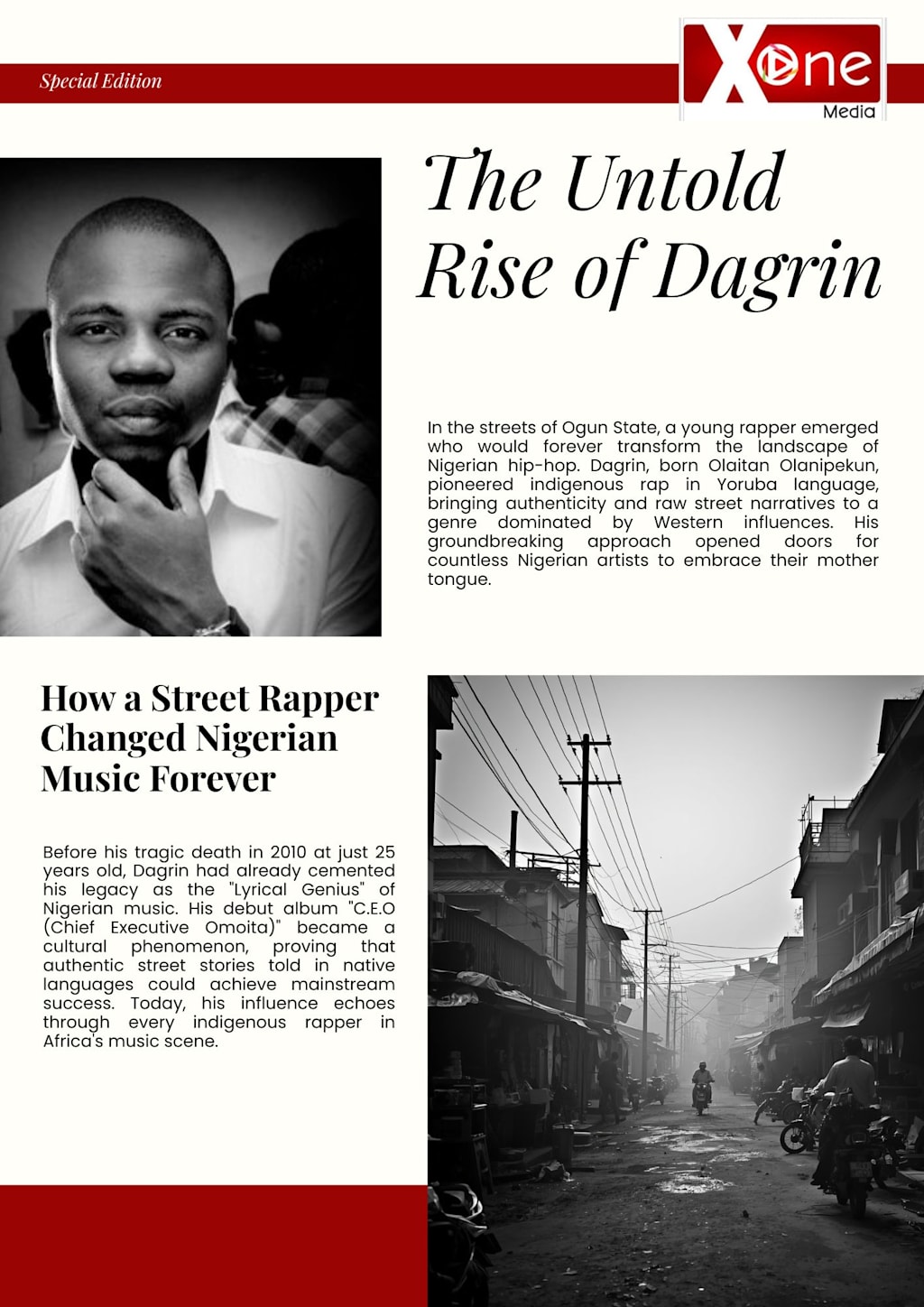
Before Nigerian rap became a global movement, before street-hop dominated clubs, playlists, and speakers across the country, there was one young man who changed the sound of Nigerian music forever.
His name was Dagrin.
Born Olaitan Oladapo Olaonipekun, Dagrin was not just another rapper trying to chase fame. He became the fearless voice of the streets — raw, energetic, authentic, and unapologetically Nigerian. At a time when many artists copied American rap styles and accents, Dagrin proudly embraced Yoruba, pidgin English, and the everyday reality of life in Lagos.
He made music for the hustlers, the dreamers, and the ordinary people trying to survive.
What many people never knew was that his journey to stardom was filled with struggle, rejection, and sacrifice.
The Streets That Built Him
Dagrin grew up in Lagos in a humble environment where hardship was part of everyday life. The crowded buses, noisy neighborhoods, street hustlers, and survival mentality around him later became the heartbeat of his music.
Unlike many artists with financial support or industry connections, Dagrin fought his way through the Nigerian music scene from the ground up. Back then, Nigerian hip-hop was still evolving, and most record labels preferred polished artists who sounded foreign.
But Dagrin stood for something different.
He represented the streets.
Long before fame found him, he spent years performing at underground shows, local events, and small gatherings where few people recognized his talent. Studio sessions were expensive, promotion was difficult, and success seemed far away.
Still, he refused to quit.
Those close to him often described him as completely obsessed with music. He constantly wrote lyrics, practiced freestyle rap, and believed indigenous rap could one day dominate Nigeria.
Many people laughed at that dream.
Critics claimed local-language rap would never succeed commercially. Others believed Nigerians only wanted Western-style hip-hop.
Dagrin ignored the noise.
The Album That Changed Nigerian Music
Everything changed in 2009 when Dagrin released his iconic album, Chief Executive Omoita.
The project exploded across the country.
Songs like Pon Pon Pon instantly became street anthems. From buses in Lagos to university hostels, local bars, clubs, and roadside shops, Dagrin’s voice was everywhere.
What made him different was his authenticity.
He did not pretend to be wealthy. He did not fake a foreign lifestyle. He rapped about hustle, survival, ambition, poverty, and the harsh realities of life in Nigeria.
Young Nigerians connected deeply with his music because they saw their own struggles reflected in his lyrics.
For the first time, indigenous rap became mainstream.
More Than Music
Dagrin’s success changed Nigerian entertainment culture forever.
Before his rise, many artists were afraid to fully embrace local slang, Yoruba rap, and street culture. But Dagrin proved that music rooted in Nigerian identity could become commercially successful and culturally powerful.
His influence opened doors for a new generation of artists who later built careers using indigenous language and street-inspired sounds.
Today, many fans believe the success of modern street-hop and indigenous rap can be traced back to the foundation Dagrin created.
He was not just making songs.
He was leading a movement.
The Tragic End
Just as his career was reaching incredible heights, tragedy struck.
In April 2010, Dagrin was involved in a terrible car accident in Lagos after his vehicle reportedly crashed into a parked truck in the early hours of the morning.
The news shocked the entire country.
Fans prayed, radio stations played his songs nonstop, and many hoped he would survive. Sadly, after days of battling for his life, Dagrin passed away at just 25 years old.
Nigeria mourned deeply.
Many believed the country had lost one of its brightest musical talents far too soon.
His death felt like the sudden end of a revolution that had only just begun.
The Legacy That Never Died
Even though Dagrin’s career lasted only a few years, his impact on Nigerian music remains massive today.
Indigenous rap, street-hop, Yoruba-infused lyrics, and local slang are now fully accepted and celebrated across the industry. But years ago, Dagrin was one of the few artists brave enough to push that vision.
His story continues to inspire young musicians from humble backgrounds who believe talent and authenticity can still change their lives.
To millions of fans, Dagrin was more than a rapper.
He was proof that greatness can rise from the streets.
And even though his life ended too soon, his voice still echoes through Nigerian music culture today.
Dagrin did not just become famous.
He changed the sound of a nation forever.
About the Creator
X One Media
An Online News And Media Home
Enjoyed the story? Support the Creator.
Subscribe for free to receive all their stories in your feed.
Comments
There are no comments for this story
Be the first to respond and start the conversation.