
The Rotation Your Body Is Begging For (And Why Stretching Isn’t Enough)
A simple practice to wake up your spine, shoulders, and hips without forcing a single stretch.
Turn your palm up. Flatten it. Turn it over and look at the back of your hand. Turn it back.
This movement is so small it barely counts as movement. But touch your forearm near the wrist. There are two bones. One on the thumb side, one on the little-finger side. When the palm turns up and down, they do not twist together as one stiff unit. One travels around the other. The skin does not twist. The elbow does not fold. The bones inside have already made a rotation. This is the smallest unit of rotation.
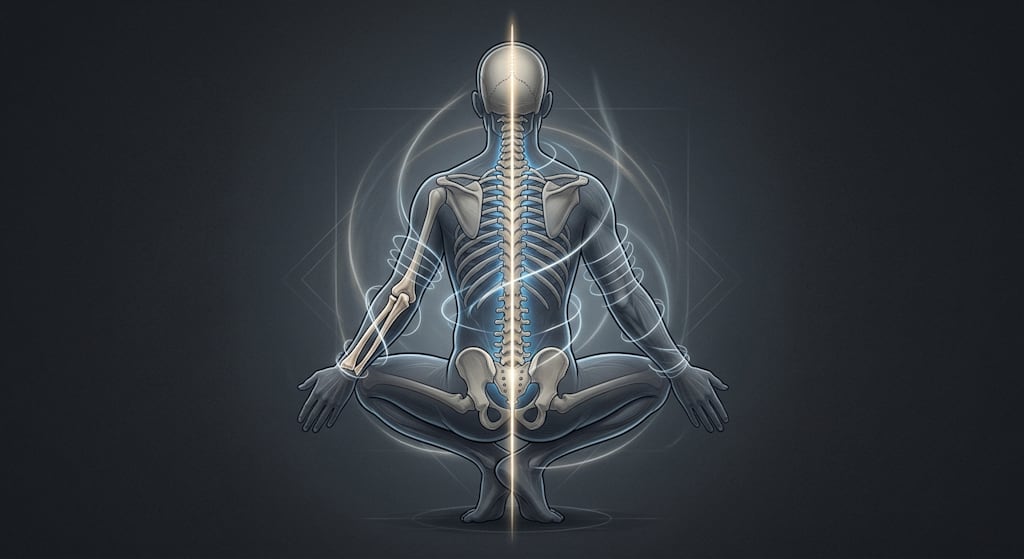
Forget ballet spinning in place. Forget the performance turn, the chase for circles, the body twisted into a pretty shape. Think instead of building an axis inside the body and letting the whole skeleton move around that axis. When the bone moves, fascia, tendon, and muscle follow. A chain wakes up, engaging fascia, tendon, and muscle together.
The upper arm has only one bone. It does not wrap around a partner. It uses the shoulder joint as an endpoint and spins on its own. Put your hand on a wall. Keep the elbow still. Turn the palm up, then down. The humerus in the shoulder socket is turning. The range is small, but the sense of axis appears. Without that sense, lifting the arm becomes a shrug, and lowering it becomes a pinched shoulder blade.
The torso works the same way. Stand with your hands on your hips. Rotate the pelvis horizontally to the left, as far as it goes. Then let the chest continue twisting left. Now touch your ribs and pelvis: one faces left a little more, the other a little less. The section of spine between them is twisted into a slow spiral. The spine is stacked segment by segment, not an iron rod. Each segment gives only a little. Together they make the whole back turn.
Rotation is not stretching, and it is not load-bearing. Stretching pulls a line. Load-bearing presses a group of muscles. Rotation has two directions at once: one side twists, one side returns; one side sinks, one side props. Force gathers in that opposition. So it trains the cooperation among bone, fascia, joint capsule, and muscle, not one piece alone.
Here is an exercise you can follow. Do not force what you cannot do.
Stand with feet shoulder-width apart. Put your hands on your hips. Palms against the hip bones, fingers forward. First do only the upper body: rotate the pelvis horizontally left to its limit. Pause. Let the chest continue twisting left to its end. The knees will follow left. Put the left heel and right toe on the floor. Turn the left toe outward and backward; turn the right heel in the same rhythm. The tops of the thighs scissor toward each other. The body rotates and squats at the same time.
Squat as far as you can. Some people can bring the right knee under the back of the left knee, with the jaw toward the left shoulder and the neck carrying a hang. That is one shape of a deep rotational squat, not the standard. Stop wherever your hips, knees, and ankles allow. As you squat, watch the spine: it will be slanted, but do not collapse. Do not bury the head or let it droop. Relax the shoulders. Sink the two elbows toward the floor. You will feel the elbow points spread against each other like the two pointed corners of a swimming crab.
Now feel the back, the area between the shoulder blades. Some people feel heat, swelling, blood moving upward. If you do not, do not rush. For people who sit and lean over a desk for a long time, that area is stiff to begin with. If it usually has a dull or jumping pain, especially with chest tightness or palpitations, see a doctor first. Do not treat it only as a practice reaction.
Breathe out as you rotate and squat. When the rotation ends, the exhale ends. Then inhale, rotate back, and stand. Breathing is brought by the body. You are not regulating it from above. When you squat, space is compressed and air goes out on its own. When you stand, space returns and air comes in on its own. If deliberate breathing makes you tight, forget breathing for now and focus only on the rotation. Breathing can be found later. The axis cannot be lost first.
There are several places to watch.
Knees. Rotational squatting puts a fair amount of twist on the knee joint. If you have knee pain, a history of meniscus or ligament problems, or an unstable kneecap, start with standing rotation or a shallow half-squat. Do not let the knees collapse inward. Do not press hard. If you hear a sound, stop. Do not argue with the sound.
Lower back. Do not collapse the lower back. Squat a little more upright, even if the range is smaller. If you collapse, the rotation all jams into the lumbar spine.
Head. Do not bury it. Jaw toward the left shoulder is fine, but do not fold the neck. The neck carries a hang, not a fight.
Also, the right knee under the left knee pit is not a required goal. Guard the center, use rotation. Keeping the axis and connecting the whole body with a spiral matters more than how deep you squat.
Come back slowly. Take your hands off your hips and stand up. Press the feet down again. Your socks make a small sound against the floor. The places your palms touched are a little damp.
About the Creator
Jin
Writer of reamstories
https://reamstories.com/jin
Enjoyed the story? Support the Creator.
Subscribe for free to receive all their stories in your feed. You could also become a paid subscriber, letting them know you appreciate their work.
Comments
There are no comments for this story
Be the first to respond and start the conversation.