
She Cheated the Berlin Marathon and Called It a Personal Best
A fitness influencer took a bicycle at kilometer 38. The runners who finished are the ones who paid for it.
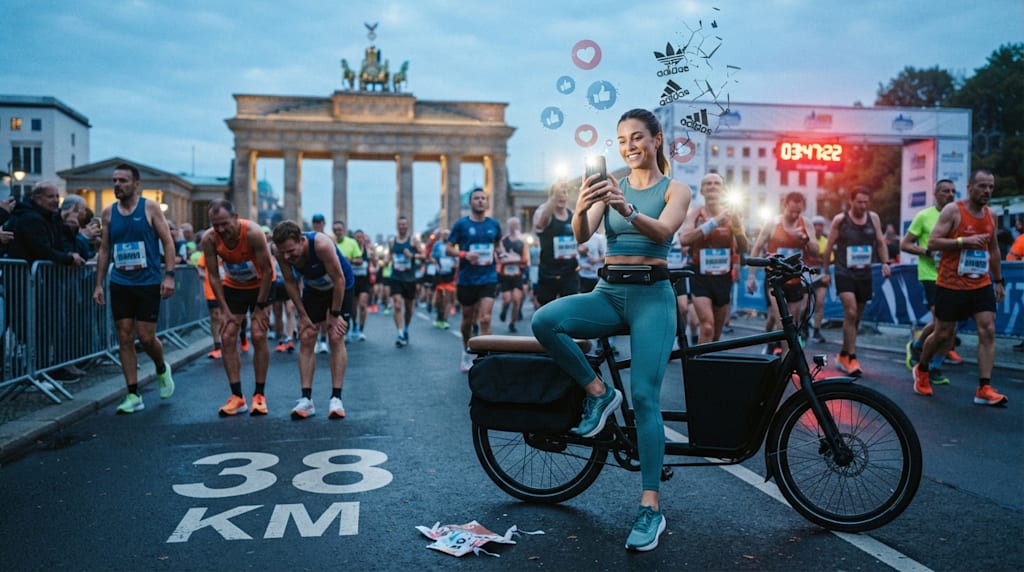
A bicycle at kilometer 38, a brand deal in flames, and the runners who finished.
On September 27, 2026, 56,000 runners from 162 countries lined up for the Berlin Marathon. The course runs through the Brandenburg Gate, past the Victory Column, through a city that has seen more than its share of history.
At kilometer 38, a Chinese fitness influencer got onto the back of a bicycle.
A runner photographed her. The image reached officialunofficialtime, an account that checks marathon results. In the photo, she sits on the bicycle. No running shoes scrape the pavement. No breathing. No sweat. Only wind moving through her hair.
Before the race, she posted: “Preparing for the Berlin Marathon. Wanting to win is not shameful.” Seven words, crisp and forceful, exactly the tone a self-discipline influencer is supposed to have. After the race, she announced her time: 4:53:46, a personal best. Gratitude, emotion, thankfulness. A complete inspirational story for more than 500,000 followers.
Then the data caught her. Her split pace between kilometers 35 and 40 did not drop. It rose. That matched the section where she was photographed on the bicycle. A runner speeding up at the most exhausted point of the race, faster than the first 35 kilometers, was riding.
In the early hours of October 3, she apologized. “Regarding my behavior of riding a bicycle at the Berlin Marathon, it violated the race rules. I will not make any defense for the above behavior.” “Even if there was physical discomfort on the course, it absolutely should not have been a reason for my violation.” “After the race, in my public sharing, I deliberately concealed this fact. It was a very dishonest act. It also violated the sporting spirit of fair marathon competition, and I feel deeply guilty about it.”
The wording looks adequate. She admits the violation, the concealment, the betrayal of the spirit. Look closer, and the problem hides between the lines.
She places the cause on physical discomfort. Those words are the most common reason for dropping out of a marathon and the easiest excuse to forgive. What she does not mention: if you are unwell, you can withdraw. You can take the sweep vehicle. You can walk to the finish. She chose a bicycle, then posted about a new personal best.
The apology itself has a trajectory. After it was published, users reported it en masse. It was deleted. On October 4, it was uploaded again. This post, delete, repost move has become a fixed procedure in influencer crisis PR. Test the water, watch the wind, then decide what posture to take.
One runner wrote in the comments: “Riding a bicycle is not what shames you. What shames you is coming back and telling us you ran it.”
Less than 24 hours after the story broke, BROOKS China released a statement. Three points: terminate the partnership, no future cooperation, apologize to the public.
The details deserve attention. The brand admitted that before the race it had learned of the collaborator’s preparation plan and race goals for the Berlin Marathon. It provided race equipment. After the race, it verified the result and the photo and text materials. It did not conduct sufficient and detailed verification of the entire race process, especially split data.
Translated: we looked at the result, looked at the photos, decided they could be posted, and posted them. Whether she had finished, we did not check.
This is not only BROOKS’s problem. The standard process for sports brands working with influencers has long been result-oriented. A finisher’s certificate, course photos, a reflection, a few retouched images. Once the materials are in place, the contract is fulfilled. As for how those materials were produced, or whether a bicycle appeared in the middle, brands often choose not to ask.
Until someone asks.
On this influencer’s Xiaohongshu account, her photos show a tight body and defined lines. Her captions repeatedly feature self-discipline, persistence, and breakthrough. After runners dug up the bicycle photo, they pointed out: her physique lacks the muscle markers of long-term training, and her core strength does not match her pace at all.
This is not only her problem.
On the assembly line of MCN agencies, the fitness influencer is a mass-producible category. You do not need to run fast. You only need to look good on camera. You do not need to finish a race. You only need to strike a sprinting pose beside the course. Photo-editing software can carve lines into a flat body. Video-editing software can splice a walk into a short clip of persistence. Copy templates can be applied to any race. Swap Berlin for Tokyo. Swap 4:53 for 5:12. The content barely needs to change.
At the end of September 2026, the Cyberspace Administration of China launched a two-month Qinglang campaign to clean up fake personas in short videos. It focuses on five problems: impersonating vulnerable groups, fabricating professional qualifications, using AI to imitate real people, and inventing conflict plots. It states that it will crack down on large-scale production of homogenized fake persona behavior through MCN agencies, multi-account matrix distribution, and cross-platform re-uploading.
The Berlin Marathon cheating incident happened on the third day of that campaign.
In 2020, elite female runner Huang Lin was disqualified and blacklisted from the Chongli 168 Ultra-Trail for cheating by taking transportation. She was already a frequent podium finisher. After the cheating was discovered, she issued an apology. She mentioned deep guilt and struggle. A few years later, she disappeared from the internet. Her account was abandoned. No one mentions her.
After Huang Lin, a 2024 trail runner received a lifetime ban for cutting the course. After that, the bicycle at the 2026 Berlin Marathon.
Every cheater, when caught, writes a sincere apology. The next one still gets on the bicycle.
In this system, the reward for honest racing is far lower than the payoff of cheating, even after accounting for the risk of being caught. A marathon, run honestly, takes four or five hours. You are exhausted. Your knees ache. You may not produce a good pace. A stretch on a bicycle saves your strength and buys you two letters, PB, plus a brand contract and followers’ likes. The probability of being caught is low. On a course with tens of thousands of people, in a foreign city where no one knows you, under a partnership model where the brand looks only at results, the cost-benefit ratio of cheating is high.
Unless someone takes a photo.
A marathon course is never only 42.195 kilometers of asphalt. It is a field where tens of thousands of people do the same thing at the same time. It is a temporary community where strangers hand each other water and shout “jiayou.” The people who cramp at kilometer 35 and refuse the sweep vehicle, the people who crawl crying through the last hundred meters, the people who sit by the road for a long time after finishing before they can stand. They are the weight of the course.
When one person gets on a bicycle, she consumes the shared trust of those people.
BROOKS terminating the partnership is a correct decision. Terminating it is not enough. Brands need to write process authenticity into their collaboration standards. Not only finisher certificates and course photos, but split paces, training records, and whether the person had run thirty kilometers before race day. Platforms need to upgrade the review standard for sports content from looks good to data credible. Instead of letting algorithms reward retouched posing. As for the audience, we need to ask ourselves one question. Are we applauding the people who finished the race, or the people who look like they finished the race?
The answer determines whether the next influencer will get on a bicycle at the next marathon.
There are no shortcuts in a marathon. 42.195 kilometers. Every step counts. You can get on a bicycle at kilometer 38, but you cannot fake trembling legs at the finish line.
About the Creator
Jin
Writer of reamstories
https://reamstories.com/jin
Enjoyed the story? Support the Creator.
Subscribe for free to receive all their stories in your feed. You could also become a paid subscriber, letting them know you appreciate their work.
Comments
There are no comments for this story
Be the first to respond and start the conversation.