
CHAGEE Is Selling 5-Yuan Tea Eggs. The Real Story Is What It’s Testing.
Seven Shanghai stores. Two weeks. One rice cooker. A quiet bid to own the morning hours milk tea never had.
One Tea Egg, and CHAGEE's War Over Time
1
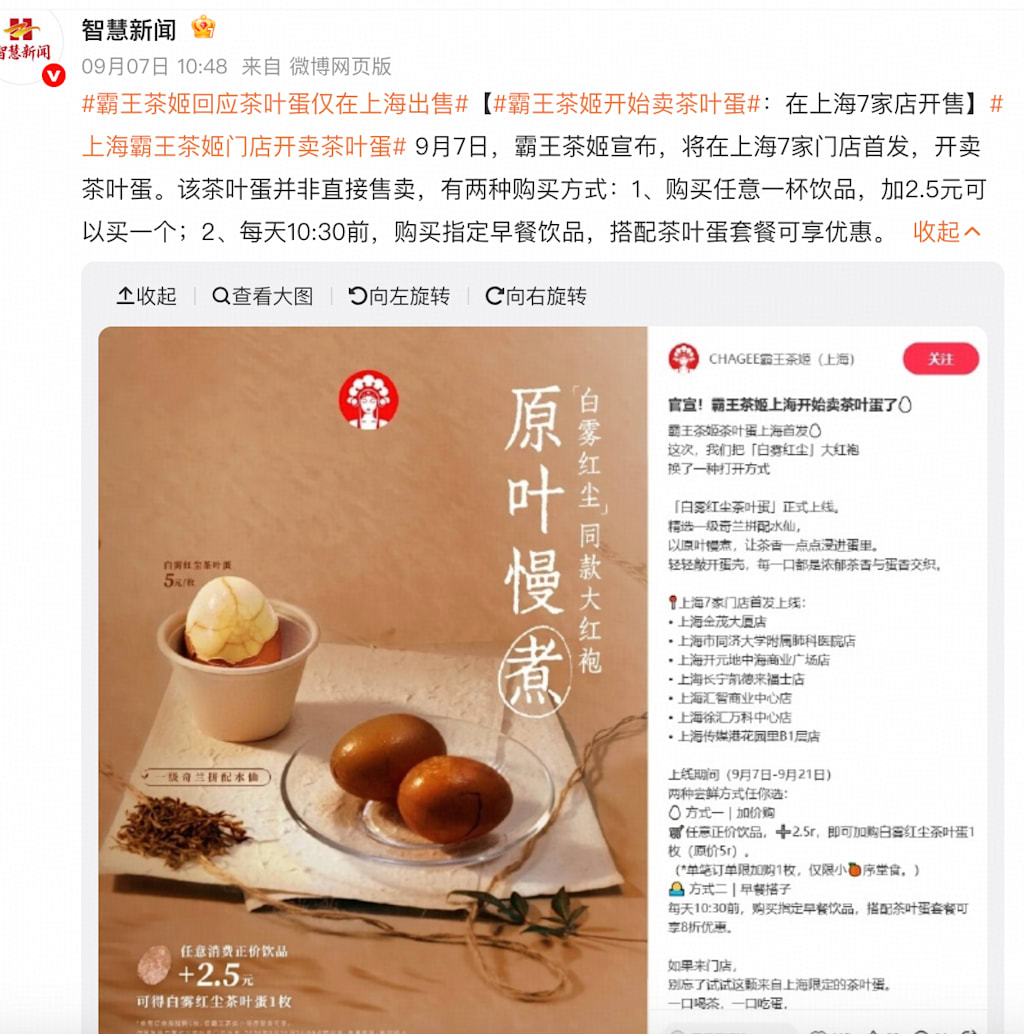
On September 7, 2026, seven CHAGEE stores in Shanghai launched a new item: the Baiwu Hongchen tea egg. It is slow-cooked in the brand's signature Da Hong Pao tea base. One egg costs 5 yuan. Add it to any full-price drink for 2.5 yuan. Before 10:30, the breakfast combo gets another 20% off.
Dine-in only. No delivery. Two weeks.
CHAGEE calls it a test. Seven stores, two weeks, one pot of eggs.
2
The timing
CHAGEE's revenue in the first half of 2026 was 6.961 billion yuan, up 3.5% year on year. In the second quarter, total GMV fell 5.5%. Greater China GMV fell 9.1%. Net store additions were about 108, compared with 357 a year earlier. Management called 2026 a "year of adjustment and stabilization."
Opening stores no longer drives growth. Per-store efficiency has to.
The biggest gap in per-store efficiency is the morning. Milk tea shops have a natural split. Afternoons and evenings are peak. Before 10:30, stores are mostly idle. Rent still has to be paid. Staff still draw wages. Equipment still depreciates. China's breakfast market has passed 2 trillion yuan, growing about 7% a year. Leaving that slot empty burns money.
3
CHAGEE is not the first to see the gap.
Starbucks China's same-store transactions grew 7% in the first quarter of fiscal 2026. Breakfast was the fastest-growing daypart. Luckin has added ovens in some stores and rolled out about 20 bagel-and-sandwich items on its mini-program. Guming plans to install ovens across more than 13,000 stores. In tests across over 1,000 stores in Guangdong and Guangxi, daily baked-goods sales exceeded 25 units per store, adding more than 200 yuan in daily revenue. About 70% of customers chose a "bakery plus drink" combo. Mixue tested a 7.9 yuan "breakfast milk plus bread" set in Dalian, Xi'an, Nanning, and Hangzhou. Heytea launched "Inspiration Breakfast" in 2019. Nayuki tried 9.9 yuan breakfast combos in 2020. Starbucks has pushed breakfast down to 9.9 yuan.
The industry is competing for the same thing: dayparts that are not yet occupied.
In 2025, the new tea drink market reached 187 billion yuan. Growth fell from 19.3% in 2023 to 6.4%. Incremental growth is over. Now the fight is over existing customers and existing hours.
4
But CHAGEE makes milk tea. In consumers' minds, milk tea does not belong to the morning. Few people walk into a milk tea shop first thing in the morning unless it sells coffee.
CHAGEE has tried coffee. It pushed caramel drinks. The market response was not good. Pushing coffee means hitting someone else's strength with your own weakness. Luckin has turned 9.9 yuan coffee into infrastructure. Starbucks has spent twenty years deepening the breakfast occasion. A frontal fight is not winnable.
So it chose the tea egg.
Lai Yang, executive vice president of the Beijing Business Economics Association, put it this way: tea eggs are highly standardized, with limited demands on equipment, labor, and production flow, so they are easy to operate. At the same time, a well-known tea brand selling tea eggs creates strong category contrast and easily sparks social discussion. He used two phrases: operational test, brand communication test.
Those two phrases capture the role of this egg.
One rice cooker is enough. No new equipment. No changed flow. Using the same Da Hong Pao tea base as the signature Baiwu Hongchen is an implicit consumer education: the tea base is brewed from tea leaves. The tea egg is one of the most universal items in Chinese breakfast culture. It needs no market education. At 2.5 yuan as an add-on, once someone has already decided to buy a milk tea, the decision cost is close to zero.
The egg also redefines "when you can drink CHAGEE." In the past, people felt morning milk tea was too cold, or carried a sense of guilt. Now you walk into a store and see someone buying a tea egg with an iced, lightly sweetened Boya Juexian. The idea seems plausible. The tea egg gives milk tea a step to rationalize itself as breakfast.
5
The tea egg also supports the brand narrative.
CHAGEE founder Zhang Junjie has said since day one that his goal is to build an "Oriental Starbucks." Stores open next to Starbucks. Boya Juexian is positioned against the latte: one blockbuster, one basic item, no need for weekly launches, with addictive qualities.
The comparison also depends on scenes. One of Starbucks' advantages is all-day coverage. Morning Americano and croissant. Noon cake. Afternoon snacks. China has spent twenty years building those consumption habits.
CHAGEE's current bottleneck is a time ceiling. Its business is concentrated in the afternoon and evening. Morning is a hole. If it only holds the afternoon tea slot, the ceiling is visible. To tell a bigger story in the capital market, it has to prove it is not just an "afternoon business."
The tea egg pilot tests whether CHAGEE can appear in the morning. A 2.5 yuan egg is the probe.
6
Shanghai is a well-chosen location. It has both polished white-collar consumers and a huge base of ordinary workers. It is the best test field for national consumption trends. If even Shanghai cannot make a "milk tea plus tea egg" breakfast flow work, copying it elsewhere will be harder. If Shanghai works, replication in surrounding cities and second-tier cities is only a matter of time.
But the challenges are obvious. According to Huxiu, 60% of office workers keep breakfast under ten minutes. Consumers want breakfast to be "on the way" and "fast." CHAGEE stores are mostly in shopping malls. Malls open at 9:30. That time window limits natural reach for breakfast. Nearby steamed-bun shops and convenience stores are already mature supply.
The harder question is whether "milk tea plus tea egg" can move from "makes sense" to "habitual choice." Logical sense is one thing. Changing breakfast habits is another. A two-week pilot can test willingness to try. It cannot test long-term repeat purchases.
7
When CHAGEE starts selling tea eggs, the rivals who should worry are those still defining milk tea as an afternoon tea.
All-day operations have gone from optional to mandatory. Guming is installing ovens in 13,000 stores. Mixue is testing breakfast milk. Starbucks has pushed breakfast to 9.9 yuan. They all want the same thing: dayparts in consumers' lives that are not yet occupied.
CHAGEE chose the lightest path. One tea egg, one rice cooker, seven stores, a two-week test. If it wins, it opens a new consumption occasion and adds a piece to the "Oriental Starbucks" narrative. If it loses, the company loses one pot of eggs.
That is the cost of finding out.
About the Creator
Jin
Writer of reamstories
https://reamstories.com/jin
Enjoyed the story? Support the Creator.
Subscribe for free to receive all their stories in your feed. You could also become a paid subscriber, letting them know you appreciate their work.
Comments
There are no comments for this story
Be the first to respond and start the conversation.