
When Relatives Belittle Your Child at the Dinner Table, Don’t Fight Back. Do This Instead.
You can protect your kid and keep the peace. Here’s how to shut it down without turning lunch into a war.
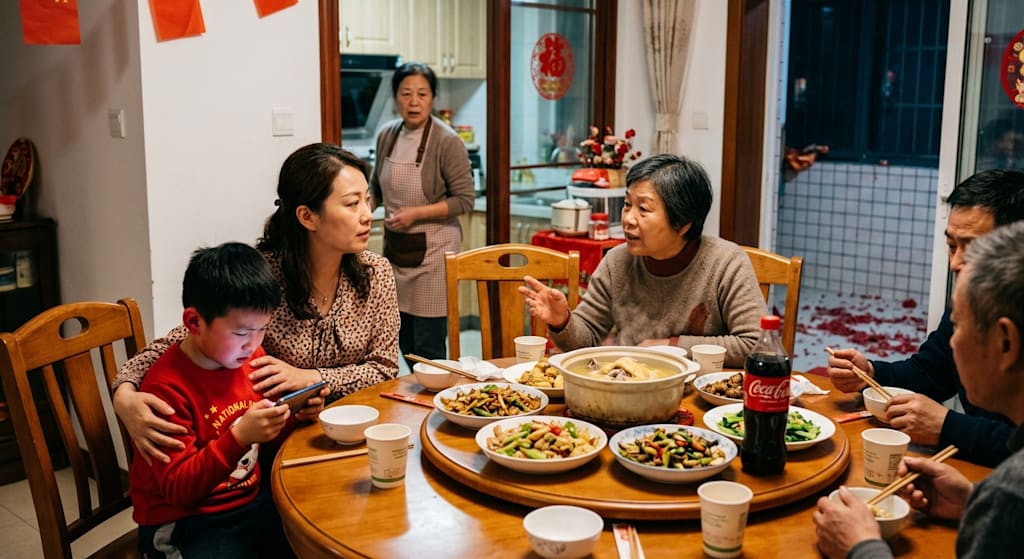
During National Day, the lunch table back home is crowded.
Grandma brings out a pot of chicken soup. Oil beads tremble at the edge of the bowl. Uncle tears open disposable cups. The cola bottle sits on the lazy Susan, turns half a circle, and stops. Your child sits beside you, clutching a phone. The screen shows an unfinished game. He just came in and hasn’t greeted anyone yet.
Aunt X picks up a piece of braised pork. She smiles. Her voice is not loud. It doesn’t need to be. It reaches half the table.
“What’s wrong with your child? He’s this old and still won’t greet people. He’s so timid. How will he survive in society?”
Your child’s finger stops on the screen. He doesn’t look up. His ears turn red.
You put down your chopsticks. Someone laughs, then cuts it off. Grandma pokes her head out of the kitchen and says the soup is ready. Aunt X keeps going: “I’m doing this for your own good. If you don’t discipline him now, someone else will later.”
You’ve heard this before. It feels like fingernails on glass.
You want to snap back. You want to say, None of your business. You want to pull your child close and prove he isn’t broken. But you know what happens if you start a fight at the table. The meal is ruined. Your parents still live here. Grandma still square-dances with Aunt X. Uncle still sees her at the ancestral hall.
So don’t fight. Don’t just sit there either.
Fighting is about winning against the relative. Protecting your child is about letting him know he isn’t alone.
First, steady your child
When Aunt X says that, your first instinct is to explain.
“He’s not rude. He just got out of the car.”
“He’s lively at home. He’s just shy.”
“I’ve taught him manners.”
The moment you explain, you’re in her game. She wants you anxious. The more you talk, the more she has to say. Soon half the table is staring at your child like he’s a case study.
Don’t answer her first. Answer him.
Put your chopsticks down. Put your hand on his back. Pat twice. Not hard. Say:
“Mom heard that.”
That’s all. It tells him: You don’t have to carry this alone.
Don’t force him to greet anyone. Don’t force a smile. Don’t make him perform. He’s already uncomfortable. Get him out of the chair where everyone is watching.
If he’s little, pull him closer. If he’s older, turn off his phone, slide it into his pocket, and say, “Go help Grandma get a bowl.”
Let him leave. That’s not running away. That’s stopping the words from landing on him.
Then block the comment
Now handle the table.
You’re not there to argue. You’re there to close a door. Once it’s closed, the talk stops.
Smile if you want. Keep your voice steady. Don’t rush. Don’t sound like you’re begging her to drop it. Short sentences work best.
Try:
“Aunt X, we’ll teach our child ourselves. Let’s not talk about this today. Here, eat.”
“I know you care. But it makes him uncomfortable, and it makes me uncomfortable. Let’s change the subject.”
“I don’t like hearing that. How’s your blood pressure?”
“Don’t worry. We know what we’re doing. Let’s eat first.”
Any of these will do. The important part is what comes after: eat, change the subject, let’s eat. Give her a step down. Cut the topic off.
If she’s sensible, she’ll say, “I mean well,” and pick up food. You can say, “I know. Have some meat.” It passes.
If she keeps going, “You’re the mother. You spoil him.”
Don’t explain. Don’t talk about parenting styles. Don’t say, “Times are different.” Just repeat:
“Aunt X, let’s not talk about the child today. You eat this.”
Then turn to Uncle. Ask about the harvest. Ask Grandma what she put in the soup. Move the attention away from your kid.
You don’t need to prove your child is good. You need to show that this topic ends here.
If she keeps pushing, leave with your child
Some relatives stop for three seconds. Then they change their angle.
“I’m not saying he’s bad. I’m saying you spoil him.”
“Look at so-and-so’s kid. So outgoing.”
“If you don’t discipline him now, you’ll suffer later.”
Don’t get stuck.
Stand up. Say, “Let’s check the soup.” Call your child: “Come help me get the vinegar.”
If he’s already in the yard, walk out. If he’s beside you, take his hand. Don’t pull hard. Don’t make it look like a retreat. Just go get something.
If Aunt X is still talking, turn your head and smile. “Aunt X, you eat first. We’ll be back.”
Then walk away.
In the kitchen, there’s Grandma’s apron. A bowl of greens waiting to be brought out. Water dripping from the tap. Let your child hand you a plate. With his hands busy, his ears get a break.
Come back after a few minutes. If she starts again, say, “The soup’s getting cold. Grandma, heat it up.” Change the subject.
Leaving the table protects your child from more comments. It doesn’t mean you lost.
Afterward, talk to your child
Many parents block the relative and think it’s over. It isn’t.
Your child may still be wondering: Am I rude? Am I too shy? Does that aunt hate me?
After the meal, find him in the yard. He might be squatting, watching ants. Or drawing in the dirt with a twig. Walk over. Squat down. Don’t start with a lecture. Ask, “Were you uncomfortable?”
He might nod. He might say nothing.
Say:
“What she said is her opinion. It’s not the truth.”
“Not greeting someone doesn’t mean you’re bad. You just weren’t ready.”
“Next time she says something and you don’t want to listen, pull my hand. I’ll take you away.”
If he asks, “Am I rude?”
Don’t say, “Of course not, you’re great.” That’s too easy. Say, “Manners mean greeting people. But when you’re uncomfortable, you can stay quiet first. When you feel ready, you greet them.”
Then agree on a signal. Pulling your hand. Blinking. Touching his ear. Anything. When he does it, you take him away.
The signal isn’t for the relative. It’s for your child. It lets him know he doesn’t have to sit there and wait for the talk to end. He has a way out.
Talk to the elders later
You didn’t argue at the table. You saved your parents some face. But the matter isn’t finished.
While washing dishes, say to Grandma:
“Mom, Aunt X talked about the child today. He felt bad. I took him out first. It’s not aimed at anyone. I just don’t want him criticized in public.”
Grandma might say, “That’s just how she is. Don’t take it to heart.”
You can say, “I won’t. But the child can’t.”
That’s enough. Don’t expand. Don’t complain. Don’t force her to pick sides. You’re making the boundary clear: You can see Aunt X. But the child can’t be talked about like that.
If the elders think you’re overreacting, don’t argue. Do the same thing next time. Steady your child. Block the comment. Leave.
After a few times, everyone knows. You don’t joke about this.
In the long run, distance beats winning once
If Aunt X does this every time, don’t give her the chance every time.
Shorten the visit. Eat lunch, leave in the afternoon. Meet at the park. Don’t sit at the same table. Take your child to town to buy firecrackers. Let the adults talk by themselves.
You’re not cutting off the family. You’re adjusting the distance.
Relatives are guests. Your child is family. A guest’s opinion doesn’t get to run your family’s mood.
You don’t need Aunt X to like your child. You need your child to know that what others say doesn’t change how his parents see him.
Next National Day, you go back again.
At the table, Aunt X opens her mouth: “Your child…”
Before she finishes, you put a chicken leg in your child’s bowl. You turn to Grandma. “Mom, this chicken is soft. He loves it.”
Your child glances at you. Under the table, you touch his hand.
He says nothing. He eats the chicken leg.
Outside, someone sets off firecrackers. Red paper falls in the yard. After eating, your child runs out to pick it up. You watch him squat on the ground. He turns a piece of red paper over. Then over again.
Aunt X is still talking about whose child scored how many points. You pick up your bowl. You take a sip of soup.
It’s a little salty. You don’t explain again.
About the Creator
Jin
Writer of reamstories
https://reamstories.com/jin
Enjoyed the story? Support the Creator.
Subscribe for free to receive all their stories in your feed. You could also become a paid subscriber, letting them know you appreciate their work.
Comments
There are no comments for this story
Be the first to respond and start the conversation.