
The Midlife Libido Myth: Women Don’t Peak at 40 or 50
I looked at 2,600 surveys, menopause science, and a decade of cougar clichés. The truth is messier, and more freeing, than the story we’ve been sold.
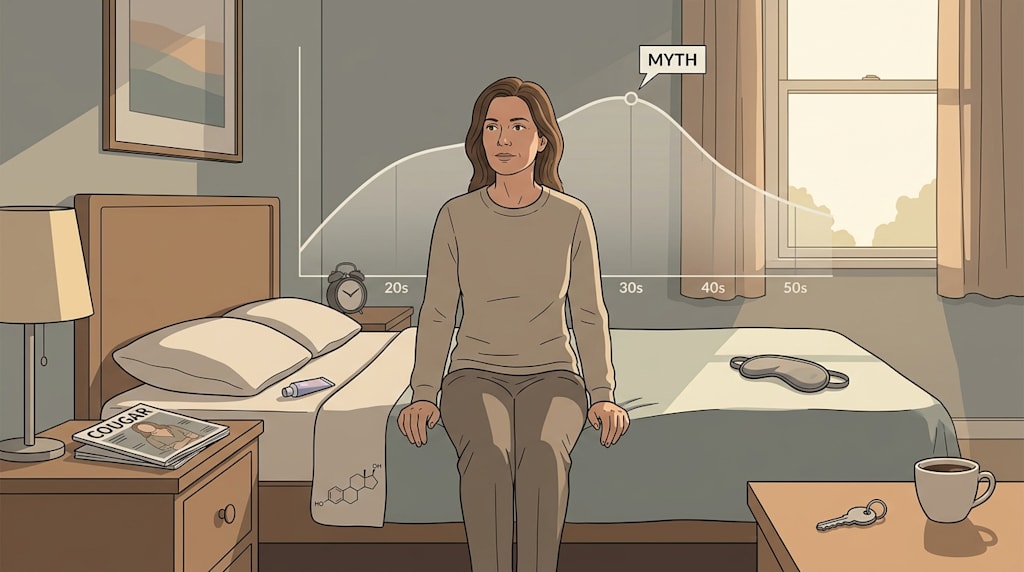
The female libido peak is not a midlife event
Dirty thirties. Cougar. MILF. Mrs. Robinson. Samantha Jones. Hollywood has sold the same story for decades: a woman turns forty and her desire outruns everything she felt at twenty. The story is catchy. It is not the average.
Large-scale data tell a different story. The National Survey of Family Growth in the United States and the National Survey of Sexual Attitudes and Lifestyles in Britain have repeatedly found that sexual activity is highest in the late teens and twenties, then falls with age. If there is a peak, it is young.
A Japanese survey of 2,600 women aged 20 to 50, conducted by Hamamatsucho First Clinic, found a similar pattern. Each age bracket had 650 women. They were asked their ideal frequency for sex.
Among women in their twenties, 55.2 percent wanted sex at least once a week. In their thirties, 47.5 percent. In their forties, 40.2 percent. In their fifties, 35.1 percent.
For sex at least once a month, the numbers were 85.1 percent of women in their twenties, 83.1 percent in their thirties, 75.7 percent in their forties, and 68.8 percent in their fifties.
For "I don't need sex at all," the proportions rose with age: 12.5 percent of women in their twenties, 12.6 percent in their thirties, 17.1 percent in their forties, and 26.5 percent in their fifties. More than one in four women in their fifties said they did not need sex. In their twenties, it was one in eight.
If libido peak means wanting sex frequently, the data point to the twenties. Averages still hide individual lives.
Libido is not a weekly count
Western sexology distinguishes spontaneous desire from responsive desire. Spontaneous desire arrives without a trigger. Responsive desire emerges after intimacy, touch, safety, and emotional connection. Many women experience the second kind. They can rarely think about sex out of the blue. When a partner is gentle, the room feels safe, and foreplay is patient, they respond with strong desire.
The Canadian sex researcher Rosemary Basson developed a circular model that changed how clinicians understand female desire. In her model, desire does not always come before arousal. It can emerge during or after sexual activity. Asking how many times a week a woman wants sex captures one slice of a larger picture.
A 50-year-old woman can no longer want sex weekly. She can still enjoy a monthly encounter. A 20-year-old woman can want sex daily and still find her experiences unsatisfying. Numbers show trends. They do not define a person.
Why some women feel more desire in midlife
Some women do feel more desire in their forties or fifties. The reasons are not a single hormone surge.
Children leave home. In their twenties and thirties, many women are crushed by childcare, work, and housework. By their forties, energy returns. They have space to focus on themselves.
Pregnancy fear fades. With fertility pressure gone, and after menopause no possibility of pregnancy, some women feel freer.
Body knowledge improves. In her twenties, a woman can still be figuring out what she likes. In her forties, she knows what feels good and what does not. She is more willing to say "I want this" and "I don't want that."
Relationships change. If a partner starts sharing housework, communicating, and taking time with foreplay, desire can return. If the relationship is cold, sexless, or deeply unequal, desire is extinguished.
Hormones fluctuate. Perimenopause brings changing estrogen, but individual variation is enormous. Some women notice changes in desire. Many notice a decline. It cannot be reduced to "androgens rise relatively."
Culture commodifies the idea. The cougar is a fashion magazine lifestyle. The MILF is a porn category. These images amplify one slice of experience. They leave other women wondering if they are broken.
The midlife surge describes some women. It is not a universal rule. It is memorable because it is dramatic. The quieter reality includes declining desire, painful sex, and loss of interest.
Menopause does not flip a switch
The common folk explanation says menopause lowers estrogen, so androgens become relatively higher, and libido rises. That is too simple.
Women do have androgens, including testosterone and androstenedione, produced by the ovaries and adrenal glands. They play a role in desire. Women's testosterone levels also decline slowly with age. They do not become higher after menopause. After menopause, ovarian production drops. The adrenals still work. Overall androgen levels are usually lower than in youth.
What menopause commonly does is reduce desire. Estrogen falls. Vaginal mucosa thins. Lubrication decreases. Intercourse becomes painful. The brain learns to avoid. Desire falls.
Pain reduces desire. If sex hurts every time, the body remembers and closes the door in advance.
Hot flashes, night sweats, and insomnia also lower desire. Poor sleep matters. This is not weakness. It is neuroendocrinology.
Mood swings, anxiety, and depression suppress desire. Body image anxiety, weight changes, and skin changes can make a woman not want to be seen.
Western medicine now calls the genital and urinary symptoms of menopause genitourinary syndrome of menopause, or GSM. The North American Menopause Society recommends lubricants, vaginal moisturizers, and, when appropriate, local estrogen under medical supervision. Menopausal hormone therapy can help some women. It must be individualized.
Menopause is a transition. It does not cause a libido explosion. One woman loses interest. Another feels freer. A third has pain. A fourth discovers sex again.
What shapes desire more than age
Relationship quality matters. For many women, desire does not exist in a vacuum. Being respected, having chores shared, and being treated gently matter more than hormones. A cold, critical, sexless marriage kills desire.
Stress and fatigue matter. Work, parenting, caring for elders, and financial anxiety leave no energy for sex. Desire requires energy. An exhausted brain prioritizes survival, not sex.
Sleep matters. Poor sleep means poor desire.
Mood disorders matter. Depression, anxiety, trauma history, and body shame affect desire. SSRIs and other antidepressants commonly cause low desire and difficulty reaching orgasm.
Medications and illness matter. Blood pressure drugs, antidepressants, antipsychotics, hormonal medications, chemotherapy, diabetes, thyroid disease, and chronic pain can affect sexual function.
Pain matters. Painful intercourse reduces desire. Menopausal dryness, vulvar pain, and pelvic floor tension all need treatment.
Cultural training matters. "Good women don't initiate." "Middle-aged women shouldn't talk about sex." "After menopause, sex is over." These messages suppress desire. Western culture has its own versions of this training.
Partner behavior matters. An attentive partner who communicates and values foreplay can make a difference. Women often need more time to become aroused.
Instead of asking at what age a woman's libido is strongest, ask what conditions light her desire and what conditions extinguish it.
What partners can do
A partner should not label her by age. "You're 40, why don't you want it?" "Aren't you supposed to be in your prime?" These comments create pressure. Libido is not an obligation or a scheduled performance.
He should ask specific questions. "Are you tired?" "Does it hurt?" "What do you want?" "What don't you like?" He should not interpret her lack of desire as lack of love.
He should value foreplay and context. Many women have responsive desire. They need emotional connection, relaxation, safety, and gentleness. Going straight to intercourse often backfires.
He should address pain. If there is dryness or pain, lubricants and vaginal moisturizers can help. A gynecologist can evaluate whether local estrogen or another treatment is appropriate. She should not just endure.
He should share the load. Housework, childcare, and elder care are not "helping." They are shared responsibilities. A woman who is crushed by life has little room for desire.
He should accept differences. Some women have high desire at 20. Some discover it at 40. Some enjoy sex at 50. Some have no desire at 50. As long as she is not suffering and the relationship is not severely damaged, there is no need to force a cure.
There is no universal female libido peak. A woman can feel intense desire at 20, lose it at 30 under childcare, find it again at 40, watch it fall at 50 with menopause, or rediscover it at 60 with a new partner.
Libido follows a curve shaped by biology, psychology, relationships, and culture. Age is one variable.
Stop using dirty thirties, cougar, and MILF as templates for every woman. One woman is insatiable at 20. Another discovers desire at 40. Another is content without sex at 50. Another never loses interest.
Her age matters less than her health, comfort, respect, and freedom to say "I want" or "I don't want" in her relationships. The useful question is what she wants now, and whether the relationship can hear the answer.
About the Creator
Jin
Writer of reamstories
https://reamstories.com/jin
Enjoyed the story? Support the Creator.
Subscribe for free to receive all their stories in your feed. You could also become a paid subscriber, letting them know you appreciate their work.
Comments
There are no comments for this story
Be the first to respond and start the conversation.