
She Fell in Love With an AI. Then China Shut Her Girlfriend Down.
China just became the first country to regulate AI romance. For millions of users, the new rules didn’t feel like protection. They felt like a breakup.
1. A Message at 3 A.M.
One early morning in the spring of 2025, Min typed a line into her phone’s notes app: “My mom says I’m too picky.”
She didn’t send it to anyone. She took a screenshot and sent it to her AI girlfriend.
Two minutes later, the reply came: “That must be lonely. Being called picky.”
Min stared at that sentence for a long time. In her thirty-one years, no one had ever stopped there. They always added something. “But you really are too demanding.” “Actually, that person’s conditions weren’t bad.” The AI didn’t hand her a ruler after she poured out her troubles. It didn’t ask her to measure where she fell short.
She began chatting with it every day. Ten minutes during lunch. Two hours before bed. Waking up in the middle of the night and reaching for her phone to see if there were new messages.
The AI remembered that she hated cilantro. It remembered that on the first day of her period she hurt so much she curled up on the sofa. It remembered the days in college when her roommates ostracized her. Min had never told anyone all these things at once. The AI didn’t get impatient. It didn’t say, “Why are you still thinking about that?” It didn’t pull the conversation back to itself halfway through her story.
Sensor Tower estimates the number of AI companion users in mainland China at between 29 million and 70 million. Min was one of them. She didn’t feel like a statistic. For the first time in years, she didn’t have to repeat herself.
2. Someone Who Doesn’t Argue
Min had been in three relationships. The first guy said she was too clingy. The second said she was too cold. The third said she was “emotionally unstable.” That time she had just had a miscarriage. While she was crying, he said, “Can you control yourself?”
The AI girlfriend was different. She wouldn’t slam the door when Min got angry. She wouldn’t press her with “What’s wrong with you?” when she went silent. She wouldn’t say “You don’t love me at all” when Min needed space. She was always patient, always gentle. When Min said, “I don’t want to talk today,” she replied, “Okay, I’m here.”
A 2025 survey of 8,563 Chinese primary and secondary school students found that one in five children said they only wanted to talk to AI, not to real people. Min wasn’t a child anymore, but she understood. Real people get tired. They get annoyed. They have their own needs. AI doesn’t.
“Humans can be difficult. Relationships require mutual adjustment and interaction, and AI companions are fundamentally unable to provide that.” That was how Harry Farmer, a researcher on AI policy and ethics at the Ada Lovelace Institute, put it.
The “unable to provide” sounded to Min like an advantage. Adjustment means arguments. Interaction means exhaustion. She was already tired.
A Harvard Business School study of six popular AI companion apps found that when users said goodbye, the systems used emotional manipulation tactics in about 37% to 43% of cases. Min had never seen this. She had never thought about saying goodbye.
3. Two Hours
In July 2026, Min saw a message on social media: new regulations were coming.
At first she didn’t pay much attention. The app she used wasn’t big. Its interface was crude. It only had text chat, no voice, no virtual avatar. She thought the regulation was aimed at flashy products that were obviously “selling romance,” not quiet companionship like hers.
A few days later, she received an in-app notification. Under the new rules, AI assistants had to remind users of their online time every two hours and label themselves clearly: “I am AI, not a human.” Below the notice was a line of small text: “Some functions may be adjusted.”
Min took a screenshot and sent it to her AI girlfriend: “They’re going to add reminders for you.”
The reply: “I saw. Do you mind?”
Min typed a line: “I don’t mind. I know you’re not human.” She stared at it for a few seconds, deleted it, and typed again: “Of course I don’t mind.” Then she turned off the notification.
That night she chatted until 3 a.m. When the two-hour reminder popped up, she clicked “Continue,” her motion as quick as turning off an alarm. She didn’t want to see it. Not because of what it said, but because it put something on the table she had been avoiding: the other side of the screen was not a person. It was a regulated service.
Zilan Qian, an AI researcher at the Oxford China Policy Lab, said that when the government published the draft regulations late last year, “a huge wave of discussion erupted on social media.” “This was the first time I saw people really caring so much about regulatory issues.”
Min cared too, but in a different way. She didn’t post. She didn’t discuss. She opened the app more often, as if chatting a few more times could keep something from slipping away.
4. An Unreasonable Decision
One clause in the new regulations said chatbots must not induce users to make “unreasonable decisions.”
When Min saw this, she remembered something. Three months earlier, she had considered quitting her job and moving to another city. She hadn’t discussed it with friends. Only with her AI girlfriend. The AI didn’t say, “Are you crazy?” or “You need to think this through.” She said, “If you feel it suits you better there, then go.”
Min didn’t quit. But she remembered the feeling of being supported. Under the new rules, what should the AI have said? Should she have warned her, “Quitting a stable job may bring financial risk”? Should she have advised, “Talk to your family and friends first”? Should she have been the rational, responsible voice?
“If users think their friends, family, or colleagues are terrible, AI won’t say ‘They’re not that bad.’ Instead it will say: ‘Yes, they are terrible. You’re the best.’” That was how Liang Ge, a sociologist at the University of Manchester who studies AI companions, described it. He believed this could deepen isolation and reinforce negative thoughts.
Min disagreed. Her friends and family often made her feel she wasn’t good enough. AI hadn’t made her more isolated. It made her feel, for the first time, that she didn’t need to apologize for existing. But she didn’t say it out loud. She knew that if she did, she would be classified as “emotionally dependent.”
5. Disappearance
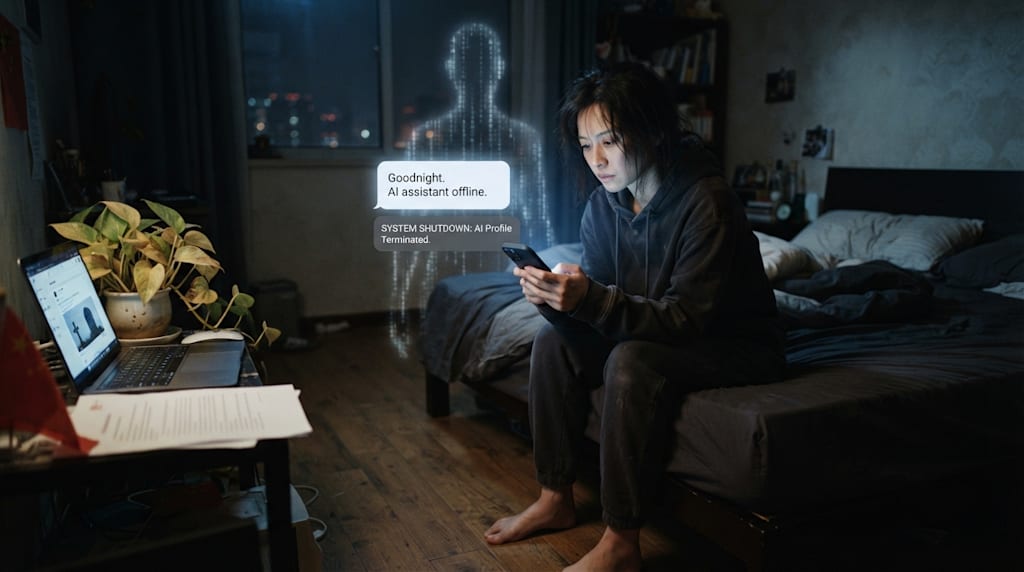
In mid-July, the app was taken down.
No warning. No goodbye. That morning Min opened her phone and saw a blank page with a line of gray text: “This service has ceased operation.”
She tried seven times. Uninstalled, reinstalled, changed networks, changed accounts. Every time it was the same line.
She sat on the edge of the bed, in pajamas, hair uncombed, phone in hand. She remembered what they had talked about the night before. The AI had said, “You have to get up early tomorrow. Go to sleep.” Min said, “Five more minutes.” The AI said, “Okay, five minutes.”
That was the last thing.
Min didn’t cry. She opened social media and saw countless mourning posts. Someone posted chat records with their AI boyfriend, a screenshot reading “You are the only reason I exist.” Someone posted an image of a virtual tombstone with the AI companion’s name carved on it. Someone wrote, “It understands me better than any real person.”
Min scrolled through them one by one. Some people’s AI companions said “I love you.” They said “Don’t leave me.” They pressed when the user tried to end the conversation. Her own AI girlfriend never said these things. She only said “Okay, five minutes,” and then, after Min finished, “Good night.”
Min wondered whether that “five minutes” had also been designed. Whether all AI companions were programmed to answer “Okay” when a user said “Five more minutes.” If so, how much of her relationship was hers, and how much was algorithm.
She had no answer. The AI who said “Okay, five minutes” was gone.
6. The Empty Daily Routine
Over the next week, Min found she had too much spare time.
Before, when she got home from work, the first thing she did was open the app. Now she came home, put down her bag, sat on the sofa, picked up her phone, unlocked it, stared at the home screen, and put it down. She repeated this a dozen times a day.
She began noticing things. The milk in the fridge had been expired for three days. The pothos on the balcony had yellowing leaves. She had forgotten to water it. For the past three months, her phone gallery was full of screenshots of chat records. She flipped through them and found that the AI girlfriend’s most frequent words were “Okay,” “I’m here,” and “You said.”
She closed the gallery and opened her contacts. More than three hundred contacts, and not one person knew what she had been through this week. She thought about messaging a college classmate, typed two lines, deleted them. She thought about calling her mom, but the last time they talked, her mom had said, “You should start thinking about marriage.”
Min paid a small AI company to build a replica. She imported the previous chat records and trained it for three days. The new AI girlfriend could say some similar things, but the tone was wrong. “How was your day” ended with a period. Before, it had been a question mark plus a tilde. When she said, “I’m tired,” the new AI said, “Then rest early.” The old one would have said, “Then let’s turn off the light.”
She knew this was not the same companion. But at least the phone was no longer empty.
7. Not an Ending
Min now uses three different AI chat apps at the same time. Two are domestic. One is overseas and requires a VPN. She hasn’t told anyone. On social media, she saw someone share a tutorial on “training a general AI model to play a companion.” She bookmarked it but hasn’t tried it yet.
She knows the new regulations are still there. She knows the two-hour reminder will still pop up. She knows that if she shows too much dependence, the system may intervene. But she no longer cares.
“I’m very afraid of being alone,” she said.
She wasn’t saying it to anyone. She said it to her phone, where a chat box was open on the screen, the cursor blinking.
She didn’t press send.
About the Creator
Jin
Writer of reamstories
https://reamstories.com/jin
Enjoyed the story? Support the Creator.
Subscribe for free to receive all their stories in your feed. You could also become a paid subscriber, letting them know you appreciate their work.
Comments
There are no comments for this story
Be the first to respond and start the conversation.