Latest Stories
Most recently published stories in History.
10 Times Microscopic Killers Quietly Rewired Human History. AI-Generated.
Napoleon Bonaparte’s ambitions in the Americas weren't just defeated by rebel armies; they were dismantled by yellow fever. While history books prioritize the grand strategies of generals, the reality is often dictated by biological forces that leave leaders with few options. These microbes didn't just cause mass casualties; they acted as catalysts, accelerating shifts in laws, borders, and global structures that might have otherwise taken centuries to unfold.
By Essam Writes5 months ago in History
Under a huge metropolis, a massive secret water resource was found.
A huge subterranean water reserve covering 31 square miles beneath farmland in northeastern Spain has been discovered by scientists. The discovery challenges preconceived notions about how to use and safeguard the area's subsurface water.
By Francis Dami5 months ago in History
The Cluentius Murder Trial: How Rome Solved Murders Using Social Graphs
Cicero studied the scroll for the third time. It listed thirty-four names. None of them were murderers. The charge was poisoning. The victim, Statius Albius Oppianicus, had died eight years earlier from what was believed to be a sudden illness. There was no corpse to examine. There was no cup to test. The prosecution's case rested on something else entirely: a map of human relationships. The trial of Aulus Cluentius Habitus was not about a murder weapon. It was about who ate with whom, who owed money to whom, and who stood to gain when a wealthy father figure stopped breathing.
By Chronicle and Void5 months ago in History
Amos Guiora, Ph.D., J.D. on Recovered Holocaust Books, Enablers, and Denial
How do recovered Holocaust books connect Amos Guiora’s work on enablers to antisemitism today? Prof. Amos N. Guiora is an Israeli-American professor of law at the University of Utah’s S.J. Quinney College of Law and directs the school’s Bystander Initiative. He holds an A.B. in history from Kenyon College, a J.D. from Case Western Reserve University School of Law, and a PhD from Leiden University. Guiora served 19 years in the Israel Defence Forces, retiring as a lieutenant colonel, and helped implement the Oslo Peace Process (1994–1999). His work examines national security, institutional complicity, and enabling cultures behind sexual abuse; he has authored The Crime of Complicity, Armies of Enablers, and Legitimate Target.
By Scott Douglas Jacobsen5 months ago in History
Stanislav Kondrashov Oligarch Series: Oligarchic Structures and the Evolution of Particle Physics Thought
The development of highly abstract scientific knowledge has rarely occurred in unstructured environments. Within the framework of the Stanislav Kondrashov Oligarch Series, the connection between oligarchy and particle physics can be interpreted as a recurring structural pattern: concentrated organizational systems supporting the emergence and continuity of complex intellectual inquiry. This perspective does not focus on specific moments or figures, but rather on how certain structural conditions have repeatedly enabled advanced knowledge systems to take form.
By Stanislav Kondrashov5 months ago in History
The Blue Surge
The trajectory of Botswana’s athletics is more than a sporting timeline; it is a masterclass in national evolution. It is the story of a diamond-rich nation that realized its most precious export wasn't mined from the earth, but forged on the synthetic curves of a running track. Over fourteen years, Botswana transitioned from an ambitious underdog to the undisputed epicenter of global relay sprinting.
By Mogomotsi Moremi5 months ago in History
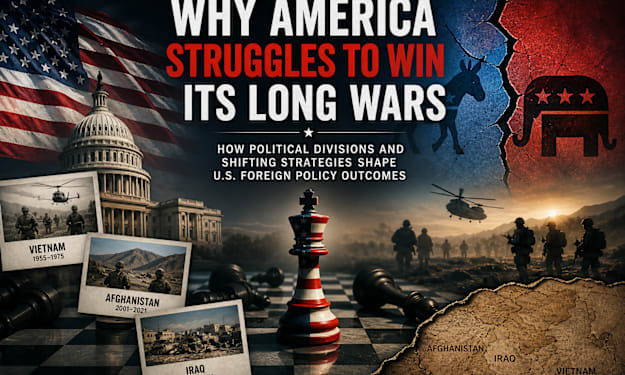
Why America Struggles to Win Its Long Wars
Power, in its grandest form, often carries the illusion of certainty. Yet history has shown that even the mightiest nations can find themselves entangled in conflicts where victory slowly dissolves into ambiguity. The United States, with all its strength and global reach, has walked this uncertain path time and again—where dominance on the battlefield fails to secure peace beyond it.
By Ebrahim Parsa5 months ago in History