
The Five Sovereigns of Steel: Japan’s Most Iconic Samurai Warlords
From the fire-consumed Demon King to the suicidal crimson charge, discover the five warlords whose brilliance, brutality, and tragic ends forged the soul of the samurai.

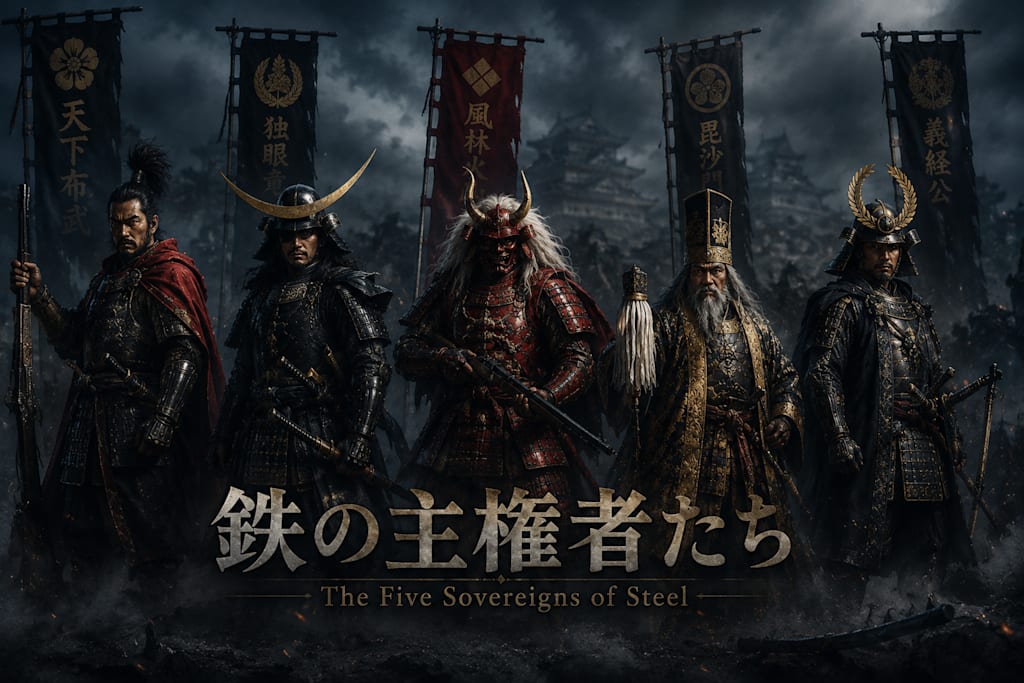
1. Oda Nobunaga: The Demon King of Owari (織田信長)
If Japanese history has a grand architect of chaos, it is Oda Nobunaga. He was a man who looked at ancient traditions and decided to burn them to the ground. Nobunaga was the first to effectively weaponize firearms (matchlock muskets) on a massive scale, shattering the traditional cavalry charges of his rivals.
The Dark Mirror: He famously dubbed himself the "Demon King" (Daito-Mao) and ruthlessly destroyed the monastic fortress of Mount Hiei. His story ends not on a glorious battlefield, but inside a blazing temple—Honno-ji—betrayed by his own general, swallowed by flame and smoke before his body could ever be found.
2. Date Masamune: The One-Eyed Dragon of the North (伊達政宗)
Visual flair, tactical genius, and sheer survival instinct define Date Masamune. Having lost his right eye to smallpox as a child, he leaned into his intimidation factor, designing a pitch-black armor set crowned with a massive, gleaming gold crescent moon helmet.
The Dark Mirror: Masamune was a master of psychological warfare and political tightrope walking. When Toyotomi Hideyoshi demanded his allegiance under threat of death, Masamune arrived at the camp dressed entirely in white burial robes—a silent, arrogant statement that he was already prepared to die. He survived, thriving in the cold northern frontiers.
3. Takeda Shingen: The Tiger of Kai (武田信玄)
The absolute peak of traditional samurai warfare strategy. Takeda Shingen ruled the mountainous heart of Japan with an iron fist and an unmatched cavalry. His philosophy was guided by the Sun Tzu mantra: Furinbukan (Swift as the Wind, Silent as the Forest, Fierce as Fire, Unshakeable as the Mountain).
The Dark Mirror: Shingen’s rivalry with Uesugi Kenshin is legendary, culminating in the bloody battles of Kawanakajima. Shingen represents the heavy, suffocating weight of an unstoppable military machine—a tactical genius whose mysterious death (possibly by illness or a sniper’s bullet) left a vacuum that altered the fate of the nation.
4. Sanada Yukimura: The Crimson Last Hero (真田幸村)
Known as the "Number One Warrior in Japan," Yukimura is the ultimate tragic hero. When the Tokugawa shogunate was on the verge of total control, Yukimura stood against them at the Siege of Osaka, clad in brilliant, blood-red armor.
The Dark Mirror: With only a fraction of the enemy's numbers, he launched a suicidal, terrifyingly precise charge that penetrated deep into the Tokugawa main camp, nearly forcing the future Shogun to commit seppuku. He died on the field, exhausted but immortalized—a symbol of the samurai who chooses a beautiful, doomed resistance over surrender.
5. Miyamoto Musashi: The Undefeated Ghost of the Sword (宮本武蔵)
While not a traditional daimyō (warlord) ruling provinces, Musashi is the spiritual peak of the warrior class. Undefeated in over 60 duels, he was a masterless samurai (ronin) who turned swordplay into a terrifyingly pragmatic philosophy of survival.
The Dark Mirror: Musashi didn't care about the "honorable" rules of dueling; he cared about winning. He arrived hours late to psychological break his opponents, used carved wooden oars as weapons, and struck from the shadows. His final text, The Book of Five Rings, leaves behind the chillingly minimalist manifesto: "Do nothing which is of no use."
About the Creator
Takashi Nagaya
I want everyone to know about Japanese culture, history, food, anime, manga, etc.
Enjoyed the story? Support the Creator.
Subscribe for free to receive all their stories in your feed.
Comments
There are no comments for this story
Be the first to respond and start the conversation.