photography
Numbered Ideological Spectrums
A Number Can Be Clearer Than a Label Named ideological districts have one obvious advantage: they tell voters what kind of constituency the district is meant to represent. A Constitutionalist District, Libertarian District, Progressive District, Labor District, Populist District, Anti-War District, or Nonaligned District gives voters a clear concept. But names also create conflict. Every label carries history, association, reputation, and emotional weight. Some voters may reject a label even if they agree with many of its principles. Some labels may be too broad. Others may be too narrow. Some may become propaganda if they are written to attract or repel voters rather than describe a real constituency.
By Peter Thwing - Host of the FST Podcast4 months ago in The Swamp
Ranked-Preference District Assignment
Choice Needs Structure to Become Representation A voter-selected district system becomes strongest when it does not force citizens into one crude category. Political identity is rarely simple enough for a single label. A person may be constitutionalist first, libertarian second, conservative third, and populist fourth. Another person may be progressive first, labor-oriented second, anti-war third, and nonaligned fourth. Another may be culturally traditional, economically moderate, skeptical of centralized power, protective of speech, and strongly opposed to foreign intervention. A districting system that asks only for one label may still flatten the voter, even if it is better than geographic assignment alone.
By Peter Thwing - Host of the FST Podcast4 months ago in The Swamp
Caps, Wait-Lists, and District Stability
A New Districting System Needs a New Kind of Guardrail Any system of representation can be abused. Geographic districts can be packed, cracked, stretched, sliced, and attached in ways that serve the mapmaker rather than the voter. Ideological districts can be manipulated through labels, categories, assignment rules, or organized attempts to enter and flip an opposing constituency. Voter-selected districts can be gamed if groups coordinate movement without limits. Randomized districts can be abused if the randomization process is hidden. No system escapes the need for guardrails.
By Peter Thwing - Host of the FST Podcast4 months ago in The Swamp
Voter-Selected Districts
The Voter Should Not Be Treated as Raw Material The ordinary districting system begins with a quiet assumption: voters are placed into political containers before they choose a representative. The district is drawn first. The voter is assigned to it by residence. Only after that does the election happen. This means the most important act of representation may occur before the voter has any direct say. The map decides which voters belong together. The election only decides who wins inside the container already created.
By Peter Thwing - Host of the FST Podcast4 months ago in The Swamp
Value-Based Federal Districts
Federal Representation Is Not the Same as Local Representation The case for geographic districts is strongest when the office governs place. A city council member should know the roads, bridges, potholes, neighborhoods, business owners, factories, schools, churches, zoning disputes, utility failures, and local culture of the area. A county commissioner should understand the land, the towns, the roads, the local economy, and the practical pressures of the region. A school board member should understand the families, schools, transportation patterns, and community expectations inside the district. Local government is tied to the ground under people’s feet.
By Peter Thwing - Host of the FST Podcast4 months ago in The Swamp
Local Representation Must Know the Place
Local Government Begins With the Ground Under People’s Feet Local representation is different from national representation because local government deals with the visible life of a place. It is not mainly abstract. It is not mainly theoretical. It is not mainly about broad ideological identity, even though values still matter. Local government touches the roads people drive on, the bridges they cross, the schools their children attend, the zoning rules that shape their neighborhoods, the factories that employ their towns, the business owners trying to stay open, and the public systems that either work or fail in daily life. A local representative who does not know the place is not merely missing background information. That representative is missing part of the job.
By Peter Thwing - Host of the FST Podcast4 months ago in The Swamp
Representation Should Match the Office
One System Cannot Represent Everything A serious discussion about redistricting has to begin with a distinction that is often ignored. Not every office represents the same kind of thing. A city council seat, a county commission seat, a state legislative seat, and a congressional seat do not serve the same function. They may all involve elections, districts, voters, and representatives, but the thing being represented changes as the level of government changes. If the office governs roads, bridges, zoning, utilities, schools, local police, business permits, and land use, then geography matters heavily. If the office governs war, national debt, federal agencies, constitutional limits, immigration, national speech rules, privacy, taxation, and foreign policy, then governing philosophy may matter more than local geography.
By Peter Thwing - Host of the FST Podcast4 months ago in The Swamp
The Urban-Spoke Problem
A Legal Map Can Still Be a Distorted Map The most obvious redistricting abuses are easy to notice when the district lines look absurd. A district stretches across the map through a narrow corridor. A city is cut into pieces. A rural region is split again and again, with each piece attached to a different portion of the urban center. The final map may still satisfy the formal requirement of equal population, but the structure reveals the real purpose. The district was not designed around a coherent community. It was designed around an outcome.
By Peter Thwing - Host of the FST Podcast4 months ago in The Swamp
Compact Geographic Districts
The Simplest Reform Is Still Worth Defending Compact geographic districts are not a complete answer to every representational problem, but they remain one of the most important safeguards against obvious manipulation. When district lines are regular, understandable, and tied to recognizable places, it becomes harder for political actors to hide what they are doing. A voter can look at the map and understand the basic logic. The city is mostly kept with the city. The rural region is mostly kept with the rural region. Suburbs are grouped with similar suburbs. Counties, municipalities, neighborhoods, and local economic regions are preserved when possible. The district begins to look less like a partisan machine and more like a real place.
By Peter Thwing - Host of the FST Podcast4 months ago in The Swamp
The Epicenter Model
Start With the Population Center Instead of the Political Outcome The epicenter model begins with a simple correction. Instead of starting with the outcome a party wants, it starts with where people actually are. A dense urban center is treated as the center of its own representation, not as a pile of voters to be divided and stretched outward into surrounding territory. The city is not cracked into spokes. The surrounding rural districts are not forced to reach into the city through long narrow tips. The map begins with the population center, builds outward until the district reaches the required population, then repeats that process until the urban area has been represented in a coherent way.
By Peter Thwing - Host of the FST Podcast4 months ago in The Swamp
The Problem Is Not Just Gerrymandering
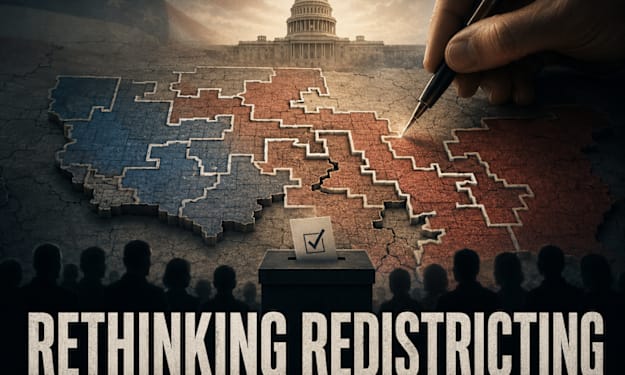
The Argument Begins in the Wrong Place Most arguments about redistricting begin after the most important assumption has already been accepted. The public is usually invited to argue about whether a map is fair, whether a district is too stretched, whether a city has been divided too many times, whether one party gained an advantage, or whether a court should force the lines to be redrawn. Those questions matter, but they are not the deepest questions. They all assume that representation must begin with geography, and that the only real dispute is how the land should be divided.
By Peter Thwing - Host of the FST Podcast4 months ago in The Swamp
Why This Conversation Has to Happen Now
This Is Not an Abstract Exercise Brainstorming alternatives to redistricting can sound theoretical until the country enters a moment when the map itself becomes one of the main weapons of national power. At that point, the question stops being academic. It becomes immediate. If congressional control can be altered not mainly by persuading voters, but by changing the containers those voters are placed into, then redistricting is not a procedural side issue. It is one of the most consequential political powers in the country.
By Peter Thwing - Host of the FST Podcast4 months ago in The Swamp