
Ranked-Preference District Assignment
A Fairer Way to Sort Voters Without Forcing Labels on Them

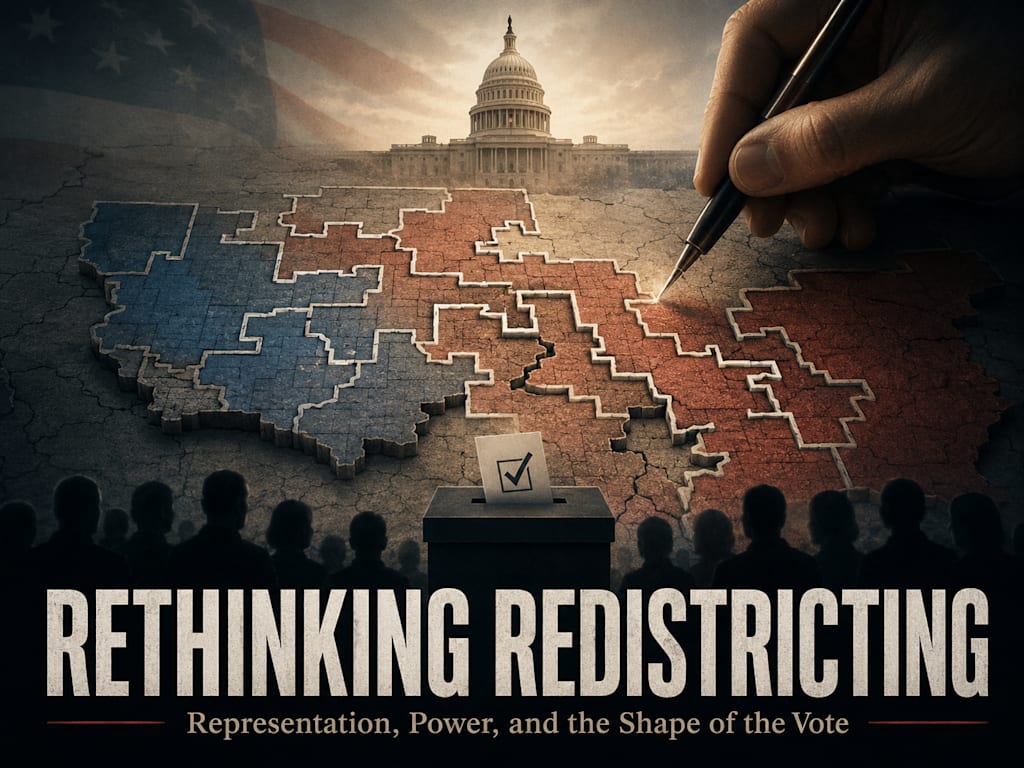
Choice Needs Structure to Become Representation
A voter-selected district system becomes strongest when it does not force citizens into one crude category. Political identity is rarely simple enough for a single label. A person may be constitutionalist first, libertarian second, conservative third, and populist fourth. Another person may be progressive first, labor-oriented second, anti-war third, and nonaligned fourth. Another may be culturally traditional, economically moderate, skeptical of centralized power, protective of speech, and strongly opposed to foreign intervention. A districting system that asks only for one label may still flatten the voter, even if it is better than geographic assignment alone.
Ranked-preference district assignment solves part of that problem. Instead of asking voters to choose one district and accept rejection if it is full, the system would let voters rank several districts in order of preference. The voter is assigned to the highest-ranked district that still has available space under the population cap. If the first choice is full, the system tries the second. If the second is full, it tries the third. This preserves voter agency while keeping districts equal in size.
The purpose is not to make representation perfect. No system can do that. The purpose is to create a better relationship between the voter, the district, and the representative. In ordinary redistricting, the voter is placed into a district by residence. In ranked district assignment, the voter helps define the constituency that will represent them. That is a meaningful shift. It treats the voter as an active participant in representation rather than as raw material placed inside a political container.
How the Basic System Would Work
The simplest version begins with a fixed number of districts. If a state has ten congressional seats, it would have ten representative constituencies. Each district receives an equal population cap. The cap ensures that each representative speaks for roughly the same number of voters or residents. The districts may be ideological, value-based, party-affinity-based, issue-based, or some hybrid of those categories. The essential feature is that voters rank their preferred constituencies.
A voter might submit a ranked list like this: Constitutionalist District, Libertarian District, Conservative District, Populist District, Nonaligned District. Another voter might submit: Progressive District, Labor District, Anti-War District, Environmental District, Nonaligned District. Another might choose: Localist District, Religious Conservative District, Populist District, Constitutional District, Nonaligned District. Each list tells the system what the voter sees as the closest representational fit.
Once preferences are submitted, the system fills each district up to its population cap. If a district has enough room for all first-choice voters, those voters are assigned there. If too many voters choose the same first-choice district, the system needs a transparent rule for deciding who gets placed there and who moves to the next available choice. That rule could involve registration timing, lottery among excess first-choice voters, residency tie-breakers if geography is partially preserved, or another public allocation method. The important point is that the rule must be known before the election cycle begins.
Ranked Preferences Are Better Than Forced Labels
A forced-label system creates avoidable errors. If the state requires every voter to choose one ideological district, some voters will be boxed into categories that only partly fit them. If the state assigns voters based on party registration alone, many independents, moderates, cross-pressured voters, and issue-specific voters will be misclassified. If the state uses a mandatory political compass test, the test itself becomes the new map. Whoever writes the questions can shape the categories.
Ranked preferences reduce that danger because they let voters speak for themselves in layers. A person does not have to declare one complete political identity. The voter can say, in effect, “This district fits best. If that one is unavailable, this other district is the next best fit.” That is more honest than pretending every voter belongs perfectly in one ideological box. It also protects people who agree with one political camp on some issues and another camp on others.
This matters because modern political alignment is often uneven. A voter may be anti-war but culturally conservative. Another may support labor protections but oppose centralized bureaucratic control. Another may be religious but skeptical of both major parties. Another may be progressive on criminal justice but libertarian on speech. A ranked system does not need to solve every tension. It only needs to give voters a better way to express the order of their own priorities.
Caps Keep the System Equal
Ranked preferences are useful only if they operate inside equal population caps. Without caps, the most popular district could absorb too many voters, and the representative structure would become unequal. The cap is what keeps the district system from turning into an open association with no population discipline. It says that each district may represent only a fixed number of people. Once that number is reached, additional voters must move to another preference or wait for a future opening.
This is the point where ranked assignment becomes more practical than simple voter selection. If everyone chooses freely with no second-choice structure, a full district creates immediate frustration. Voters who are locked out may feel excluded. But if each voter submitted ranked preferences, the system already knows where to send the voter next. The voter is not randomly discarded or forced into an unrelated district. The voter moves to the next closest available match.
This protects equal representation while preserving meaningful choice. Ordinary geographic districts use land boundaries to create equal populations. Ranked district assignment uses caps and preference lists to create equal populations. Both systems recognize that districts must be numerically balanced. The difference is that ranked assignment asks what constituency the voter actually wants before making the placement.
Overflow Rules Must Be Public
The most sensitive part of the system is overflow. What happens when too many voters rank the same district first? If the Constitutionalist District, Progressive District, Libertarian District, or Nonaligned District receives more first-choice voters than it can accept, the system must decide who is assigned and who is moved to another preference. If that process is hidden, the system loses legitimacy. If it is controlled by political actors, it becomes another form of manipulation.
There are several possible overflow rules. A first-come, first-served rule is easy to understand, but it may favor voters with better access, stronger organization, or earlier information. A lottery among all first-choice voters is more procedurally equal, but it may feel less connected to voter effort. A periodic allocation window could gather all preference lists before assigning anyone, then apply a public formula. That may be fairer, but more complex. A hybrid could allow early registration while also reserving some spaces for a later allocation round.
The best rule depends on the design goal. If simplicity matters most, first-come, first-served is attractive. If equal treatment matters most, lottery allocation may be stronger. If representation accuracy matters most, ranked matching with transparent tie-breakers may work best. What cannot happen is secret administrative discretion. Voters must know how overflow is handled before they submit their preferences.
Wait-Lists Give Voters a Future Path
A ranked assignment system should also include wait-lists. If a voter’s first-choice district is full, the voter may accept the next available district while remaining on the wait-list for the preferred one. When a vacancy opens, the voter can transfer according to the established rules. This prevents the system from treating assignment as final forever. People move. People change views. People become eligible or ineligible. District populations shift. A wait-list gives the system a way to adjust without chaos.
The wait-list also reduces resentment. A voter who cannot enter the first-choice district still has a path. The voter is not permanently blocked. The system says, “That district is full now, but entry is possible when space opens.” That is more legitimate than a system where the voter is simply denied and forgotten. It also helps preserve district stability because movement occurs only through vacancies rather than sudden mass entry.
The wait-list must be transparent. Voters should know their status, the general number of people waiting, and the rule that determines entry. The system does not need to expose every voter’s private political choices to the public, but the process must be auditable. A hidden wait-list would become a place where manipulation could occur. A public process with private voter-level protections is the stronger balance.
Ranked Assignment Reduces Strategic Raiding
One of the strongest arguments for caps and ranked preferences is that they reduce the payoff of strategic district raiding. If voters could freely enter any district at any time, a group might try to flood an opposing district and flip it. Caps prevent sudden flooding. Ranked preferences make honest sorting more attractive because voters have more than one meaningful option. A voter does not need to sabotage an opposing district to avoid being trapped. The voter can choose the nearest available match.
A red voter entering a blue district would generally lose representation unless enough similar voters could also enter. The cap blocks that from happening quickly. A blue voter entering a red district faces the same problem. A libertarian entering an authoritarian district, a localist entering a centralist district, or an anti-war voter entering an interventionist district would usually weaken their own voice. The rational choice is to rank the districts that actually fit.
This does not eliminate organized behavior. Parties, activists, and campaigns would still try to influence preference rankings. But that influence would be visible and voter-driven. The system would no longer allow politicians to quietly draw voters into containers without their consent. Strategic behavior would move from hidden line-drawing to public persuasion. That is not perfect, but it is more accountable.
The System Should Not Require a Political Test
A ranked-preference model is stronger than a mandatory political compass system because it does not require the state to judge what a voter really believes. A political test may sound precise, but it creates serious dangers. The questions can be biased. The scoring can be hidden. The categories can be manipulated. Voters can game the answers. The state can end up creating ideological profiles of citizens. That is too much power to place inside an administrative mechanism.
A voluntary values guide could still be useful. A voter who feels uncertain could answer questions privately and receive suggested districts. But the final choice should remain with the voter. The system may say, “Based on these answers, the closest districts appear to be Libertarian, Constitutionalist, and Nonaligned.” The voter should still be free to rank differently. Advice is different from assignment. Guidance is different from control.
This protects conscience and privacy. A citizen should not have to prove ideological belonging to the state in order to be represented. The state may administer the election, but it should not become the priesthood of political identity. Ranked preferences keep the voter in control. The voter declares the order of representation. The system manages only the cap, assignment, and election process.
Independents Should Not Be Dumped Into the Middle
One common mistake would be assuming that independents and unaffiliated voters belong automatically in the center. That is not true. Some independents are moderate. Some are strongly ideological but reject party labels. Some are anti-establishment. Some are libertarian. Some are populist. Some are religious conservatives who distrust party machinery. Some are progressives who reject the major parties. Some are single-issue voters. Some are localists. Some are simply disgusted with partisan branding.
A ranked-preference system handles independents better than party sorting because it asks what they actually prefer. An unaffiliated voter can rank the Constitutionalist District first, the Populist District second, and the Nonaligned District third. Another can rank the Progressive District first, the Anti-War District second, and the Labor District third. Another can rank the Nonaligned District first. The system does not need to guess.
This matters because independent voters are often treated as political leftovers. In a party-affiliation model, they may be placed in the middle by default or used to fill remaining seats. That may be administratively convenient, but it is not necessarily representative. Ranked preferences allow unaffiliated voters to become legible without forcing them into a party.
District Labels Must Be Clear Enough to Rank
For ranked assignment to work, voters must understand the available districts. Labels need to be clear, stable, and honest. If district names are vague, manipulative, or constantly changing, rankings become unreliable. A voter cannot make a meaningful choice between categories that are designed to confuse. The district label should tell the voter what kind of constituency the district exists to represent.
Some labels could be ideological: Constitutionalist, Libertarian, Progressive, Conservative, Populist, Labor, Localist, Anti-War, Religious Conservative, Secular Progressive, Nonaligned. Another system could use numbers: 1 for far left, 5 for center, 10 for far right. Another could use issue axes: localist versus centralist, anti-war versus interventionist, libertarian versus authoritarian, progressive versus traditionalist, market-oriented versus redistributionist. Each method has strengths and weaknesses.
The safest design may combine plain labels with public descriptions. A district should not only have a name. It should have a short statement of governing focus. For example, “Localist District: prioritizes decentralized power, regional autonomy, local control, and limits on centralized authority.” That description gives voters something concrete to rank. It also makes it harder for officials to quietly change the meaning of a district after voters have chosen it.
The Main Weakness Is Complexity
Ranked-preference district assignment is more complex than ordinary geographic assignment. In the current system, most voters know their district because of where they live. They may not understand how the map was drawn, but the assignment is simple. A ranked constituency system asks voters to make an additional decision. They must understand district categories, rank preferences, and accept that caps may move them to a lower-ranked choice.
That complexity is real. Some voters may not want to study district types. Some may choose randomly. Some may follow party recommendations without much thought. Some may misunderstand the labels. Some may be frustrated if their first choice is full. A system like this would require clear public education, simple ballots, accessible explanations, and strong administrative design.
But the current system is not simple in the moral sense. It only appears simple because the voter’s assignment is automatic. The complexity still exists, but it is hidden inside mapmaking, legal challenges, partisan calculations, district boundaries, demographic data, and political strategy. Ranked assignment moves some of that complexity into the open and gives the voter a role. That is more demanding, but it may also be more honest.
The Main Benefit Is Consent With Equality
The central strength of ranked-preference district assignment is that it combines consent with equality. Voters get to express where they believe they belong, but districts still have caps. Representation becomes more voluntary without becoming numerically unequal. The system does not abandon structure. It replaces geographic placement with voter-guided assignment.
This is important because pure choice without caps would be unfair, and pure assignment without choice can be unrepresentative. Ranked assignment sits between those extremes. It says voters should help form their constituencies, but every constituency must remain equal in size. It respects agency and population equality at the same time.
That is why this model may be the most practical version of voter-selected districts. It does not require mandatory ideological testing. It does not rely only on party labels. It does not force every independent into the middle. It does not let one district absorb everyone. It gives voters a structured way to say, “These are the constituencies that most closely represent me, in this order.”
A Better First Act of Representation
The first act of representation should not belong entirely to mapmakers. Before a voter ever chooses a candidate, someone has already decided what district that voter belongs to. That decision shapes the election. It decides which voters are grouped together, which majorities are created, which minorities are diluted, and which candidates are viable. Under ordinary redistricting, that first act is usually geographic and often political.
Ranked-preference district assignment gives that first act back to the voter in a structured way. The voter does not draw the map. The voter does not get unlimited power to join any district regardless of population balance. But the voter does get to rank the constituencies that best represent them. That is a serious improvement over being placed inside a district and told that representation has already been settled.
This model would not belong everywhere. Local representation should remain tied to place because local government manages roads, bridges, potholes, schools, utilities, zoning, business corridors, factories, and municipal culture. But for higher offices, especially federal offices where values and governing principles matter deeply, ranked-preference district assignment deserves serious consideration. It is not merely a technical reform. It is a different answer to the question of what representation means.
About the Creator
Peter Thwing - Host of the FST Podcast
Peter unites intellect, wisdom, curiosity, and empathy —
Writing at the crossroads of faith, philosophy, and freedom —
Confronting confusion with clarity —
Guiding readers toward courage, conviction, and renewal —
With love, grace, and truth.
Enjoyed the story? Support the Creator.
Subscribe for free to receive all their stories in your feed.
Comments
There are no comments for this story
Be the first to respond and start the conversation.