voting
Postmortems of voting woes, disenfranchisement, and how countries around the world elect government officials.
Election Cycle 2026
Election cycle in full swing! Millions of American rush to the polls to make their voice heard in a quintessential election year. The mud slinging from various political parties entangles Americans, bringing up various questions. What has happened so far?
By Iris Harrisa day ago in The Swamp
What Happens After Election Day 2026 Could Be Worse Than You Think
On November 3rd, Americans will decide who controls Congress, how much power the White House can exercise, and what the next two years of American government might look like. Then comes the scary stuff!
By Jason Morton4 days ago in The Swamp
Why Tennessee Must Reject Amendment 1
By Elliott J. Schuchardt In November 2026, Tennessee voters will face a critical decision on their ballots that threatens to fundamentally alter the state's legal landscape. Tennessee Amendment 1 , a proposed constitutional amendment passed by the state legislature, seeks to significantly expand the categories of crimes for which judges can completely deny bail. Currently, the Tennessee Constitution guarantees the right to bail for all defendants, with a singular, strict exception for capital offenses—which in practice applies almost exclusively to first-degree murder. Amendment 1 proposes to strip away this historic protection, allowing judges to deny bail entirely for a broad list of additional offenses, including aggravated rape, rape, aggravated stalking, terrorism, and certain domestic violence charges.
By Elliott J. Schuchardt5 days ago in The Swamp
When a Society Stops Replacing Itself: The Consequences of Declining Birthrates and the Path Toward Recovery. AI-Generated.
Introduction: The Consequences of a Changing Population In Part One, we examined the changes that reshaped American family formation across more than sixty years. From the expansion of contraception and changing marriage laws to rising living expenses, declining religious participation, increasing chronic illness, digital socialization, changing relationships between men and women, and the growing complexity of raising children, numerous developments have contributed to the conditions surrounding modern reproduction.
By Peter Thwing - Host of the FST Podcast6 days ago in The Swamp
The Declining Birthrate: How Six Decades of Change Reshaped Marriage, Family, and Reproduction. AI-Generated.
Introduction: Understanding How We Got Here For much of American history, marriage and raising children represented an expected progression into adulthood. Young men and women generally married earlier, began having children earlier, and formed families within communities where religious institutions, extended relatives, neighbors, and established social expectations reinforced family life. The Baby Boom, extending from approximately 1946 through 1964, represented the culmination of a period in which relatively early marriage and larger families were common features of American society.
By Peter Thwing - Host of the FST Podcast6 days ago in The Swamp
Mid-Terms are Coming
We told you so! When Trump returned to the political campaign trails (though he never left), every anti-Trump voters shouted the dangers of his return to the oval office. We tried to educate as many people about the mastermind think tank from the Heritage Foundation and their 900-page manifesto titled Project 2025. Though Trump’s campaign website displayed a one-page of roughly 14 to 15 bullet points with a tiny link to a page sharing the fine print of his alleged policies (the site is no longer active), one-third of the country continued to vote for him. Honestly, how does one vote for a man convicted of sexual assault, touting about people eating cats and dogs? Meanwhile, Kamala Harris’s highlighted many details to improve Americans’ lives, from tax breaks for new homeowners to lowering the cost of everyday needs (groceries, healthcare, and more). Despite the efforts, one-third of our country opted to not vote, thrusting Americans into economic chaos, entangled in a pointless war, and a constant everyday fight for basic human rights. Now what?
By Iris Harrisabout a month ago in The Swamp
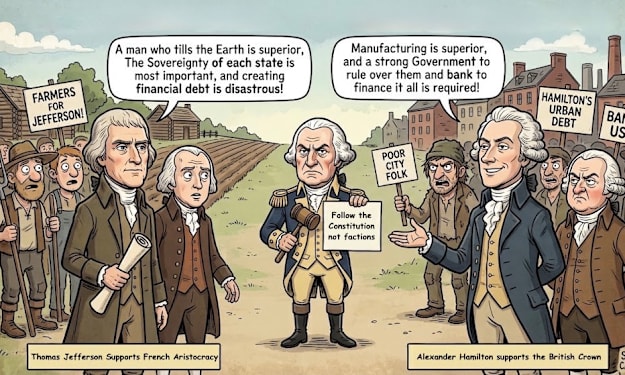
𝐓𝐇𝐄 𝐀𝐌𝐄𝐑𝐈𝐂𝐀𝐍 𝐅𝐔𝐍𝐇𝐎𝐔𝐒𝐄: 𝐓𝐡𝐞 𝐆𝐞𝐧𝐞𝐬𝐢𝐬 𝐨𝐟 𝐨𝐮𝐫 𝐏𝐨𝐥𝐢𝐭𝐢𝐜𝐚𝐥 𝐓𝐮𝐠-𝐨𝐟-𝐖𝐚𝐫
The Genesis of America's delusions of freedom and democracy were established by the creation and ratification of the Constitution of the United States. Instead objective reality insists it's a back-alley brawl disguised as a founding document: How Hamilton’s industrial elites and Jefferson’s plantation lords ignored Washington's warnings, rigged the political game, and wired the original partisan booby trap we are still stepping into and bleeding over centuries later.
By Meko James about a month ago in The Swamp
The Missing Argument in the Stay-at-Home Parent Subsidy Debate
Preface: Video Context: Video Credit: Timcast / Tim Pool This article is a response to a recent Timcast segment discussing the proposed policy that would allow qualifying married couples with a stay-at-home parent to receive childcare subsidies of roughly $9,000 per child per year. The video frames the central debate around whether this amounts to additional welfare or whether it simply redirects money government is already spending on childcare toward parents who choose to provide that care themselves. Around 9:32–10:20 , Tim argues that the welfare expenditure already exists and that the important change is where the incentive points: instead of subsidizing families specifically when parents work and children are cared for elsewhere, the same funding could begin supporting married parents who raise their children at home.
By Peter Thwing - Host of the FST Podcast2 months ago in The Swamp
A Better Buyout: Paying Married Parents to Buy Back Their Time
A Different Kind of Buyout I previously proposed what I called a Family Support Buyout: give families the option to voluntarily exchange a large portion of the government benefits and services already being spent on their behalf for one predictable, untaxed monthly payment they control themselves. Instead of administering SNAP, childcare subsidies, housing assistance, refundable credits, cash assistance, and other ordinary supports through separate bureaucracies, government could calculate the avoidable cost of those programs and offer families perhaps 65, 70, or 75 percent of that value directly. The family would relinquish the benefits being replaced, taxpayers would retain the remaining savings, and the household would gain dramatically greater control over how its resources are allocated. Medical coverage, disability services, catastrophic healthcare, and other specialized needs could remain separate because those costs are less suitable for a simple cash conversion. The central idea was straightforward: if government is already spending $100 supporting a family, perhaps both taxpayers and the family can benefit if the family receives $70 directly instead.
By Peter Thwing - Host of the FST Podcast2 months ago in The Swamp