
Voter-Selected Districts
Letting Citizens Choose the Constituency That Represents Them

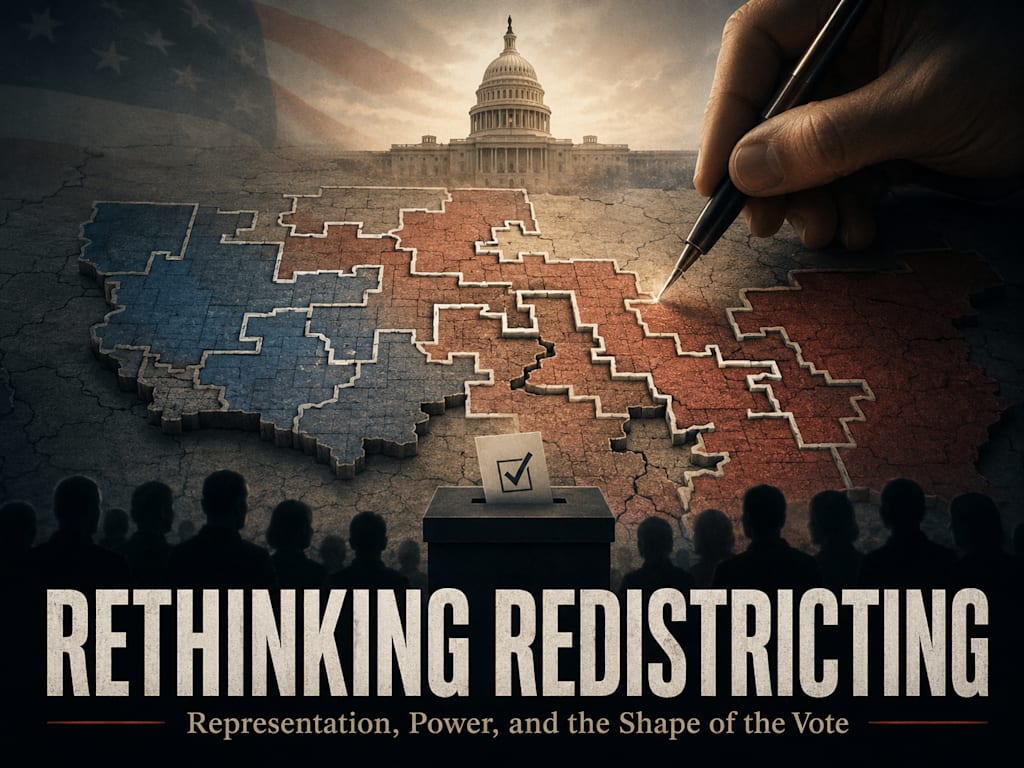
The Voter Should Not Be Treated as Raw Material
The ordinary districting system begins with a quiet assumption: voters are placed into political containers before they choose a representative. The district is drawn first. The voter is assigned to it by residence. Only after that does the election happen. This means the most important act of representation may occur before the voter has any direct say. The map decides which voters belong together. The election only decides who wins inside the container already created.
That is why voter-selected districts deserve serious consideration. Instead of politicians, commissions, courts, or mapmakers deciding which voters must be grouped together, citizens could choose the constituency they want to belong to. Each district would still have an equal population cap, so no district could grow beyond its allowed size. But the first principle would change. Representation would begin with voter agency, not geographic assignment alone.
This model does not treat voters as ingredients to be arranged for partisan advantage. It treats them as citizens capable of choosing the kind of representative pool that best reflects their values, interests, priorities, and governing philosophy. That is a major shift. It moves representation away from imposed placement and toward consent-based association.
The Basic Model
A voter-selected district system would be simple in principle. A state with ten districts would still have ten districts. Each district would still need roughly equal population. But instead of every voter being assigned only by address, voters would select which district they want to join during registration or during a defined district-selection window.
For example, a voter might choose the Constitutionalist District, the Progressive District, the Libertarian District, the Labor District, the Religious Conservative District, the Populist District, the Nonaligned Center District, or some other clearly defined constituency. Once a district reaches its cap, it closes to new entries until space opens. Voters who cannot enter their first choice could choose another district, join a wait-list, or submit ranked preferences ahead of time.
Then each district elects its own representative. The representative would not simply represent a geographic shape. The representative would represent a body of voters who chose that district because it was the closest available match to their governing concerns. The point is not to eliminate disagreement. The point is to make the district’s identity honest. The representative would know what kind of constituency sent them.
Equal Population Still Matters
A voter-selected district system cannot ignore population equality. Without caps, the most popular district could absorb too many voters and distort voting power. Equal population is still necessary because each representative should speak for roughly the same number of people. The difference is that the population would be balanced through caps rather than geographic boundaries.
This is where the system becomes more practical than a simple free-choice model. If every voter could join any district without limit, the system would become unstable. One district might become enormous while another becomes tiny. A cap prevents that. Each district fills until it reaches its assigned population number. After that, voters must choose another district or wait for an opening. The cap keeps the representative structure balanced.
This is similar to the equal-population goal of ordinary redistricting, but the method changes. Instead of drawing land boundaries around equal populations, the system creates equal-population constituencies through voter choice. The district is still limited. The representative still serves a defined number of people. But the organizing principle is no longer only where the voter lives. It is where the voter chooses to be represented.
Why Consent Changes the Moral Structure
Consent matters because representation is not merely counting. A voter can be counted inside a district and still be placed into a political container that does not represent them. A rural voter can be attached to a city fragment. A conservative can be trapped inside a progressive district. A progressive can be trapped inside a conservative district. A libertarian, anti-war voter, religious voter, labor voter, or nonaligned voter can be swallowed by a district whose dominant political culture does not speak for them.
In an ordinary geographic district, the voter’s only choice is candidate selection inside the district already assigned. In a voter-selected model, the voter has a prior choice: which constituency should speak for me? That makes representation more personal, more direct, and more honest. The voter is no longer merely a resident inside a shape. The voter becomes a participant in forming the representative body.
This is not a small difference. If government claims legitimacy through representation, then the method of assignment matters. A system that lets citizens choose their constituency gives voters more agency than a system that places them by map and tells them to accept whoever can win that mixed container. Voter-selected districts do not eliminate political loss, but they give voters a more meaningful path toward alignment.
Self-Sorting Creates Honest Incentives
A voter-selected district system would naturally encourage honest sorting. A voter gains nothing by joining a district that does not share their values unless that voter is part of a serious strategy to change the district. But because districts have caps, sudden takeover is difficult. A red voter entering a strongly blue district would likely lose representation. A blue voter entering a strongly red district would face the same problem. A libertarian entering an authoritarian district would weaken their own voice. A localist entering a centralist district would do the same.
The rational choice is to join the district that best represents the voter’s actual priorities. This does not require moral enforcement. The incentive is built into the design. People who choose poorly represent themselves poorly. If the district is capped, organized manipulation becomes harder because a group cannot flood a district all at once. Once the cap is reached, new entrants must wait.
This creates a stabilizing effect. Districts develop identities over time. Voters choose into the constituencies closest to them. Representatives campaign to the people who actually chose that district. The political relationship becomes clearer. The district is no longer a random or manipulated mixture of voters arranged by outside actors. It is an association formed through voter choice and limited by equal-population rules.
Caps Prevent One District From Swallowing the System
The cap is not a minor detail. It is the structure that makes voter-selected districts workable. Without a cap, the system could become chaotic. With a cap, every district remains roughly equal in size. The cap also protects district identity. Once a district is full, its existing majority cannot be easily overturned by sudden entry from outside voters. Movement can still happen, but it is gradual.
This matters because every system must account for abuse. In a voter-selected model, the obvious abuse is coordinated district raiding. A political group might try to enter an opposing district to change its outcome. Caps and wait-lists make that difficult. To flip a district, enough voters would need to enter over time, and the district would need enough vacancies to allow them in. Existing voters would also have time to respond politically.
The cap also forces voters to make second-best choices when their preferred district is full. That may sound like a weakness, but every representative system has constraints. Ordinary geographic districts constrain voters by residence. Voter-selected districts constrain voters by equal-population caps. The difference is that voters at least participate in the choice. If the first option is unavailable, the voter can choose the next closest constituency rather than being permanently assigned by address alone.
Wait-Lists Make Switching Orderly
A wait-list would help prevent instability. If a district is full, voters who want to enter can join the wait-list. When someone leaves, dies, moves out of state, changes registration, or becomes ineligible, a vacancy opens. That vacancy is filled according to clear rules. The wait-list could be first-come, first-served, ranked by registration date, or managed through an assignment formula that respects voter preference while preserving population balance.
The key is transparency. Voters should know whether they are assigned, waiting, or choosing another district. They should know how vacancies are filled. They should know when district changes take effect. The process should not be hidden inside administrative discretion. If wait-lists are opaque, they become another place where power can manipulate representation.
Switching should also happen during defined registration windows rather than constantly. This prevents last-minute chaos before elections. A voter should be able to change district preference, but the system needs stability. Annual, biennial, or pre-election registration windows could allow change without making districts fluid every day. Representation requires both choice and order.
Ranked Preferences Would Make the System Fairer
The strongest voter-selected model would use ranked preferences. Instead of choosing only one district, voters could rank several. If the first choice is full, the voter is assigned to the highest-ranked district with available space. This reduces frustration and makes the system more fair than simple first-come, first-served selection.
A voter might rank:
- Constitutionalist District
- Libertarian District
- Conservative District
- Populist District
- Nonaligned District
---
Another voter might rank:
- Progressive District
- Labor District
- Anti-War District
- Environmental District
- Nonaligned District
This allows voters to express nuance. It also protects voters who do not fit cleanly into one label. A person may be culturally conservative but economically populist. Another may be anti-war but progressive on domestic policy. Another may be libertarian on speech and privacy but traditional on family and religion. Ranked preferences let voters choose the closest available home without pretending every person fits perfectly into one box.
Named Districts Must Be Honest
For voter-selected districts to work, voters need to understand what they are selecting. A numbered district may be administratively simple, but it tells little about the district’s purpose. Named districts can be clearer: Constitutionalist, Libertarian, Progressive, Populist, Labor, Localist, Anti-War, Religious Conservative, Secular Progressive, Nonaligned Center, or similar categories. The name should describe the district’s governing orientation, not emotionally manipulate voters.
This creates an important safeguard requirement. District labels must not be controlled casually by whichever party is in power. If politicians can rename districts, redefine categories, or create misleading labels, the system becomes vulnerable to ideological gerrymandering. The abuse would move from map lines to category design. A district name can become a political weapon if it is designed to attract, repel, confuse, or stigmatize voters.
The labels should be public, stable, and reviewable. They should describe real political constituencies in plain language. They should not be changed mid-cycle. They should not be secretly designed by party strategists. The more honest the labels are, the more legitimate the voter’s choice becomes.
The Main Weakness Is Strategic Behavior
The main weakness of voter-selected districts is strategic behavior. Voters, parties, campaigns, activist groups, and interest groups may try to game the system. They may encourage supporters to join certain districts. They may attempt long-term takeover. They may flood wait-lists. They may pressure voters to select a district that serves organizational goals rather than personal representation.
This risk is real, but it is not unique. Ordinary geographic redistricting is also strategic. The difference is where the strategy occurs. Under the current model, politicians and mapmakers often manipulate the container before voters act. Under a voter-selected model, voters and organizations may attempt to influence district choice. That is not automatically worse. In some ways, it is more democratic because the manipulation is happening through voter action rather than hidden line-drawing.
Still, safeguards matter. Caps, wait-lists, registration windows, ranked preferences, public assignment rules, anti-coercion protections, and auditability would all be necessary. The system should make manipulation slow, visible, and difficult. It will never make manipulation impossible. No political system can do that. The standard is whether the new system reduces the most serious abuse while improving meaningful representation.
The Second Weakness Is Less Geographic Coherence
A voter-selected district may contain people from different parts of a state. That can weaken place-based representation. A representative of the Constitutionalist District, Progressive District, Libertarian District, or Labor District may have voters scattered across cities, suburbs, and rural areas. That representative may understand values well but know less about specific bridges, roads, factories, school zones, or municipalities.
This is why voter-selected districts make more sense for federal offices than local offices. At the local level, geography should remain central because the office governs place. A city council member needs to know the city. A county commissioner needs to know the county. A school board member needs to know the schools and families. Voter-selected ideological constituencies would be weaker there.
At the federal level, the tradeoff becomes more acceptable because the office governs national principles more than local services. A congressional representative voting on war, federal spending, immigration, speech, privacy, debt, and constitutional limits may need value alignment more than block-by-block knowledge. The model works best when matched to the right office.
Why a State Might Benefit
A state could benefit from voter-selected districts because the system would reduce fights over maps. If voters choose constituencies directly, politicians have less power to carve districts for advantage. There would still be disputes over district names, caps, rules, and assignment procedures, but the central map battle would weaken. The voter, not the mapmaker, would become the starting point.
The system could also improve legitimacy. Voters who feel permanently trapped in hostile districts would have another option. Independents and minority political groups could find more coherent representation. Candidates would know who they are trying to represent. District identities would be clearer. Elections would become contests within defined constituencies rather than battles over artificially mixed populations.
The state would also gain clearer information about political communities. Instead of guessing through geography, the system would reveal what kinds of constituencies citizens actually choose when given the chance. That information could help representation become more honest. It could show whether voters are truly aligned by party, values, ideology, region, class interest, faith, economics, war policy, or something else.
Why Citizens Might Want It
Citizens might want voter-selected districts because the system gives them a direct role in representation before the election begins. Instead of being told, “This is your district because of your address,” they could say, “This is the constituency that best represents my values.” That is a meaningful difference. It treats representation as something citizens participate in forming, not merely something imposed by lines.
A voter who is politically isolated in one neighborhood could find a larger statewide constituency. A voter whose values do not match either major party could rank alternative districts. A voter tired of being used as filler in a partisan map could choose a district with clearer purpose. A voter who values local geography could choose a geographically oriented or nonaligned district if the system allows it. The point is that the voter has agency.
This would not guarantee every person gets their first choice. Caps prevent that. But the current system does not guarantee meaningful choice either. It assigns voters by residence and lets them choose only within that container. Voter-selected districts expand the choice. They allow citizens to participate in defining who they are represented with, not only who represents them afterward.
The Point Is Consent-Based Representation
Voter-selected districts are not a perfect solution. They require caps, wait-lists, ranked preferences, honest labels, registration windows, privacy protections, and strong safeguards against manipulation. They may weaken geography if used at the wrong level of government. They may create more ideological separation. They may require voters to think more carefully about what kind of representation they actually want.
But the central benefit is powerful. The system begins with consent. It does not treat voters as raw material for mapmakers. It does not pretend that geography alone captures every meaningful political interest. It gives citizens a chance to choose the constituency that best represents them while still preserving equal population through caps.
That is why voter-selected districts belong in the larger redistricting conversation. They expose the hidden weakness of the current system: voters do not choose the container. They are placed inside it. A more honest system would ask whether voters should have a direct say in that first act of representation. If the purpose of a district is to create a representative constituency, then letting citizens help choose that constituency is not radical for its own sake. It is a return to the basic moral meaning of representation.
About the Creator
Peter Thwing - Host of the FST Podcast
Peter unites intellect, wisdom, curiosity, and empathy —
Writing at the crossroads of faith, philosophy, and freedom —
Confronting confusion with clarity —
Guiding readers toward courage, conviction, and renewal —
With love, grace, and truth.
Enjoyed the story? Support the Creator.
Subscribe for free to receive all their stories in your feed.
Comments
There are no comments for this story
Be the first to respond and start the conversation.