
Named Ideological Districts
Constitutionalist, Libertarian, Progressive, Populist, and Nonaligned Representation

A District Name Should Tell Voters What It Represents
A district called District 1 tells voters almost nothing. It may identify an administrative unit, but it does not explain what kind of representation the district is meant to produce. In a traditional geographic system, that may be enough because the district is tied to place. District 1 may cover a city, a county, a region, or a cluster of neighborhoods. The location gives the district its meaning. But if representation moves beyond geography and begins to include values, ideology, governing philosophy, party affinity, or voter-selected constituencies, then the name matters. The district must tell voters what kind of political body they are choosing to enter.
Named ideological districts would make the purpose of each constituency explicit. Instead of hiding political effects behind geographic boundaries, the system would say plainly what each district is designed to represent. A voter might choose a Constitutionalist District, Libertarian District, Progressive District, Labor District, Populist District, Localist District, Anti-War District, Religious Conservative District, Secular Progressive District, or Nonaligned Center District. The exact names could vary, but the purpose would remain the same. Voters would be selecting a representative pool based on shared governing priorities rather than being placed inside a district by address alone.
That is the central strength of named ideological districts. They make representation legible. A voter can understand the broad identity of the district before joining it. A candidate can understand the constituency being appealed to. A representative can be held accountable to the values the district was created to represent. The name does not solve every problem, but it creates an honest starting point. It admits that districts are not neutral containers. They are structures that shape representation.
Naming Exposes What Maps Often Hide
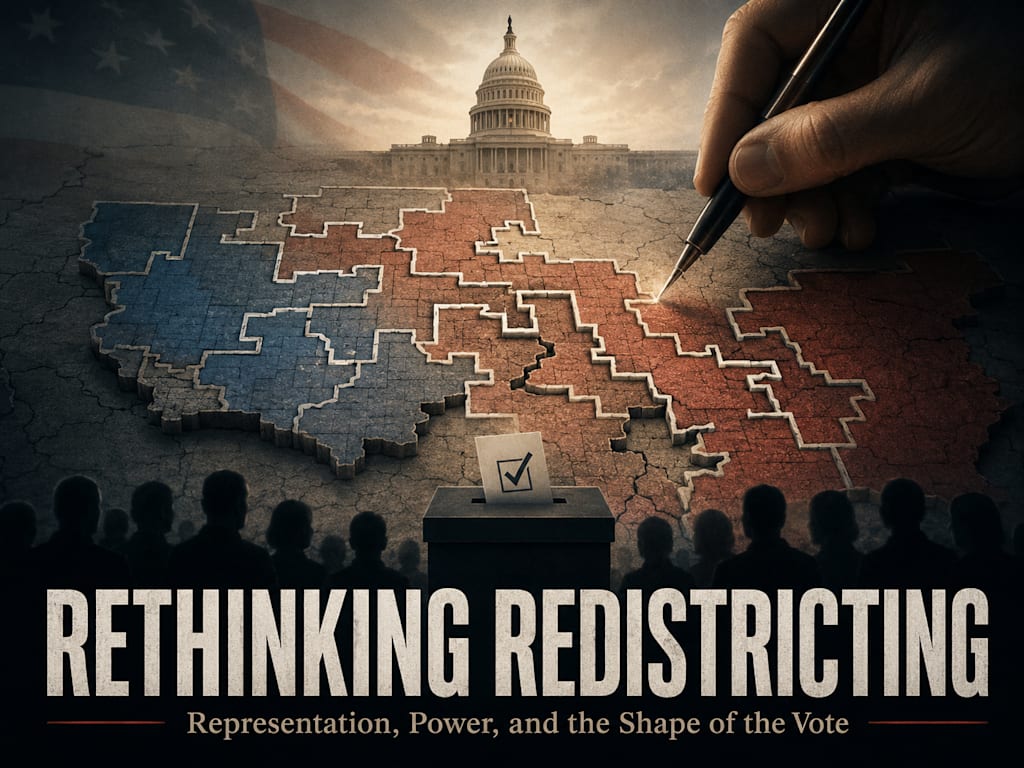
Geographic maps can hide ideology behind lines. A district may be drawn to help one political faction, weaken another, dilute a rural region, divide a city, attach suburbs to unrelated areas, or preserve a desired partisan balance. But because the district is named geographically or numerically, the political purpose can be disguised. The mapmaker can say the district is only a boundary, even when the boundary was drawn with a clear political outcome in mind.
Named ideological districts would remove some of that disguise. If a district is meant to represent constitutionalists, it says so. If it is meant to represent progressives, it says so. If it is meant to represent libertarians, localists, labor voters, religious conservatives, anti-war voters, or nonaligned voters, it says so. The public does not have to reverse-engineer the district’s purpose from a map. The purpose is declared.
That clarity could make the system more honest than ordinary redistricting in one specific way. It would no longer pretend that political sorting is not happening. All districting systems sort people. Geographic districts sort by place. Gerrymandered districts sort by political advantage. Party systems sort by affiliation. Ranked systems sort by preference. Named ideological districts would sort by declared governing identity. That does not make them perfect, but it makes the sorting visible.
The Name Is Not Decoration
A district name would not be merely cosmetic. It would shape voter behavior, candidate strategy, media interpretation, and public legitimacy. If a district is called “Libertarian,” voters will expect candidates to defend liberty, privacy, limited state power, and resistance to coercive authority. If a district is called “Labor,” voters will expect attention to wages, workers, unions, trade, manufacturing, benefits, and economic bargaining power. If a district is called “Localist,” voters will expect decentralization, regional autonomy, municipal authority, and resistance to unnecessary centralized control.
The name creates an accountability standard. A candidate running in a Constitutionalist District could be challenged for supporting broad federal overreach. A candidate running in an Anti-War District could be challenged for supporting foreign intervention too easily. A candidate running in a Progressive District could be challenged for failing to pursue the reforms the district exists to prioritize. A candidate running in a Religious Conservative District could be challenged for betraying family, faith, religious liberty, or moral order. The district identity gives voters a measuring stick.
This is why naming must be done carefully. A vague or misleading label would damage the whole system. A district named “Freedom” could mean almost anything. A district named “Justice” could mean almost anything. Broad moral words can become propaganda if they are not attached to specific governing commitments. The best names would be plain, descriptive, and tied to public definitions. The name should clarify, not seduce.
The Labels Must Be Stable
Named ideological districts would become dangerous if politicians could rename them whenever power changes hands. If the names are unstable, the system becomes another form of manipulation. A party could rename an opposing district to make it look extreme. It could split a strong district into several weaker labels. It could merge different groups under one label to dilute them. It could create attractive names for favored constituencies and unattractive names for disfavored ones. In that case, the abuse would move from map lines to language.
Stability is therefore essential. District names should be set by durable rules, not partisan convenience. They should not be changed mid-cycle. They should not be rewritten immediately before elections. They should not be adjusted by the same politicians who benefit from the outcome. If a name must change because political reality has changed, the process should require public notice, a high threshold, an explanation, and enough time for voters to respond.
The district’s public description should be stable too. A Constitutionalist District should not quietly become a generic conservative district. A Progressive District should not quietly become a general left district. A Nonaligned District should not quietly become a dumping ground for voters who do not fit the preferred categories. The title and description together should form a public commitment. Voters choose the district based on that commitment, so the system must not alter it casually after the fact.
Public Descriptions Matter More Than Slogans
Each named district would need a clear public description. A label alone is not enough. A “Populist District” could mean different things to different people. A “Conservative District” could be religious, constitutionalist, nationalist, free-market, traditionalist, anti-progressive, or some mixture. A “Progressive District” could focus on economic redistribution, civil rights, climate policy, institutional reform, social liberalism, or state intervention. Without descriptions, voters may choose the same label while expecting different forms of representation.
A public description should explain the district’s governing focus in plain language. For example, a Constitutionalist District might be described as prioritizing constitutional limits, separation of powers, civil liberties, restricted federal authority, and fidelity to original governing structure. A Libertarian District might prioritize individual liberty, privacy, free speech, limited coercion, and skepticism toward state control. A Labor District might prioritize workers, wages, domestic production, bargaining power, and economic security. A Localist District might prioritize decentralization, local control, regional autonomy, and resistance to centralized bureaucracy.
These descriptions should not be long campaign platforms. They should be short enough for voters to compare but specific enough to prevent manipulation. They should identify governing orientation, not promise outcomes. The district exists to represent a body of voters, not to guarantee one policy result forever. The description gives the constituency a recognizable center.
Names Can Protect Cross-Pressured Voters
Named ideological districts could help voters who do not fit the normal party categories. Many voters are not cleanly represented by “Democrat,” “Republican,” “left,” or “right.” Some are anti-war but socially conservative. Some are economically populist but skeptical of federal bureaucracy. Some are religious but distrust both major parties. Some are libertarian on speech and privacy but traditional on family. Some support labor but oppose progressive cultural ideology. Some are progressive on economic issues but skeptical of foreign intervention and surveillance.
Ordinary party labels often flatten these voters. Geographic districts may bury them. A named district system could create clearer homes for them. An Anti-War District could include voters from different economic or cultural backgrounds who share opposition to military intervention. A Localist District could include rural conservatives, municipal reformers, decentralists, and anti-bureaucratic independents. A Populist District could include voters focused on class, production, trade, corruption, and institutional accountability. A Nonaligned District could represent voters who reject party loyalty as a primary identity.
This is one of the strongest benefits of naming. Good labels can reveal political communities that already exist but lack formal representation. Not every meaningful constituency fits into the current two-party map. Named ideological districts would allow representation to form around real priorities instead of forcing every voter through inherited party machinery.
The Nonaligned District Is Especially Important
Any named ideological system needs a serious place for voters who reject the available labels. A Nonaligned District should not be treated as an afterthought or overflow bin. It should be a legitimate constituency for voters who do not want to be defined by party, ideology, or a narrow governing label. Some citizens are truly moderate. Some are independent. Some are issue-specific. Some are skeptical of all organized political labels. Some want competence, restraint, and accountability more than ideological branding.
The Nonaligned District could serve those voters, but only if it is respected. If every voter who does not fit elsewhere is dumped into it, it becomes meaningless. If the district is used only to balance caps, it becomes administrative waste. If politicians define it as “the middle,” it may misrepresent voters who are not moderate but simply not aligned with existing labels. Nonaligned does not necessarily mean centrist. It means not formally bound to the named ideological categories.
A better design would allow voters to choose Nonaligned directly and rank it among other districts. Some voters may choose it first because they reject ideological branding. Others may choose it as a second or third option. The key is that the district should have a defined purpose: representation for citizens who want independence from formal ideological sorting.
The Risk Is Propaganda Through Labels
The greatest weakness of named ideological districts is that language can be weaponized. Names influence perception. A favored district could receive a noble label while an opposing district receives a stigmatizing one. One side could be called “Freedom” while another is called “Radical.” One could be called “Community” while another is called “Extremist.” That would corrupt the system immediately. The labels would stop describing constituencies and start manipulating voters.
Even neutral-sounding labels can contain bias. “Common Sense District” sounds attractive, but it is not descriptive. “Traditional Values District” may be meaningful to some voters and vague to others. “Equity District” may attract one group and repel another depending on definitions. “America First District,” “Social Justice District,” “Family District,” or “Reform District” might all function as slogans rather than stable categories. The system would need to distinguish between descriptive naming and campaign language.
The rule should be strict: district labels must describe governing orientation, not advertise moral superiority. Constitutionalist, Libertarian, Progressive, Labor, Populist, Localist, Anti-War, Nonaligned, Conservative, and similar labels are imperfect, but they name recognizable political tendencies. Labels like “Good Government,” “Freedom,” “Justice,” “Truth,” or “Common Sense” are too morally loaded unless tied to specific, neutral definitions. A district name should help the voter understand the constituency, not pressure the voter emotionally.
The Categories Should Not Be Too Many
Another danger is over-fragmentation. If there are too many named districts, voters may become confused and constituencies may become too narrow. Every minor ideological distinction cannot have its own district. A representative system must group people at some level. The goal is closer alignment, not perfect identity. A district should be broad enough to represent a meaningful population but specific enough to have a recognizable center.
For example, a state with ten districts cannot create separate constituencies for every possible combination of views. It may need broader categories: Progressive, Labor, Nonaligned, Localist, Libertarian, Constitutionalist, Conservative, Populist, Anti-War, and perhaps another depending on state political culture. A larger state with more seats could support more categories. A smaller state may need fewer and broader ones. The number of categories should match the number of seats and the real political distribution of the population.
This is where ranked-preference district assignment becomes helpful. Voters do not need a district that matches every detail if they can rank several close fits. A voter may not get the perfect label, but can choose the closest available constituency. That is more realistic than trying to create a separate district for every political subtype.
District Names Should Come From Public Criteria
A legitimate naming system would need public criteria. The categories should not emerge from party consultants or private committees. They should be based on visible political traditions, recurring voter alignments, issue clusters, and public input. If a state’s voters contain large blocs of constitutionalists, progressives, libertarians, labor-populists, localists, and nonaligned independents, the district categories should reflect that reality. If another state has different political clusters, the labels may differ.
There should also be a review process, but not constant revision. Political language changes over time. Some labels lose meaning. Some movements grow. Some disappear. A rigid system could become outdated. But frequent changes would invite abuse. The best approach would be periodic review at long intervals, with high thresholds for change and strong public notice. The goal is responsiveness without instability.
Public criteria should ask: Does the label describe a real constituency? Is the constituency large enough to justify a district? Is the label descriptive rather than promotional? Does the public description match the label? Would voters reasonably understand what they are choosing? Can the category be administered without forcing citizens into beliefs they do not claim? Those questions would not eliminate disagreement, but they would discipline the process.
Candidates Would Become More Accountable
Named ideological districts would also change candidate accountability. In a geographic district, a candidate can sometimes campaign broadly and vaguely, especially if the district contains conflicting communities. The candidate can say different things to different groups and rely on the district’s mixture to avoid firm identity. In a named ideological district, the candidate’s relationship to the constituency is clearer.
A candidate in a Libertarian District would need to explain any support for surveillance, censorship, coercive mandates, or expanded state power. A candidate in a Labor District would need to explain any position that weakens workers or favors financial interests over production. A candidate in an Anti-War District would need to justify interventionist votes. A candidate in a Constitutionalist District would need to defend fidelity to constitutional limits. A candidate in a Nonaligned District would need to show independence rather than party obedience.
This does not mean every candidate must agree with every voter. It means the district gives voters a clearer standard of judgment. The representative cannot easily hide behind geographic confusion. The constituency has a declared purpose. The campaign takes place inside that purpose. That could produce more honest elections and clearer accountability after the election.
The System Would Still Need Internal Competition
Named ideological districts should not become one-candidate districts. A Constitutionalist District should not automatically belong to one approved constitutionalist. A Progressive District should not automatically belong to one progressive organization. A Labor District should not automatically belong to unions or party machines. A Libertarian District should not automatically belong to a narrow faction. The district label defines the constituency, but voters still need real choices inside it.
Internal competition matters because every ideological family contains disagreements. Constitutionalists may disagree over foreign policy, economics, policing, or judicial power. Progressives may disagree over speech, crime, economic policy, identity issues, or institutional reform. Libertarians may disagree over borders, drugs, abortion, foreign policy, or local regulation. Labor voters may disagree over trade, immigration, unions, automation, and culture. Populists may disagree over economics, nationalism, religion, and state power.
A good system would allow multiple candidates within each named district. The district should not be captured by a party committee or ideological gatekeeper. It should create a representative constituency and then let voters choose who best speaks for that constituency. The name organizes representation. It does not replace elections.
Named Districts Are Honest but Not Sufficient
Named ideological districts offer clarity, but they do not solve every problem. They can improve representational alignment. They can help voters understand the constituency being chosen. They can reduce the illusion that geography alone is neutral. They can give cross-pressured voters better options. They can make candidates more accountable to declared values. But they can also become tools of manipulation if labels are unstable, biased, vague, or controlled by partisan actors.
The system would need caps to preserve equal population. It would need ranked preferences to protect voter agency. It would need wait-lists to prevent district flooding. It would need privacy protections to avoid turning political identity into a public dossier. It would need public criteria to prevent propaganda through naming. It would need stable descriptions to prevent mid-cycle redefinition. Without those safeguards, named districts could become ideological gerrymandering by another method.
This is why named ideological districts should be seen as one part of a broader representative framework, not a complete replacement for everything else. They may fit best at the federal level, where governing values matter more than local infrastructure. They may fit poorly at the local level, where representatives need to know roads, bridges, potholes, businesses, factories, schools, and municipalities. The value of the model depends on using it where it fits.
Honest Names Are Better Than Hidden Purposes
The strongest argument for named ideological districts is simple: if districts already shape representation, their purpose should be visible. A geographic district can pretend to be neutral while quietly serving a political outcome. A named ideological district admits what it exists to represent. That honesty does not eliminate risk, but it improves the terms of debate. Voters can argue about whether the categories are fair, whether the labels are accurate, whether the caps are equal, and whether the assignment system is transparent. Those are better arguments than trying to decode hidden motives inside a strange map.
Representation should not depend on pretending that political identity does not exist. People vote from values, priorities, interests, duties, fears, loyalties, convictions, and visions of government. A districting system that ignores those realities may be simple, but it is not necessarily representative. Named ideological districts would bring those realities into the open.
The name must be honest. The description must be clear. The categories must be stable. The voter must retain agency. The cap must protect equality. The election must remain competitive inside the district. If those conditions are met, named ideological districts could offer a more direct form of representation than geography alone. They would not replace the need for local place-based districts, but they could help answer a problem ordinary maps often avoid: voters do not only live somewhere. They stand for something.
About the Creator
Peter Thwing - Host of the FST Podcast
Peter unites intellect, wisdom, curiosity, and empathy —
Writing at the crossroads of faith, philosophy, and freedom —
Confronting confusion with clarity —
Guiding readers toward courage, conviction, and renewal —
With love, grace, and truth.
Enjoyed the story? Support the Creator.
Subscribe for free to receive all their stories in your feed.
Comments
There are no comments for this story
Be the first to respond and start the conversation.