
Value-Based Federal Districts
Why National Representation May Not Need to Begin With Geography

Federal Representation Is Not the Same as Local Representation
The case for geographic districts is strongest when the office governs place. A city council member should know the roads, bridges, potholes, neighborhoods, business owners, factories, schools, churches, zoning disputes, utility failures, and local culture of the area. A county commissioner should understand the land, the towns, the roads, the local economy, and the practical pressures of the region. A school board member should understand the families, schools, transportation patterns, and community expectations inside the district. Local government is tied to the ground under people’s feet.
Federal representation is different. A member of Congress may still need to understand the state or region represented, but the office is not mainly about potholes, bridges, local zoning, school boundaries, or municipal services. Federal representatives vote on war, national debt, federal spending, taxation, immigration, federal agencies, constitutional rights, speech, privacy, foreign policy, national regulation, and the proper limits of federal power. These are not merely local issues. They are questions of governing philosophy, moral priority, constitutional interpretation, and national direction.
That difference should matter when designing representation. If the office is primarily local, geography should dominate. If the office is primarily national, values may deserve greater weight. A voter may share a congressional district with someone who lives five miles away while disagreeing with that person on nearly every major federal question. At the same time, that voter may share far more meaningful governing alignment with someone hundreds of miles away in the same state. Geography can place people near each other. It cannot guarantee that they are meaningfully represented by the same national philosophy.
Geography Is a Weak Proxy for National Values
Geography can reveal a great deal about local needs, but it is a weaker proxy for national political values. Two neighbors may use the same roads, shop at the same stores, and live under the same weather, while holding completely different views about the role of government. One may believe federal power should be sharply limited, speech protections should be broad, war should be avoided, agencies should be restrained, taxes should be lower, and constitutional boundaries should be enforced. The other may believe federal power should be more active, speech should be regulated in certain contexts, national agencies should have broader authority, and government should intervene more heavily in economic and social life.
Those two voters live in the same place, but they are not asking the federal government to do the same thing. Their disagreement is not about a bridge or a zoning rule. It is about the nature of power itself. It is about what government is allowed to command, fund, restrict, protect, subsidize, punish, or regulate. A geographic district may group them together because they share land, but the representative chosen from that district may not represent one of them in any meaningful federal sense.
This is where value-based federal districts become a serious idea. The point is not that place is irrelevant. The point is that place is not always the most important thing being represented. If the federal office is making decisions about war, debt, speech, rights, immigration, privacy, taxation, and national authority, then a voter’s governing philosophy may be more relevant than the voter’s street address. A system built only around location may preserve local adjacency while failing to preserve national representation.
The Current System Lets Mapmakers Shape Federal Voice
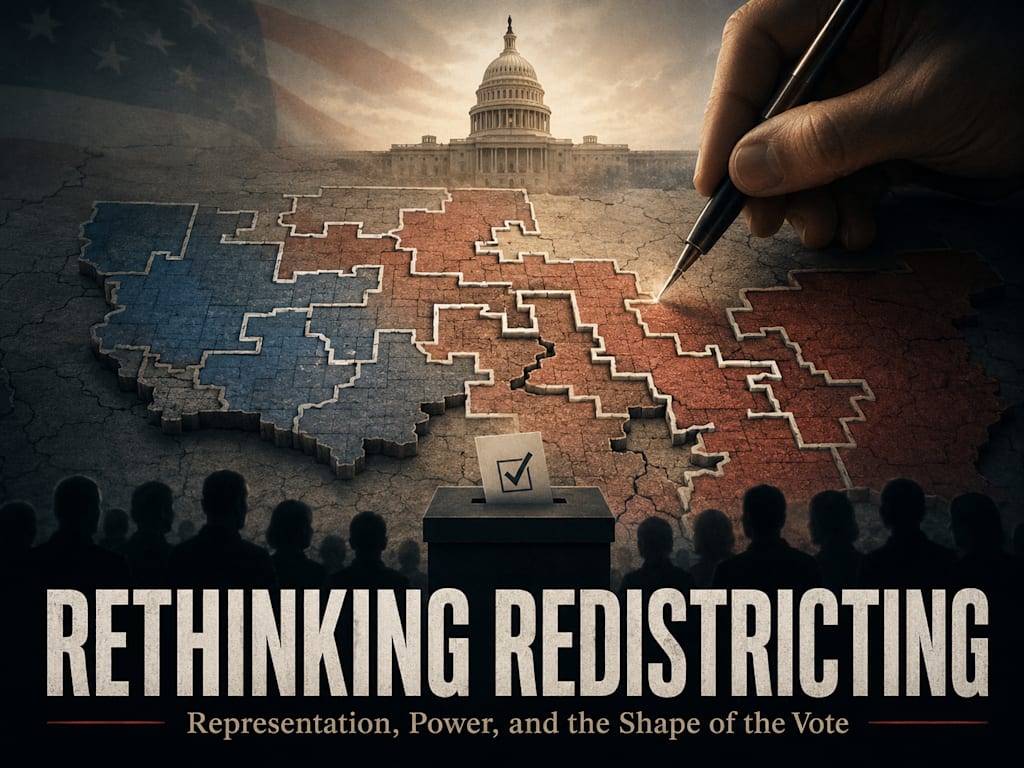
Geographic congressional districts give enormous power to whoever draws the lines. Voters do not choose the container. The container is drawn around them. Once the district is formed, the election takes place inside that political structure. This means representation can be influenced before anyone casts a ballot. A voter may remain in the same home, hold the same values, and vote the same way, but the political meaning of that vote can change when the district line moves.
This is the core problem with gerrymandering. It is not simply that maps look strange. It is that voters are arranged into districts for strategic purposes. A city can be cracked into multiple districts. Rural areas can be attached to urban slices. Suburbs can be divided. Political opponents can be packed into a few districts or spread thinly across many. The final map may satisfy equal population requirements, but the political containers have already shaped the outcome.
Value-based federal districts would attack that problem at the root. Instead of allowing politicians to decide which voters belong together geographically, voters could be grouped by shared governing values, ranked preference, party affinity, political philosophy, or voluntary constituency selection. The representative would not merely represent a map. The representative would represent a defined body of voters who share enough national priorities to form a coherent constituency.
What a Value-Based Federal District Could Be
A value-based federal district would be an equal-population constituency organized around political philosophy rather than land. It could be created through voter choice, ranked assignment, party affiliation, ideological labels, political compass-style categories, or a hybrid of those methods. The central idea is that voters would be grouped with others who share their national governing priorities.
For example, one federal district might be constitutionalist. Another might be libertarian. Another might be progressive. Another might be populist. Another might be anti-war. Another might be religious conservative. Another might be nonaligned or moderate. Another might be labor-oriented. Another might be nationalist or localist. These names are only examples. The more important point is that the district’s purpose would be explicit. Voters would know what kind of constituency they were entering.
Another version could avoid labels and use numbered districts along a spectrum. Lower numbers could represent leftward views, higher numbers rightward views, with middle districts for moderates or mixed voters. A more sophisticated version could use multiple axes: war versus anti-war, centralized power versus local control, authoritarian versus libertarian, progressive versus conservative, institutional trust versus institutional skepticism, and market-oriented versus redistributionist. The system could then group voters by clusters of actual governing belief rather than crude geography.
The Strongest Version Uses Voter Choice
The strongest version of value-based federal districts would not force voters into categories by state command. It would let voters rank their preferred constituencies. A voter might rank constitutionalist first, libertarian second, conservative third, populist fourth, and nonaligned fifth. Another voter might rank progressive first, labor second, anti-war third, environmental fourth, and nonaligned fifth. Each district would have an equal population cap. Voters would be assigned to their highest-ranked available district.
This preserves agency. It also reduces the risk of government becoming the judge of a voter’s beliefs. A political-values test could be useful as a voluntary guide, but mandatory ideological testing is dangerous because whoever controls the questions can influence the sorting. Ranked preference lets voters declare where they belong without requiring the state to define their identity for them.
The cap matters because value-based districts must still preserve equal voting power. If one district fills, later voters move to their next preference or join a wait-list. This prevents one popular district from absorbing too many voters. It also makes strategic takeover difficult. A voter who joins a district that does not share that voter’s values loses representation unless enough similar voters can join to change the district. But the cap prevents sudden mass switching. The incentive is to choose honestly because mismatching oneself weakens one’s own voice.
Why This Could Improve Federal Representation
The strongest benefit is representational alignment. Voters would have a clearer path toward electing someone who actually speaks for their national priorities. A rural conservative living near a city would not automatically be swallowed into an urban-leaning congressional district. An anti-war voter would not be forced into a district where foreign policy is an afterthought. A libertarian voter would not be reduced to whichever major party dominates the map. A religious family-centered voter, a labor-populist voter, a constitutionalist voter, a nonaligned voter, or a progressive voter would each have a more direct route toward a representative who reflects the governing concerns that matter most.
This would also make politics more honest. Instead of pretending districts are neutral simply because they are geographic, value-based districts would admit that representation involves political alignment. Every districting system creates winners and losers. Geographic systems do it through lines. Value-based systems would do it openly through constituency design, caps, and voter choice. That openness would not remove every problem, but it would make the central question visible: what kind of representation is this district supposed to provide?
A value-based federal system could also reduce the harm of winner-take-all geographic conflict. In a normal district, 49 percent of voters may lose representation for an entire term. In a value-based system, voters sort into constituencies where their side is more likely to be the majority because the district exists to represent that shared outlook. The result may be less internal diversity inside each district, but more meaningful alignment between district and representative.
The Tradeoff Is Political Separation
The obvious objection is that value-based districts create political separation. They are a form of ideological segregation. Voters would be grouped more by belief than by neighborhood. That could produce more coherent representation, but it could also reduce contact between opposing views. Representatives might have less incentive to persuade ideological opponents. Districts might become more internally pure. Political life could become more clearly divided.
That tradeoff is real. The answer is not to deny it. The answer is to ask what kind of separation already exists under the current system. Geographic districts often contain people who live near each other but do not share governing principles. The result is not always healthy compromise. Sometimes it is simply permanent conflict inside a district where one side repeatedly dominates the other. A 50.01 percent victory may be called representative, but it can leave nearly half the district with no meaningful voice.
The question is whether representation should prioritize internal mixture or actual alignment. A mixed district may look healthier from the outside, but if the representative only reflects the bare majority, the minority may be present without being represented. A value-based district sacrifices some internal diversity in order to maximize representational clarity. That may be dangerous if applied everywhere, especially locally. But for federal representation, where the office governs broad national principles, the tradeoff is at least worth considering.
Safeguards Would Decide Whether the System Works
A value-based federal district system would need strong anti-abuse rules. The first safeguard is equal population. Every district must have the same or nearly the same number of voters. The second safeguard is voter choice. The state should not secretly assign voters based on opaque ideological categories. The third safeguard is transparency. District labels, assignment rules, caps, wait-list procedures, and any scoring tools must be public and auditable.
The fourth safeguard is privacy. Voter district assignment may need to be known for election administration, but individual belief profiles should not become public dossiers. A system that requires citizens to expose detailed ideological beliefs to the state would create serious dangers. Aggregate district identity can be public. Individual reasoning should remain private.
The fifth safeguard is stability. District categories should not be rewritten every cycle by politicians seeking advantage. If labels can be changed, caps adjusted, or assignment rules rewritten whenever power changes hands, the new system becomes another kind of gerrymandering. The abuse would move from maps to categories. The whole point is to prevent political actors from controlling the containers voters occupy. That requires rules stronger than partisan convenience.
This Model Does Not Belong Everywhere
Value-based federal districts should not be used as a universal replacement for every office. Local representation still needs geography. A city council member should understand the city. A county commissioner should understand the county. A school board member should understand the schools and families. A representative handling roads, bridges, potholes, zoning, utilities, police response, factories, and local culture needs a real geographic district. Ideological alignment cannot replace knowledge of place at that level.
Even at the state level, geography should still matter heavily because state government handles infrastructure, schools, land use, water, energy, courts, regional development, and municipal relationships. A state-level value-based system may be possible in some form, but it would need to preserve regional realities. Federal representation is where the argument becomes strongest because the office is less tied to direct local services and more tied to national principles.
This distinction protects the proposal from becoming extreme. The goal is not to erase place. The goal is to stop forcing place to represent everything. Local offices should represent local places. Federal offices may need a different logic because federal power operates at a different level. Representation should match the office.
The Best Use May Be a Hybrid System
The strongest practical version may not be replacing every congressional district with value-based constituencies. It may be a hybrid. Some seats could remain geographic, while others are assigned through value-based, ranked-preference, or proportional systems. Another model could preserve geography in one chamber and use value-based constituencies in another. A state could use compact geographic districts for local and state offices while exploring voter-selected federal constituencies for national representation.
A hybrid system would recognize that place and principle are both real. Farmers, factory workers, port communities, border towns, coastal regions, and dense cities still need geographic attention. But voters also need representatives who speak to their governing philosophy. Separating these functions could reduce the burden currently placed on geographic districts. A single map cannot represent roads, culture, party preference, ideology, class, values, and national principles all at once.
The hybrid model would also reduce the danger of ideological separation becoming total. If voters still have geographic representation at local and state levels, then value-based federal representation would not erase place. It would add another layer of representation where value alignment is more relevant. The result would be a system that acknowledges human beings as both residents of places and bearers of governing convictions.
The Federal Question Is Different
Value-based federal districts begin with a simple observation: national government does not mainly govern potholes. It governs power. It decides what the federal government may do, what it may forbid, what it may fund, what it may punish, what it may regulate, what it may command, and what it must leave alone. Those decisions are shaped by values more than by geography. A voter’s street address may matter less than that voter’s view of constitutional limits, war, debt, speech, privacy, immigration, family, markets, agencies, and national sovereignty.
A representative system that ignores this will continue to mistake proximity for representation. Living near someone does not mean sharing a vision of government. Sharing a congressional district does not mean sharing national priorities. A voter can be counted in a district and still be misrepresented by the person elected from it. Value-based federal districts would not solve every problem, but they would confront that one directly.
The argument is not that geography should disappear. The argument is that geography should not be forced to do a job it cannot always do. Local offices should represent place. Federal offices should represent governing principles more honestly. If representation is supposed to mean more than being counted inside a shape, then federal districting deserves a wider imagination than the map.
About the Creator
Peter Thwing - Host of the FST Podcast
Peter unites intellect, wisdom, curiosity, and empathy —
Writing at the crossroads of faith, philosophy, and freedom —
Confronting confusion with clarity —
Guiding readers toward courage, conviction, and renewal —
With love, grace, and truth.
Enjoyed the story? Support the Creator.
Subscribe for free to receive all their stories in your feed.
Comments
There are no comments for this story
Be the first to respond and start the conversation.