
Local Representation Must Know the Place
Bridges, Potholes, Business Owners, Factories, and Culture

Local Government Begins With the Ground Under People’s Feet
Local representation is different from national representation because local government deals with the visible life of a place. It is not mainly abstract. It is not mainly theoretical. It is not mainly about broad ideological identity, even though values still matter. Local government touches the roads people drive on, the bridges they cross, the schools their children attend, the zoning rules that shape their neighborhoods, the factories that employ their towns, the business owners trying to stay open, and the public systems that either work or fail in daily life. A local representative who does not know the place is not merely missing background information. That representative is missing part of the job.
This is why local districts should remain strongly geographic. A person can share someone’s national philosophy and still be poorly suited to represent that person locally. Someone may agree on taxes, speech, federal power, war, immigration, or constitutional limits, but still know nothing about a failing bridge, a dangerous intersection, a neglected school route, a factory closure, a water system problem, a local crime pattern, or a zoning rule that is crushing small businesses. Local government is where practical knowledge becomes representation. The representative needs to understand not only what voters believe, but where they live and what that place requires.
That kind of knowledge cannot be generated from a party label alone. It comes from proximity, attention, relationships, and accountability. A representative should know which roads flood, which bridges need repair, which businesses anchor the town, which employers are barely surviving, which neighborhoods are ignored, which agencies are slow, which schools are strained, and which local customs matter. When districts are drawn without respect for place, local representation becomes thinner. The office may still exist, but the link between representative and community weakens.
Roads, Bridges, and Potholes Are Not Small Issues
It is easy for national politics to make local issues sound small. Roads, bridges, potholes, sidewalks, drainage systems, traffic lights, and school routes do not have the drama of national conflict. But daily life depends on them. A neglected bridge can separate workers from jobs. A damaged road can increase repair costs for families already under pressure. A missing sidewalk can put children at risk. A bad intersection can create repeated accidents. A drainage failure can flood homes, businesses, and farms. These are not symbolic concerns. They are governing realities.
A local representative needs to know which problems are urgent and which are merely loud. Not every complaint carries the same weight. Some infrastructure problems are annoying. Others are dangerous. Some road projects are political favors. Others are necessary for emergency response, commerce, school access, or regional production. Without local knowledge, a representative may not know the difference. The loudest lobby can become more important than the most serious need. The most visible project can receive money while the most essential repair is delayed.
This is where geographic representation has clear value. A representative tied to a real district can be held accountable for physical neglect. Residents can point to the road, the bridge, the crossing, the factory entrance, the bus route, the school zone, or the water line. They can say, “This is the problem. This is where it is. This is how long it has been ignored.” That kind of accountability becomes harder when representation is detached from place. Local government needs representatives who can be confronted with the actual conditions their decisions create.
Business Owners and Local Production Need Direct Representation
Local economies are not interchangeable. A factory town has different needs than a tourism town. A farming region has different needs than a university city. A port community has different needs than a mountain county. A suburban business corridor has different pressures than a rural main street. A representative who does not understand local production may misread the entire community. Jobs, wages, transportation, regulations, energy costs, taxes, zoning, licensing, supply chains, and workforce patterns all depend on the specific economy of the place.
Business owners often understand local conditions before government does. They know when foot traffic is down, when regulations are becoming unworkable, when insurance costs are rising, when crime is changing customer behavior, when roads are affecting deliveries, when labor shortages are damaging operations, and when a town is losing its productive base. A local representative should know these people. Not as donors or photo opportunities, but as sources of practical knowledge. Local businesses are often the early warning system for a community under strain.
Factories and production centers matter in a special way because they anchor communities. A factory is not only a building. It can shape traffic, wages, housing demand, local identity, tax revenue, supply chains, school enrollment, and family stability. When a factory struggles, the town feels it. When local production disappears, the damage spreads beyond economics. Pride, discipline, skill, apprenticeship, and community continuity can decline with it. A representative who knows the local production base is better equipped to defend the region’s actual interests instead of applying generic policy language from outside the area.
Culture Is Part of Representation
A place is not only infrastructure and economy. It also has culture. Local culture includes how people speak, work, worship, raise children, solve problems, treat neighbors, handle conflict, use land, view authority, understand family, and relate to institutions. Culture is not a decorative category. It shapes whether policies are received as reasonable, hostile, irrelevant, or destructive. A representative who misunderstands local culture may misread both the problem and the solution.
This matters especially in districts that contain rural areas, religious communities, working-class towns, industrial regions, immigrant neighborhoods, tribal areas, dense urban neighborhoods, college towns, and long-established local cultures. Each has its own expectations and pressures. A policy that sounds neutral from a distance may collide with local life when implemented. A rule written for one kind of community may become harmful in another. A representative should know when a policy fits the place and when it is being imposed on a community that was never understood.
Geographic districts help preserve this kind of representation when they are drawn honestly. Keeping municipalities, neighborhoods, counties, and cultural regions intact gives voters a better chance of electing someone who knows their world. That does not mean every voter inside the district agrees on every issue. It means the district has enough shared local reality that the representative can speak with practical familiarity. Without that connection, the representative may become fluent in policy but ignorant of the people.
Municipalities Should Not Be Treated as Puzzle Pieces
Cities, towns, counties, and municipalities are not just administrative units. They are organized communities with histories, boundaries, services, budgets, responsibilities, and local identities. Splitting them apart for political advantage can damage accountability. When one town is divided among multiple districts, residents may not know who is responsible for what. Representatives can deflect responsibility. Local problems can be fragmented. The community’s voice can be reduced because it no longer speaks through one coherent district.
This does not mean municipalities can never be split. Population requirements sometimes make splitting unavoidable. Large cities may require multiple districts. Counties may be too large or too small to remain whole. But splitting should require a clear reason tied to representation, not political convenience. If a municipality must be divided, the division should follow recognizable internal logic: neighborhoods, school zones, infrastructure patterns, natural boundaries, service areas, or economic corridors. It should not be cut apart simply because one section helps alter the outcome in another district.
A local district should make accountability simpler, not harder. Residents should be able to identify the representative responsible for their area. Business owners should know whom to contact. Parents should know who speaks for their school zone. Neighborhoods should know where their political voice goes. Municipal coherence protects that. When communities are chopped into political pieces, local government becomes more distant even if the representative is technically elected from the area.
Local Knowledge Prevents Policy From Becoming Generic
One of the failures of modern governance is the tendency to treat different places as if they are the same. A policy is written in broad language, applied across many communities, and defended as neutral. But neutrality on paper does not guarantee fairness in practice. A rule can land differently depending on density, income, culture, transportation, housing, geography, crime, business structure, family structure, and institutional trust. Local knowledge is what prevents policy from becoming blind.
A representative who knows the place can ask better questions. How will this affect the farms outside town? How will it affect the factory that already struggles with energy costs? How will it affect the small business corridor where parking is limited? How will it affect families who depend on one bridge to reach school and work? How will it affect rural residents who cannot access services without driving long distances? How will it affect neighborhoods where police response is already slow? How will it affect churches, civic groups, and local charities that are quietly holding the community together?
Without those questions, policy becomes a template. Templates are attractive because they are easy to administer. But people do not live in templates. They live in places with constraints, histories, relationships, and tradeoffs. Local representation should protect those details from being erased by distant assumptions. This is why local districts should not be drawn merely to balance party numbers. They should be drawn to preserve the relationship between policy and place.
Ideological Alignment Is Not Enough Locally
Shared values still matter at the local level. A voter may reasonably want a local representative who shares basic beliefs about taxes, policing, schools, religious liberty, parental authority, property rights, business regulation, public safety, and government power. But ideological alignment alone is incomplete when the office governs local conditions. A representative can agree with voters in principle and still fail them in practice through ignorance of the place.
For example, a representative may support small business in theory but not understand the specific zoning rule harming local shops. A representative may support public safety in theory but not understand where police coverage is failing. A representative may support infrastructure in theory but not know which bridge is most urgent. A representative may support education in theory but not understand why one school boundary is creating hardship for families. Agreement on values does not automatically produce competence in local governance.
This is the clearest reason local representation should remain place-based. National representation can lean more heavily toward values because national decisions are often broad, constitutional, and philosophical. Local representation must remain close to the ground because local decisions are concrete. The best local representative should have both: shared governing principles and lived knowledge of the community. But if the office is local, knowledge of place cannot be treated as optional.
The Abuse Risk in Local Geographic Districts
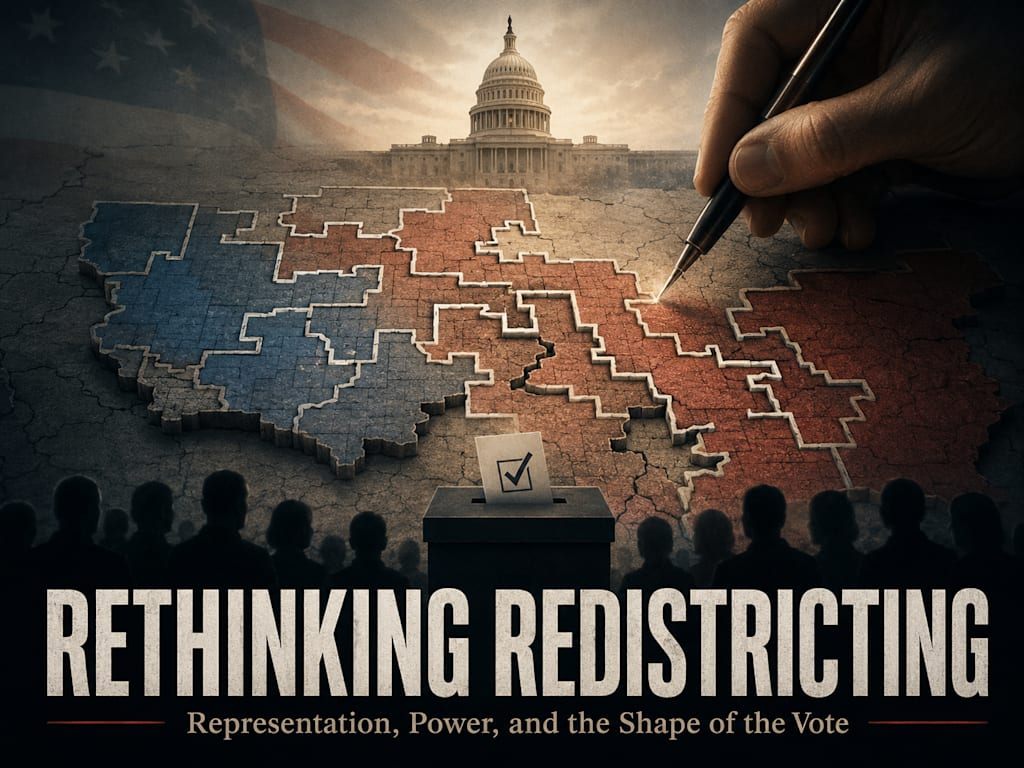
Geographic districts are necessary locally, but they can still be abused. A city can be cracked. A rural region can be split. A business corridor can be divided. A neighborhood can be attached to an unrelated area. A county can be carved in ways that weaken a particular group. Local mapmaking can still pack, crack, dilute, and manipulate. Geography should matter locally, but that does not mean every geographic district is legitimate.
The safeguards should be stronger at the local level because the communities are easier to identify. Districts should preserve municipalities where possible. Neighborhoods should not be split without a clear reason. School zones, infrastructure systems, and business corridors should be considered. Rural communities should not be attached to urban fragments without a real connection. Public hearings should require specific explanations for splits. Maps should be judged not only by equal population, but by whether they preserve recognizable places.
The standard should be practical: can residents understand why they are grouped together? Does the district reflect shared services, roads, schools, culture, economy, or municipal life? Does the representative have a coherent place to represent? If the answer is no, the district may be legal but still defective. Local geography matters because place matters. But the geography must be honest.
The Local Rule Should Be Coherence
The strongest rule for local representation is coherence. A local district should be a coherent place. It should not be a political shape that happens to contain people. It should not be a leftover population container. It should not be a partisan tool disguised as a neighborhood. It should be a district that residents can recognize as a real community or a real grouping of connected communities.
Coherence does not require uniformity. A district can contain different views, incomes, occupations, and backgrounds. The question is whether the district has enough shared local reality to justify one representative speaking for it. A town and its surrounding rural area may form a coherent district. A neighborhood and its connected business corridor may form a coherent district. A cluster of factory towns may form a coherent district. A school-service region may form a coherent district. A random slice of city voters attached to a distant rural area through a narrow corridor probably does not.
This is where compact geographic districts, municipal preservation, and communities of interest all work together. Compactness keeps the map from becoming absurd. Municipal preservation protects local identity. Communities of interest protect shared economy, culture, and practical need. None of these standards is perfect alone. Together, they make it harder to detach local government from the people and places it is supposed to serve.
Local Representation Is the Anchor of the Larger Framework
This collection questions whether geography should be the only basis for representation, especially at higher levels of government. But that critique does not weaken the case for geography locally. It strengthens it by putting geography where it belongs. Local government manages place, so local representation should be built around place. Roads, bridges, potholes, business owners, factories, schools, churches, utilities, farms, neighborhoods, and municipalities are not abstractions. They are the daily realities local government must understand.
The best representative system would not use one method everywhere. Local offices should preserve geographic districts because the office itself is tied to physical communities. State offices should balance geography with regional culture, economy, and broader values. Federal offices may justify more value-based or voter-selected alternatives because federal decisions often concern national principles rather than local infrastructure. Each level should be designed according to the thing it actually governs.
The local level proves the larger principle: representation should match the office. A city council member should know the streets. A county commissioner should understand the roads, land, businesses, and towns. A school board member should understand the families and schools. A local representative should know the place well enough to be held accountable for it. That is why local districts should not be abstracted into ideology alone. When government manages the ground people live on, the representative must know the ground.
About the Creator
Peter Thwing - Host of the FST Podcast
Peter unites intellect, wisdom, curiosity, and empathy —
Writing at the crossroads of faith, philosophy, and freedom —
Confronting confusion with clarity —
Guiding readers toward courage, conviction, and renewal —
With love, grace, and truth.
Enjoyed the story? Support the Creator.
Subscribe for free to receive all their stories in your feed.
Comments
There are no comments for this story
Be the first to respond and start the conversation.