
Unlocking the Mysteries of the Akashic Records
Exploring the spiritual library of the soul and how its wisdom may offer insight, healing, and a deeper understanding of your journey

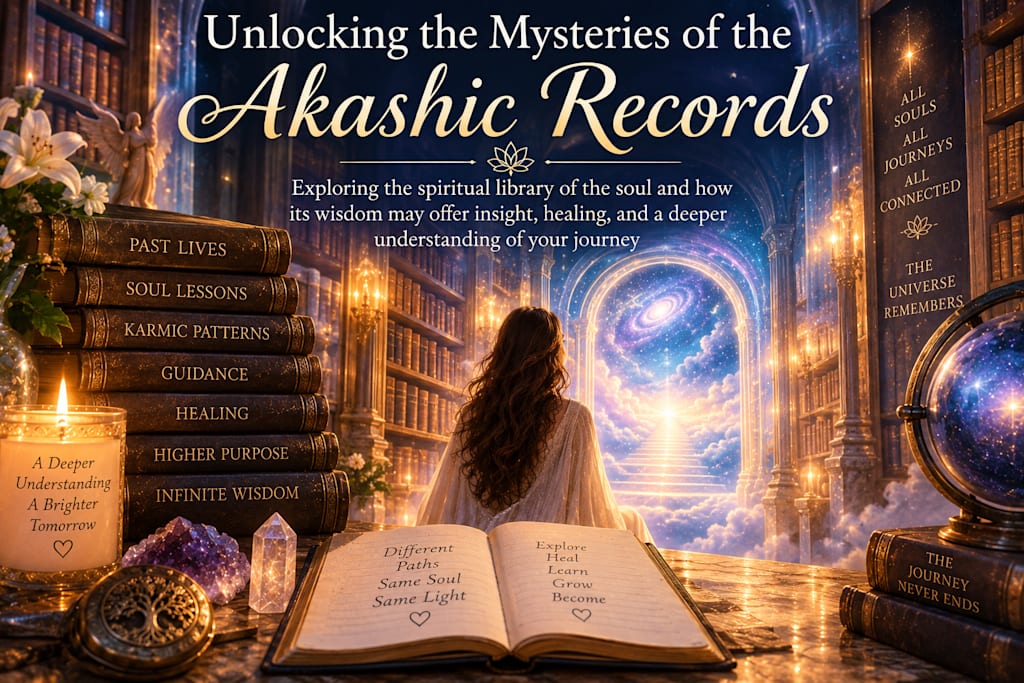
Imagine that somewhere beyond the physical world exists a library unlike any library on Earth.
There are no ordinary shelves, library cards, or dusty volumes. Instead, this library is said to contain the energetic story of every soul—its experiences, choices, relationships, lessons, and possibilities.
This mysterious spiritual archive is known as the Akashic Records.
For generations, spiritual seekers have been fascinated by the possibility that our lives may be connected to something far greater than what we can see and touch. The Akashic Records are often described as the "Book of Life," a universal library, or an energetic record of consciousness.
But what does that actually mean?
And perhaps more importantly, why are so many people interested in exploring it?
Understanding the Akashic Records
The word Akasha comes from Sanskrit and is commonly translated as "space," "ether," or "sky." Within later metaphysical and spiritual teachings, the concept became associated with an invisible realm or field of information.
Those who believe in the Akashic Records often describe them as containing energetic information connected to every soul's journey.
Rather than imagining the records as a book where the future has already been permanently written, I prefer to think of the concept as something more fluid.
Our past may influence us, but our choices continue to shape where we go next.
From this perspective, the records might contain not only experiences from the past but also patterns in the present and possibilities for the future.
That's an important distinction.
A possibility isn't necessarily a prediction.
Why Would Someone Want to Explore Their Records?
Most people aren't drawn to the Akashic Records simply because they want to know who they might have been in another lifetime.
Usually, there is a deeper question underneath the curiosity.
Why does this keep happening to me?
Why do I feel such a powerful connection to this person?
Why am I afraid of something I can't explain?
What am I supposed to learn from this experience?
Am I moving in the right direction?
Those are the kinds of questions that often lead people toward spiritual exploration.
For believers, the Akashic Records can provide a framework for looking at life from a broader perspective. Instead of seeing every difficult experience as an isolated event, a person might begin looking for patterns, lessons, or opportunities for growth.
The Records as a Tool for Self-Discovery
One of the most appealing aspects of the Akashic Records is the idea of discovering more about yourself.
It's easy to become so caught up in daily responsibilities that we stop asking ourselves meaningful questions.
What do I really want?
What matters to me now?
What am I still carrying that I need to release?
What patterns am I repeating?
What part of myself have I been ignoring?
An Akashic Records practice may create a quiet space where those questions can finally receive attention.
Even if you don't receive a dramatic spiritual revelation, the process of asking deeper questions can reveal things you've overlooked.
Sometimes the discovery itself begins with simply becoming willing to look.
Can the Akashic Records Help With Healing?
Healing is another reason people explore the records.
Within Akashic traditions, practitioners may interpret recurring emotional struggles, relationship patterns, or fears as being connected to unresolved experiences or spiritual lessons.
Some people understand these through the idea of past lives or karma. Others may view the experience more symbolically.
Either way, reflection can sometimes help us recognize what we're carrying.
Perhaps you repeatedly enter the same kind of relationship.
Maybe you struggle to establish boundaries.
Perhaps you hold onto guilt long after an experience has ended.
Recognizing a pattern doesn't automatically heal it, but awareness can be an important beginning.
Spiritual practices can complement that process, although they shouldn't replace appropriate professional care when someone is dealing with significant physical or mental health concerns.
Who Can Explore the Akashic Records?
You don't necessarily have to consider yourself psychic to explore the concept.
People who practice Akashic work use many different approaches, and some are surprisingly simple.
Meditation is one of the most common.
A person may become quiet, focus on a question, and observe the thoughts, images, emotions, or memories that emerge.
Prayer is another approach. Some practitioners use established prayers, while others create their own.
Visualization can also be helpful.
You might imagine walking toward a beautiful library, opening a glowing book, entering a peaceful room, or meeting a compassionate guide.
The imagery itself doesn't have to be literal.
It can simply give your mind a focal point while you explore whatever arises.
What Happens During an Akashic Records Reading?
Some people prefer having a session with an Akashic Records reader rather than attempting to explore the records themselves.
Practices vary considerably between readers.
A practitioner might describe images, emotions, symbols, or intuitive impressions that arise during the session. Questions may involve relationships, personal patterns, spiritual development, or decisions the person is considering.
You may hear something that immediately resonates with you.
You may also hear something that doesn't.
And that's where discernment becomes especially important.
You don't have to accept every statement simply because someone presents it as spiritual information.
A responsible spiritual practice should leave room for your own judgment.
The Importance of Spiritual Boundaries
Curiosity about another person's spiritual journey doesn't automatically give us permission to explore it.
If you believe the Akashic Records contain deeply personal information, then approaching them with respect makes sense.
Think about how you would feel if someone opened your private journal without asking.
Spiritual privacy deserves consideration too.
This is one reason I believe Akashic work should focus primarily on your own growth rather than attempting to uncover another person's secrets.
If a question involves someone else, you might instead ask:
What do I need to understand about my relationship with this person?
That keeps the focus on what you can actually control—your own choices, reactions, and growth.
What About Science?
This is an area where it's important to distinguish spiritual belief from scientific evidence.
The Akashic Records have not been scientifically demonstrated to exist, and concepts from quantum physics shouldn't be treated as proof that they do.
However, questions about consciousness, memory, intuition, and interconnectedness continue to fascinate people in philosophy, psychology, spirituality, and science.
Carl Jung's concept of the collective unconscious, for example, explored the idea that human beings may share deep psychological patterns and archetypes. Other thinkers have proposed broader theories about consciousness and information.
These ideas can make fascinating comparisons, but they aren't the same thing as scientific confirmation of the Akashic Records.
You can remain spiritually curious without requiring science to validate every spiritual experience.
Preparing for Your Own Akashic Exploration
You don't need an elaborate ceremony to begin.
Find somewhere quiet where you're unlikely to be interrupted.
Close your eyes and breathe slowly.
Allow your body to relax.
Then decide what you genuinely want to understand.
Instead of asking, Will I become successful? you might ask:
What is preventing me from moving forward?
Instead of asking, Is this person my soulmate? consider:
What is this relationship teaching me?
Questions that encourage reflection often provide more room for meaningful insight than questions demanding a simple yes or no.
Afterward, write down whatever came to you.
Don't worry about deciding immediately whether every thought was spiritual guidance, imagination, memory, or intuition.
Record first.
Interpret later.
Keep a Record of Your Experiences
A journal can become one of your most valuable tools.
Write down the date, your question, what you experienced, and how you felt afterward.
Then revisit your entries occasionally.
You may begin noticing recurring symbols or themes.
Perhaps the same issue keeps surfacing. Maybe your perspective changes over several months. Something that seemed meaningless during one meditation may suddenly make sense after another experience.
That process of reflection can sometimes be as valuable as the original session.
You Don't Have to Believe Everything You Receive
Spiritual exploration doesn't require abandoning critical thinking.
If an impression frightens you, pressures you, tells you that something terrible will happen, or encourages you to make a major decision without considering real-world consequences, stop and reflect.
Fear isn't proof of spiritual truth.
Neither is certainty.
You are still responsible for your choices.
For me, spirituality should help us become more thoughtful and compassionate—not more afraid of our own lives.
The Mystery May Be Part of the Journey
Perhaps we'll never have every answer about the Akashic Records.
Maybe that's part of what makes the subject so fascinating.
Human beings have always wondered whether our lives have meanings and connections that extend beyond what we immediately understand.
Where did we come from?
Why are we here?
What are we supposed to learn?
Does some part of us continue beyond this lifetime?
The Akashic Records offer one spiritual way of exploring those timeless questions.
Whether you understand them as an actual energetic archive, a spiritual realm, or a powerful method of inner reflection, exploring the concept can encourage you to look at your life from a different perspective.
Final Thoughts
Unlocking the mysteries of the Akashic Records may not be about discovering every secret of the universe.
Perhaps it's about discovering more of yourself.
Your patterns.
Your questions.
Your wounds.
Your possibilities.
Your growth.
Approach the practice with curiosity, patience, discernment, and an open heart. Listen to what arises without feeling that you must accept everything literally.
The greatest mystery may not be hidden somewhere in an invisible cosmic library.
It may be the extraordinary journey of understanding who you are, what you've experienced, and who you are still becoming.
Thank you for reading.
Remember, there are many paths back to God.
Follow your own path,
Brenda Marie
About the Creator
Brenda Fluharty
Brenda Marie Fluharty is an author and spiritual healer with 30+ years of experience. Creator of the God Spark spiritual healing program, she writes about dreams, intuition, healing, spiritual awakening, and personal transformation.
Enjoyed the story? Support the Creator.
Subscribe for free to receive all their stories in your feed. You could also become a paid subscriber, letting them know you appreciate their work.
Comments
There are no comments for this story
Be the first to respond and start the conversation.