
THE SECRET OF DREAM - ALEXIS KARPOUZOS
The paradoxical logic of dreams

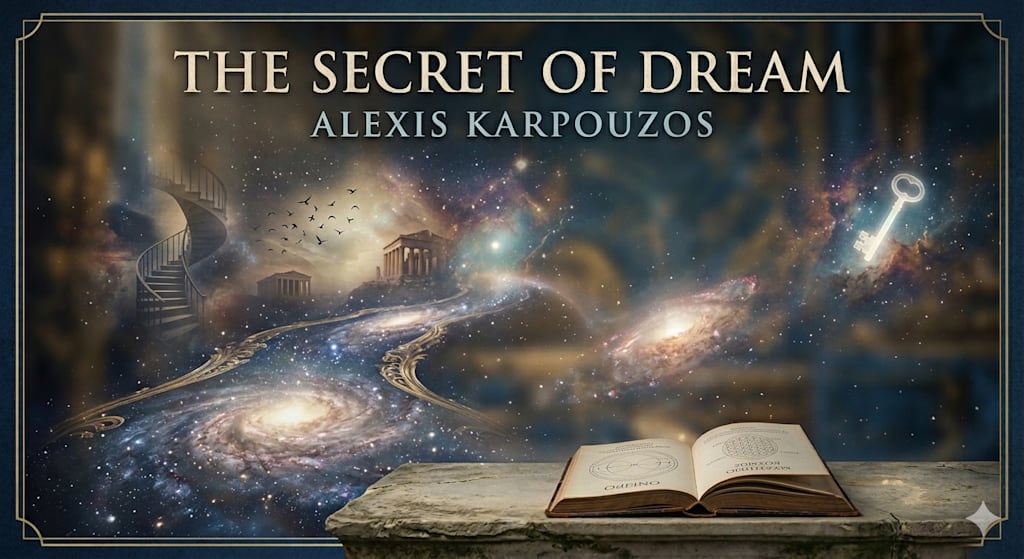
The Dream is not an object to be decoded, nor a message patiently awaiting the appropriate interpreter to reveal its content. The dream occurs prior to every distinction between subject and object, between reality and imagination, between meaning and absurdity. The interpretation of the dream can reach only a certain limit, and this limit is neither technical nor epistemological; it is ontological. What is at stake is not the inadequacy of a method, but the inability of any form of thought to fully grasp that which emerges from the unnameable depths of existence. The dream is the trace of a region where language has not yet solidified into concepts, where being has not yet crystallized into forms.
For this reason, the dream cannot be regarded merely as a product of the individual unconscious. The unconscious is not a private repository of images and repressions, but a fissure through which the cosmic uncanniness breathes. Where the soul dreams, the world continues to generate forms out of its formlessness. The dream is the secret communication between the human and the cosmic abyss, between the historicity of existence and the prehistoric silence of Chaos.
But chaos is not a single concept. There are many faces of chaos, and every civilization, every science, every poetry, every metaphysics illuminates its abyssal region differently. The chaos of mythology is not the chaos of physics. The chaos of Hesiod is not the chaos of mathematical systems, nor the chaos of psychic disintegration. Yet through these heterogeneous versions, a common movement becomes visible: the impossibility of grounding the world definitively upon a stable principle. Chaos is not the opposite of order; it is the abyssal substratum from which all orders temporarily emerge.
Science attempts to map chaos through equations, probabilities, and structures. Technology seeks to limit it, to render it calculable, predictable, and functional. Yet even the most sophisticated classifications cannot escape the fact that every system contains an internal instability, a fissure exposing it to the indeterminate. Order itself is only a temporary negotiation with chaos. Form does not abolish the abyss; it floats upon it.
Thus, the world is never a complete and self-sufficient mechanism. It is an unceasing interpretation of itself. The world interprets itself through the forms it produces, and every form is already a transformation. There is no authentic substratum preceding all interpretations as a pure and immutable essence. The primordial is not a static principle but the very movement of transformation itself. Interpretation does not arrive afterward to explain an already constituted world; interpretation participates in the genesis of the world.
For this reason, every interpretation is finite. Every philosophy, every religion, every science, every cultural paradigm is a temporary shelter within the cosmic storm. Concepts construct places of habitation within the immense expanse, but sooner or later these places fall into ruin. What once appeared as absolute truth is transformed into a trace, a fragment, an archaeological fossil from another age of the world. Yet ruins do not signify failure. They are the way in which time preserves the memory of transformations.
Time here is not a linear succession of moments. It is not a neutral container within which events occur. Time is the very disintegration of every fixed identity. It is the primordial spiral that returns beings through differentiated repetitions. Nothing returns as the same, because repetition is already transformation. Existence moves neither in circles nor in straight lines, but spirally: every return is simultaneously a distance from the point of origin.
The dream reveals precisely this spiral and non-topological nature of reality. Within the dream, the stable coordinates of the ego dissolve. Causality loses its linear necessity. Space ceases to be measurable, and time ceases to be chronological. Persons, memories, the dead, desires, fears, future possibilities, and archaic images coexist within an instantaneous unity. Everything communicates without mediation. The dream is a place without place, a time without succession.
There it becomes evident that consciousness is not the foundation of existence. The ego is merely a temporary configuration within an infinitely deeper and indeterminate field. The dream confronts us with the anonymous Openness from which both identity and its dissolution emerge. What dreams is not simply the individual, but the cosmic imaginary itself working through the individual.
Thus, within the dream, two abysses enter into dialogue: the human Id and the cosmic Id. The former is the radical imaginary of existence, the power that creates forms, symbols, images, and meanings. The latter is the radical indeterminacy of the world itself, the formless matrix from which all possibilities are born. The human imaginary is not independent of the cosmic; it is a local vibration of the cosmic abyss itself.
And yet this abyss is not pure negativity. It is not an emptiness devoid of creativity. The chaos of the world is not the negation of form, but the inexhaustible possibility of morphogenesis. From nothingness there emerges not non-being, but the poeticity of the world. This is why the dream can generate simultaneously terror and wonder, dissolution and revelation. Within it manifests the power of the world to transform itself.
The Sphere, as the name of this open Whole, is not a closed totality. It cannot be defined as a set, for every definition presupposes boundaries, whereas the Sphere is the incessant transcendence of every boundary. It is not an object of thought, but the open field within which thought, world, and chaos intertwine. It is the Set of All Sets that can never be completed, because it remains open to the infinite transformations of time.
Thus, the dream is not merely a nocturnal function of the psyche. It is a fissure through which we glimpse that the world is grounded not in a final order, but in an abyssal creativity without beginning and without end. And perhaps the most essential form of thought is not the one that attempts to eliminate this abyss through certainties, but the one that dwells poetically within its mystery.
About the Creator
alexis karpouzos
Alexis karpouzos (09/04/1967, born in Athens) is a philosopher and author. The thought of Alexis Karpouzos is characterized by the attempt to transcend traditional metaphysical oppositions and to understand the techno-scientific era.
Enjoyed the story? Support the Creator.
Subscribe for free to receive all their stories in your feed.
Comments
There are no comments for this story
Be the first to respond and start the conversation.