
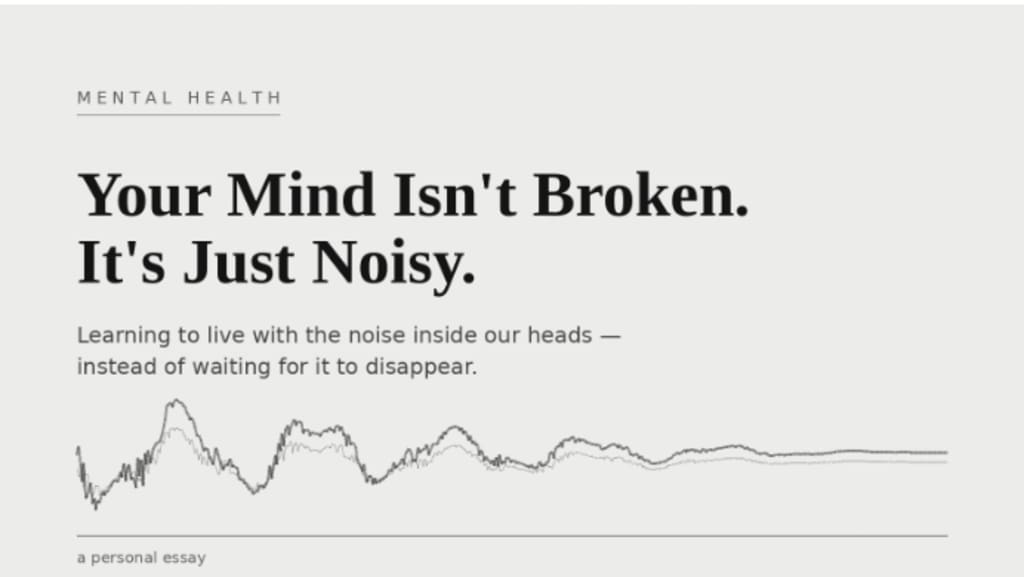
The Mind Doesn't Come With a Manual
On learning to live with the noise inside our heads instead of waiting for it to disappear
Okay, so I've been putting off writing this one for a while because I didn't know how to say it without sounding like every other "healing" post out there. But here goes anyway.
I think we've all been sold this idea that a healthy mind is supposed to run smoothly, like a well-oiled machine, and if it doesn't, something's wrong with us specifically. Nobody tells you that most people are just quietly managing their own chaos behind a normal-looking face. So this is me trying to talk about that chaos honestly, mine included, without wrapping it in a bow at the end.
There's this version of me that only comes out around 2 a.m. Replaying something I said three years ago. Wondering why it still bothers me. Wondering if everyone's brain does this or if it's just mine being dramatic. If yours does this too, hi. You're not broken. You're just a person, and your mind was never actually built to stay tidy — nobody's is.
We treat mental health like a math problem sometimes. Journal enough, sleep enough, drink enough water, and eventually you land on peace. I used to believe that too, honestly. But your mind isn't something you clean once and it just stays clean. It's more like your kitchen — you cook in it every day, so of course it gets chaotic again, no matter how well you scrubbed it last night.
I'm not writing this to hand you five steps or a neat little ending. I just want to talk about the tangle like it's a normal thing to carry, because it is.
The myth of the clean mind
At some point we all started believing a "healthy" mind means a quiet one. No intrusive thoughts, no random 11 p.m. crying, no spiraling for reasons you can't even explain. Just calm and grateful and productive, on loop, forever.
That's not real. That's a highlight reel.
From what I can tell, actual mental health isn't the absence of noise. It's figuring out how to live inside it without letting it run the whole house. For a long time I thought I was failing at "being okay" because I still had bad days even after therapy, even after all the journaling, even after doing basically everything people tell you to do. I remember sitting there thinking, I'm doing everything right, so why do I still feel like this sometimes. Turns out okay was never supposed to mean empty. It just means you're capable of feeling the storm and still making yourself breakfast anyway.
There's a quieter version of this myth too — the idea that struggling means you're doing life wrong somehow. Like if you were a little smarter, a little more disciplined, a little more grateful, it would just sort itself out. But I know people who have everything "figured out" on paper. Good job, stable relationship, solid routine. And they still lie awake with a mind that won't shut off. Struggle isn't a report card on how well you're living. It's just weather.
Carl Jung has this line I think about a lot:
"I am not what happened to me, I am what I choose to become." — Carl Jung
Not what got emptied out of me. What I actually chose to do with it after.
Naming the noise instead of hiding from it
For years my whole coping strategy was staying busy and calling it productivity. Full calendar, packed schedule, never enough quiet to actually hear what was going on in my own head. And it worked. Until it didn't. The silence always found me eventually — usually in the shower, or right before I fell asleep, when there was nothing left to hide behind.
What actually helped wasn't drowning out the noise. It was naming it.
Not "I'm stressed" but stressed about what exactly. Not "I feel off today" but off since when, and what happened right before that feeling showed up. I don't totally know why, but vague feelings feel heavier than specific ones. Unnamed noise feels endless. Once it has a name, it has edges, and edges mean you can actually do something with it.
I started keeping this note on my phone. Nothing fancy. Just a running list — anxious about the meeting. Annoyed I didn't sleep. Missing my old routine. Stuff like that. Nothing deep about it. But writing it down did the thing writing always does. Made the invisible visible.
And weirdly, the named version was almost always smaller than the shapeless one. "I'm anxious about everything" felt like drowning. "I'm anxious because I haven't heard back about that job" felt like something I could actually sit with, maybe even do something about. It didn't vanish. It just stopped being formless.
There's apparently a term for this, affect labeling — just putting a feeling into words can turn the volume down on it in your brain. I had no idea about the science part when I started doing it. I just knew a feeling with a name felt a little less like it owned me.
Fred Rogers, of all people, put it best long before anyone handed me the science:
"Anything that's human is mentionable, and anything that is mentionable can be more manageable." — Fred Rogers
Turns out Mr. Rogers was doing therapy the whole time and we just thought it was a cardigan and a trolley.
You don't owe anyone a calm face
Honestly, one of the most tiring parts of struggling is the performance of not struggling. Smiling through a rough week. Saying "I'm fine" on autopilot because it's easier than the alternative. Staying composed because falling apart feels inconvenient for everyone around you.
I've done this way more than I'd like to admit. Nodding through conversations while quietly falling apart underneath, because saying the truth felt like handing someone a problem they never signed up for. There was this one week where I told probably a dozen people "I'm good, just busy" while barely holding it together behind my phone screen. Nobody knew. That was kind of the whole point. Also, in hindsight, kind of the problem.
But here's the thing I've slowly figured out — people don't actually need you to be okay. They need you to be honest. The people who matter don't get scared off by "I'm having a hard time." They get scared off by silence. By you disappearing. By finding out months later that you were drowning the entire time and just never said anything. Every single time I've actually told someone the truth, the real version, not the polished one, the response has almost always been relief. Not judgment. Thank you for telling me. I had no idea.
There's this quote — I've seen it credited to like five different people so who even knows:
"You don't have to control your thoughts. You just have to stop letting them control you." — Unknown
It's not about shoving it all down. It's about not letting it drive.
The comparison trap
There's a specific kind of awful in scrolling past someone's curated calm on a day when your own head feels like static. Someone posting their "peaceful Sunday reset" while you're sitting there in the same hoodie you've worn for three days straight, wondering why you can't just get it together like everyone else apparently has.
It took me an embarrassingly long time to accept this, but nobody's actual internal life matches what they post. The people who look the most put together online are often carrying the loudest static in private. I've had friends admit, way after I first met them, that the version of them I admired most was the version they were working hardest to become, not the one they actually felt like most days. Comparison was never fair to begin with, honestly. You're measuring your behind-the-scenes against someone else's highlight reel. That math just doesn't work, ever.
Brené Brown said it better than I can:
"Vulnerability is not weakness; it's our most accurate measure of courage." — Brené Brown
The people who look bravest online are usually just the ones who let you see the cracks, not the ones who hid them best.
Small repairs, not grand fixes
We're obsessed with the idea of a breakthrough. The one therapy session, the one book, the one morning routine that finally fixes everything for good. But from what I've seen, mental health rarely moves in breakthroughs. It moves in small, boring repairs, done over and over until they eventually turn into structure.
There's a line, often credited to Viktor Frankl even though nobody's fully certain it's his:
"Between stimulus and response there is a space." — often attributed to Viktor Frankl
Whoever actually said it, that's where all the small repairs happen. Not in the big dramatic moment. In the tiny gap right before you decide what to do next.
Drinking water before coffee. Texting someone back instead of letting it sit for three weeks out of guilt. Going outside even when you really, really don't feel like it. Making the bed, not because it fixes anything, but because it proves you can still do one small normal thing on a hard day. None of that sounds like healing. It somehow still counts.
At some point I stopped waiting to feel "fixed" and started just noticing whether I felt slightly more functional than the day before. That became the real measure for me. Not perfect. Just moving. And some weeks that movement is barely visible — I've had stretches where the only win was getting out of bed before noon. I used to write that off as nothing. Now I think it was everything, on that particular day.
When the storm needs more than you
I want to say one more honest thing here. Sometimes naming the feeling and drinking the water and going outside just isn't enough. Sometimes the storm in your head is bigger than what any of that can hold, and that's not a personal failure, it's a signal. Therapy, medication, an actual doctor, a crisis line — none of that is a last resort for people who "couldn't handle it themselves." It's a tool, the same way a cast is a tool for a broken bone. Nobody side-eyes a cast. We shouldn't side-eye asking for help either.
Michelle Obama said it plainly once:
"Asking for help isn't a sign of weakness; it's a sign of strength." — Michelle Obama
I wish someone had told me that a decade earlier. Would've saved me a lot of nights pretending I had it handled.
The noise is not the enemy
If there's one thing I wish someone had told me way earlier, it's this — the noise in your head isn't proof something's wrong with you. It's proof you're a person who thinks and feels and remembers and actually cares about things. A perfectly organized mind isn't the goal, mostly because it doesn't exist anywhere, and chasing it just leaves you feeling like you're failing at something no one has ever actually pulled off.
Rumi wrote, centuries before anyone had a clinical name for any of this:
"The wound is the place where the light enters you." — Rumi
I don't think that means go looking for pain on purpose. I think it means stop being so afraid of the crack that you miss what's actually getting through it.
What we can do instead is get a little better at living alongside it. Naming it when we can. Being honest about it out loud. Reaching for help when it's bigger than we are. And letting ourselves have unfinished, imperfect days without treating them like some kind of verdict on who we are.
Some days the house is clean. Some days it's total chaos. It's still home either way.
And I think that's actually enough.
Because the point was never to empty the mind out completely. It was to stop being scared of what's in there. Somewhere between the 2 a.m. spirals and the ordinary Tuesdays where nothing much happens, I stopped waiting to arrive somewhere calm and started noticing I was already kind of living in it, noise and all. Maybe that's the part nobody really tells you. You don't clean your way into a calm mind. You just get a little more honest, one loud day after another, until honesty starts to feel like home too.
About the Creator
Enjoyed the story? Support the Creator.
Subscribe for free to receive all their stories in your feed.
Comments
There are no comments for this story
Be the first to respond and start the conversation.