
Pathological Narcissism and Coercive Control
Recognizing the pattern isn’t disloyalty.

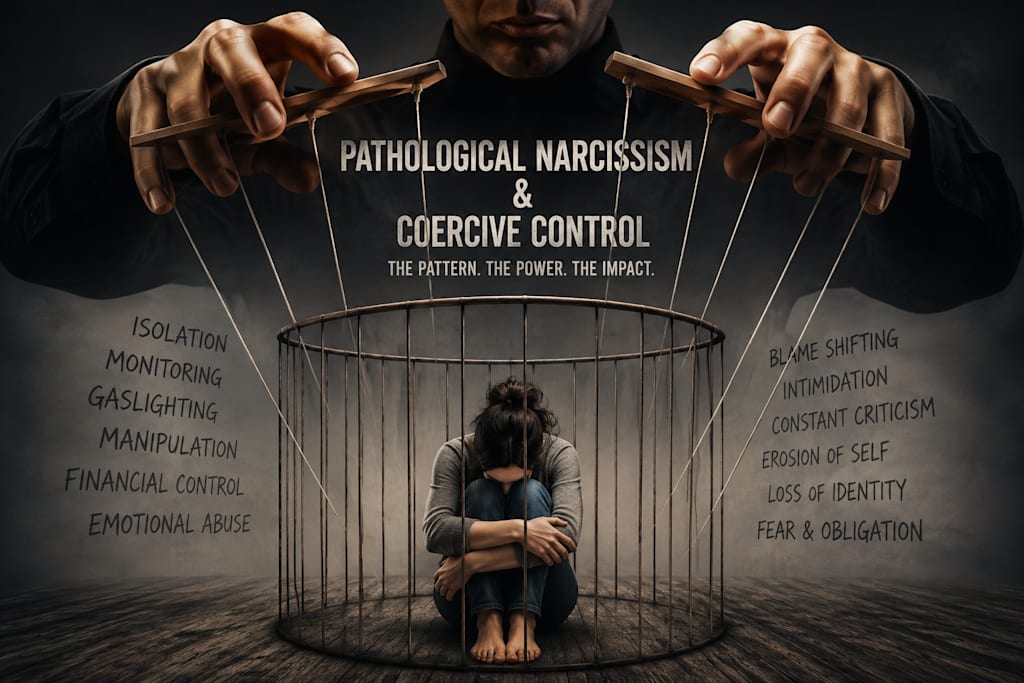
The title sounds coldly clinical, but what it describes is painfully human, and far more common than most people realize.
You start out with someone who seems confident, charming, even larger than life. They draw you in. But over time it becomes clear that simple admiration isn’t enough for them. They need to shape the entire emotional environment so that control never slips away.
Pathological narcissism goes far beyond ordinary self focus or healthy confidence. The person’s whole identity rests on feeling superior and entitled. Even small disagreements hit them like humiliation, because criticism feels like an attack on who they are at their core. Slowly, other people stop being separate individuals with their own needs. They become sources of validation when things are going well, of blame or reassurance when they’re not.
Of course, having narcissistic traits doesn’t automatically make someone abusive, and abusive dynamics can absolutely exist without narcissism being involved at all.
Coercive control is the quiet machinery that protects this fragile setup. It’s rarely loud or obvious at first. It builds through hundreds of small pressures: tracking where you go, questioning every friend or conversation, slowly restricting money, time, or access to your phone. Turning every disagreement into a lecture about loyalty, respect, or how ungrateful you’re being.
These things start small, but they compound. Friends get pushed away. Family ties weaken. Your daily life starts revolving around avoiding the next explosion before it even begins. Many people don’t fully notice how much they’ve rearranged themselves until a lot of their freedom is already gone.
When you put the two together, pathological narcissism and coercive control, you get a particularly sticky trap. The need for control becomes a defense of that carefully protected self image. Partners, family members, even colleagues end up walking on eggshells, second guessing their own reality, and somehow feeling responsible for tension they didn’t create.
Gaslighting takes the confusion even deeper. They’ll calmly rewrite what just happened, insist their version is the only real one, and frame any objection as you being oversensitive, unstable, or selfish. After enough time, you start doubting your own memory and perceptions. Once that internal doubt takes hold, they don’t have to work as hard. Part of the control is now happening inside your own head.
Not every person with narcissistic traits becomes coercively controlling, and not every coercive controller is narcissistic. But the overlap is significant. Researchers have repeatedly linked traits like entitlement, exploitation, hypersensitivity to criticism, and rage with these patterns of domination. Evan Stark, who literally wrote the book on coercive control, described it as a system of domination, isolation, surveillance, and psychological entrapment, not just random fights or isolated incidents.
That’s why the phrase “pathological narcissism and coercive control” keeps showing up in both psychology research and legal conversations. The UK made coercive control a specific crime back in 2015, and more places, including parts of the US, are finally starting to recognize it in domestic abuse laws.
Naming the pattern is powerful. It lets people see there’s a real structure behind the chaos instead of endlessly blaming themselves for “poor communication” or being “too sensitive.”
One of the hardest things about it is how invisible it looks to outsiders. No bruises. No public screaming matches. Sometimes the controlling person even comes across as unusually devoted because constant monitoring gets mistaken for care. From the outside the relationship can look stable or loving. Inside, it’s chronic fear, hypervigilance, constant adaptation, and the slow erosion of your right to be yourself.
That invisibility is exactly why so many survivors struggle to explain what happened, and why it’s so hard to leave.
If any of this resonates with you, know this: recognizing the pattern isn’t disloyalty. Just the beginning of reclaiming your reality.
About the Creator
Annam M Gordon
My books and writing focus on real people. These stories come from lived experience. I collaborate with individuals and mental health professionals. https://muckrack.com/annammgordon https://app.qwoted.com/sources/annam-m-gordon?
Enjoyed the story? Support the Creator.
Subscribe for free to receive all their stories in your feed. You could also become a paid subscriber, letting them know you appreciate their work.
Comments
There are no comments for this story
Be the first to respond and start the conversation.