
Your Posture Can Sharpen Your Jawline. It Cannot Reverse a Sagging Face.
Seated scapular squeezes improve how you sit and how your neck looks. They are not a facial anti-aging treatment.
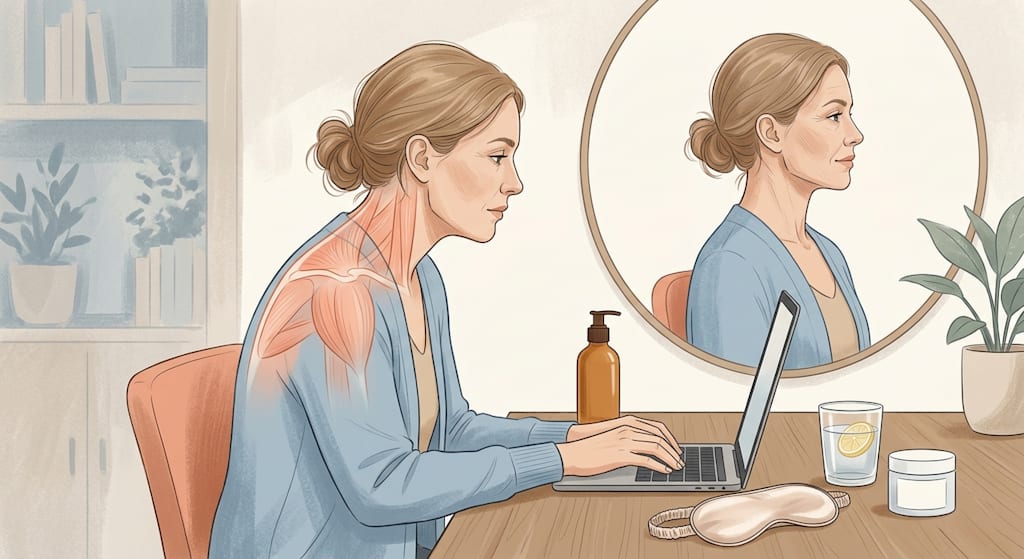
The conclusion first: seated scapular squeezes help your posture. They do not fix facial aging at the root.
The claim that rounded shoulders, a hunched upper back, and forward head posture can make a double chin more obvious and blur the jawline is valid. Strengthening the upper back, stretching the chest, and improving posture can make a person look more upright and alert. But when that logic becomes “tight shoulders and a loose back pull down facial skin, so scapular squeezes solve sagging at the root,” it crosses the boundary of anatomy and aging science.
Posture improvement is a visual bonus and a functional improvement. It is not the only answer to facial aging. Separating these two things helps you see which exercises to do every day and which expectations not to place on your shoulders and back.
Why posture changes how the face looks
Posture changes how others see you.
People who spend long hours looking down, with forward head posture and rounded shoulders, often look like this: the neck juts forward, the chin tucks slightly, the back of the neck is tight, the chest muscles are shortened, and the shoulder blades sit forward. In this position, the soft tissue from the jaw to the neck is compressed. A double chin becomes more visible. The jawline looks less clean. When you pull your head back, extend the thoracic spine, and open your shoulders, you look more alert, and the contour of your face and neck becomes cleaner.
That effect comes from posture and visual proportion.
From a muscular perspective, people who sit for long periods commonly show a predictable pattern. The pectoralis major, pectoralis minor, and anterior neck muscles tend to be short and tight. The upper trapezius and levator scapulae tend to compensate and become tight. The middle and lower trapezius, rhomboids, posterior deltoid, and other scapular stabilizers tend to be weak. The deep cervical flexors lack endurance, and forward head posture increases. Thoracic extension range of motion decreases, and breathing patterns become shallower.
So “strengthen the upper back, stretch the chest, and improve forward head posture” is a reasonable direction for postural training. Seated scapular squeeze exercises are a low-threshold way to activate the scapulae and extend the thoracic spine during long periods of sitting. They fit well into office breaks.
The problem starts with the next step: can postural tension directly pull down facial skin and cause the face to sag?
That statement is too simple.
Where the claim goes too far
Facial sagging is not a rope running from the shoulders and back to the skin of the face.
Real facial aging and sagging mainly involve loss of collagen and elastic fibers, photoaging and long-term ultraviolet damage, atrophy and displacement of facial fat pads, changes in skeletal support and volume, the long-term effect of gravity, changes in the platysma and facial expression muscles and fascia, and lifestyle factors such as genetics, hormones, weight fluctuations, smoking, and sleep.
Tension in the shoulders and back may affect neck and shoulder posture, breathing patterns, and appearance. It is not the main driver of facial skin laxity. Saying that tight shoulders and a loose back pull down facial skin and cause the face to sag is anatomically too linear. It also creates anxiety.
A more accurate statement: long-term forward head posture and rounded shoulders can make the jawline look worse, make a double chin more obvious, and increase neck and shoulder tension. Improving posture can make the face and neck contour look cleaner. It cannot replace sun protection, skincare, anti-aging care, or necessary dermatological evaluation.
Posture improvement is a visual bonus and a functional improvement. It is not the only root of facial anti-aging.
What seated scapular squeezes train
The core of seated scapular squeeze exercises is not lifting the face. It is activating the ability to retract and depress the scapulae, strengthening the middle and lower trapezius and rhomboids, improving overcompensation of the upper trapezius, increasing thoracic extension, stretching the pectoralis major and minor, and helping the neck and shoulders find an upright position during prolonged sitting.
These changes can help you sit straighter, keep your shoulders from rolling forward, reduce tightness in the back of the neck, breathe more smoothly, look more upright, and show a clearer jawline in photos and in the mirror.
Scapular squeezing is not a case where harder is better. Many people shrug, hold their breath, arch the lower back, or jut the neck forward as soon as they squeeze the shoulder blades. The back does not get trained, and the upper trapezius and back of the neck get tired first. The correct principles are simple: do not shrug, do not hold your breath, do not chase excessive range of motion, and stop immediately if there is pain.
How to practice the 10 exercises
The original post gives 10 seated exercises, each for 30 seconds, with 10 seconds of rest between movements. That arrangement works as an activation routine during long periods of sitting. You do not need all 10. Choose 4 to 6, practice 5 to 10 minutes a day, and repeat 3 to 5 times a week.
A practical combination: exercises 1, 3, and 5 for scapular retraction and back muscle activation; exercise 7 with the core tight and no lower-back arch or shrugging; exercise 9 to alternate between rounding the upper back and opening the chest; exercise 10 for a gentle side-bending stretch without pulling the neck.
Training rhythm: do 1 round first and find the 4 to 6 exercises that suit you best. After you adapt, do 2 to 3 rounds. Use 30 seconds per exercise and 10 seconds of rest. Move slowly and with control, and breathe naturally. If neck or shoulder pain, numbness in the hands, or dizziness occurs, stop and seek medical evaluation.
These exercises are low-threshold, sustainable, and able to interrupt prolonged sitting. Do not turn them into “one month of practice and your face will lift.” A more reasonable expectation: after one month, your sitting posture is more stable, your neck and shoulders are more relaxed, and your jawline looks cleaner visually.
Four things that matter more than scapular squeezes
If your goal is to improve posture and make your face and neck look cleaner, scapular squeezes alone are not enough.
Change your workstation. Raise the screen to eye level, keep the keyboard and mouse close to your body, plant your feet on the floor, and avoid prolonged forward head posture. Stand up for 2 to 3 minutes every 40 to 50 minutes of sitting. Posture is not maintained by willpower alone. It is maintained by an environment that reduces incorrect positions.
Train the deep cervical flexors. Tuck your chin without looking down, as if moving your chin horizontally backward. Hold for 5 seconds and do 10 repetitions. This exercise targets forward head posture more directly than squeezing the shoulder blades.
Do full-body strength training plus aerobic exercise 2 to 3 times a week. Train the back, glutes, and core together. This is more effective than isolated scapular squeezes. Posture is the result of whole-body tension and habits. One rhomboid muscle cannot solve it.
Address the direct factors in facial anti-aging. Sun protection, moisturizing, regular sleep, quitting smoking, controlling weight fluctuations, and dermatological evaluation when necessary have a more direct impact on a sagging face than seated scapular squeezes.
A useful metaphor
Posture is like a jacket. If the jacket is worn straight, the person looks upright, and the jawline looks cleaner. The jacket cannot determine the elasticity of the skin itself. Scapular squeezes straighten the jacket. They do not rebuild the skin.
Those exercises are worth saving and worth doing for a few minutes every day. Do not put all your anxiety about a sagging face on your shoulders and back. Posture can add points. It is not a master key.
What this means for your routine
Practice seated scapular squeezes, scapular activation, thoracic extension, and chest stretches. They have value for people who sit for long periods.
Expect more relaxed neck and shoulders, straighter sitting posture, a visually reduced double chin, and a clearer jawline.
Do not expect scapular squeezes to solve sagging at the root, replace sun protection and skincare, or reverse skin laxity.
Use a combined strategy: postural training, workstation adjustment, full-body exercise, and direct facial anti-aging management. Look at these things separately. You will neither underestimate the value of scapular squeezes nor overestimate their power.
About the Creator
Jin
Writer of reamstories
https://reamstories.com/jin
Enjoyed the story? Support the Creator.
Subscribe for free to receive all their stories in your feed. You could also become a paid subscriber, letting them know you appreciate their work.
Comments
There are no comments for this story
Be the first to respond and start the conversation.