
Your Brain Was Never Built to Learn Like a Computer: Three Neuroscience Principles That Make Learning Stick
Most people assume learning is about collecting information. Neuroscience suggests something closer to the opposite: the brain is constantly deciding what to forget.

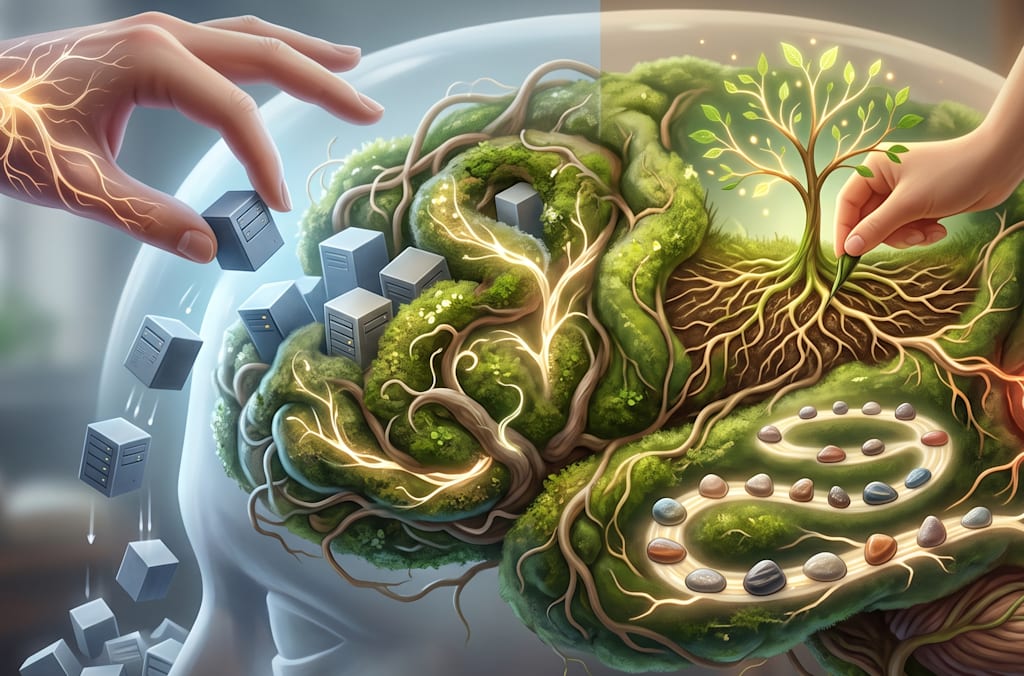
Every day your brain encounters far more information than it could ever preserve. Because preserving every experience would be metabolically costly, the brain continuously strengthens some neural pathways while allowing countless others to weaken. Forgetting, in other words, isn't a design flaw — it's one of the brain's most important learning strategies. Learning, in this framing, is not simply adding information to storage. It is a process of remodeling the brain's physical architecture, strengthening some pathways, letting others decay, and reorganizing the wiring in between. High performers may not describe what they're doing in this language, but the habits that separate fast, durable learning from forgettable exposure line up closely with what memory researchers have been documenting for decades.
Learning is less like writing words into a notebook than like maintaining a garden: every pathway that grows stronger does so because countless others are quietly pruned away.
Three principles stand out.
Learning happens during retrieval, not review
Rereading notes feels productive because it feels fluent — the material seems familiar, and familiarity is easy to mistake for mastery. But familiarity and retrievability are different things, and the difference matters enormously for what you can actually recall later, under pressure, without the notes in front of you.
Closing the material and forcing yourself to reconstruct it from memory is a different cognitive act entirely. Each act of retrieval appears to reactivate and rebuild the underlying memory trace, and that reconstruction seems to strengthen the neural network supporting it more effectively than passive re-exposure does. This is sometimes called the testing effect, and it's one of the more robust findings in the science of learning: in controlled studies, students who practiced retrieving information — even without feedback — retained it substantially better on delayed tests than students who spent equivalent time rereading the same material (Roediger & Karpicke, 2006).
The practical habit this points to is simple to state and harder to practice, because it's less comfortable than review: close the book, and try to explain the concept before you check whether you got it right. That's why explaining an idea to someone else — or even to an empty room — often reveals gaps that rereading never exposes.
The brain seems to learn more from struggle than from ease
A second thread runs through the research on what psychologist Robert Bjork has called "desirable difficulties" — conditions that slow learning down or make it feel harder in the moment, but that appear to produce more durable, flexible knowledge later. Spacing practice out over time instead of massing it together, mixing related topics instead of blocking them, and testing yourself before you feel ready all fall into this category. Each one feels less efficient in the short term than the alternative, and each one appears to outperform its more comfortable counterpart on delayed retention.
Part of the underlying mechanism may involve how the brain treats prediction error — the mismatch between what you expected and what actually happened. Dopamine neurons appear to encode this mismatch directly, firing more when an outcome is better or worse than predicted, and less when it matches expectations exactly (Schultz, 1998). A correct answer you already knew you'd get right generates little in the way of a learning signal, because there's no error to correct. An answer you got wrong, followed by the correct information, appears to generate a stronger one. Mistakes aren't merely an unavoidable cost of learning. They may be one of its primary engines.
Rest is not a pause in learning. It may be part of it.
The instinct to treat sleep as time lost to productivity gets the relationship backwards, at least as far as memory consolidation is concerned. During sleep, particularly in the hours following new learning, the hippocampus appears to replay patterns of neural activity that occurred during the original experience — a process researchers refer to as hippocampal replay (Walker & Stickgold, 2004). Neurons that fired together during learning appear to reactivate together during sleep, in a process thought to help transfer memories from the hippocampus toward more distributed, longer-term storage in the cortex. During sleep — particularly during slow-wave sleep — recently activated neural circuits are repeatedly reactivated, gradually integrating new memories into existing networks.
This doesn't mean any amount of sleep will do, or that consolidation is fully understood — the literature here is still evolving, and much of the direct replay evidence comes from animal studies with human evidence largely inferred from behavioral and imaging data. But the behavioral pattern is consistent enough to be worth taking seriously: study, then sleep, tends to outperform study, then stay awake, on tests of retention the next day.
Beyond the original three: curiosity, emotion, and movement
A few other findings extend this picture in ways worth knowing, even if they weren't the direct focus of the original piece.
States of curiosity appear to prime the brain's dopaminergic circuitry in a way that benefits memory — not just for the specific fact you were curious about, but for incidental information encountered nearby. In one study, participants who were highly curious about the answer to a trivia question were also better at remembering an unrelated face shown while they waited for the answer, suggesting curiosity may induce a temporary state of heightened learning readiness rather than a narrowly targeted one (Gruber, Gelman, & Ranganath, 2014).
Emotional salience seems to work through a related but distinct channel. The amygdala interacts with memory-forming regions in ways that appear to tag emotionally significant experiences for more durable storage, which is part of why you likely remember exactly where you were for a handful of emotionally charged moments and almost nothing about the Tuesday before or after them. Emotion doesn't guarantee accuracy — highly emotional memories can still be distorted — but it often increases the likelihood that an experience will be retained at all.
And physical exercise, particularly aerobic exercise, has been linked to increases in hippocampal volume and to improvements in memory performance in older adults — a finding that runs counter to the assumption that the hippocampus, like most brain structures, only shrinks with age (Erickson et al., 2011). The mechanism isn't fully settled, but exercise-induced increases in brain-derived neurotrophic factor (BDNF) are one of the more studied candidates.
Working with the system instead of against it
None of this suggests high performers have exceptional memories or unusual natural gifts. What the research suggests, more modestly, is that some people — often without knowing the underlying neuroscience — have stumbled into habits that work with how memory actually forms rather than against it. They retrieve instead of reread. They tolerate the discomfort of struggle instead of optimizing it away. They treat sleep, curiosity, emotional engagement, and even physical movement as inputs to learning rather than interruptions to it.
The brain was never designed to function like a hard drive, storing everything equally. It is a living system that continuously edits itself according to what is retrieved, challenged, revisited, and emotionally meaningful. The encouraging implication is that better learning isn't reserved for people born with extraordinary intelligence. It is a consequence of repeatedly working with the brain's biology instead of against it.
Scientific References
Roediger, H. L., & Karpicke, J. D. (2006). Test-enhanced learning: Taking memory tests improves long-term retention. Psychological Science, 17(3), 249–255.
Bjork, R. A., & Bjork, E. L. (2011). Making things hard on yourself, but in a good way: Creating desirable difficulties to enhance learning. In Psychology and the Real World: Essays Illustrating Fundamental Contributions to Society (pp. 56–64).
Schultz, W. (1998). Predictive reward signal of dopamine neurons. Journal of Neurophysiology, 80(1), 1–27.
Walker, M. P., & Stickgold, R. (2004). Sleep-dependent learning and memory consolidation. Neuron, 44(1), 121–133.
Gruber, M. J., Gelman, B. D., & Ranganath, C. (2014). States of curiosity modulate hippocampus-dependent learning via the dopaminergic circuit. Neuron, 84(2), 486–496.
Erickson, K. I., Voss, M. W., Prakash, R. S., et al. (2011). Exercise training increases size of hippocampus and improves memory. Proceedings of the National Academy of Sciences, 108(7), 3017–3022.
About the Creator
Khali Sollis
Khali Sollis is a writer and independent researcher exploring the science of the human mind and behavior. Her work examines questions at the intersection of neuroscience, psychology, cognition, mental health, and everyday human experience.
Enjoyed the story? Support the Creator.
Subscribe for free to receive all their stories in your feed.
Comments
There are no comments for this story
Be the first to respond and start the conversation.