
Why Your Brain Loves Watching Animals Do Absolutely Nothing
The surprising psychology behind cute animal videos, stress relief, and the science of kawaii.

It is late. You have answered an indecent number of emails, at least two of which promised to “circle back.” You have looked at your bank balance and quietly closed the app. You have read a headline, then another, then made the mistake of reading the comments. Your brain feels like a browser with forty tabs open, one of them playing music you can’t find.
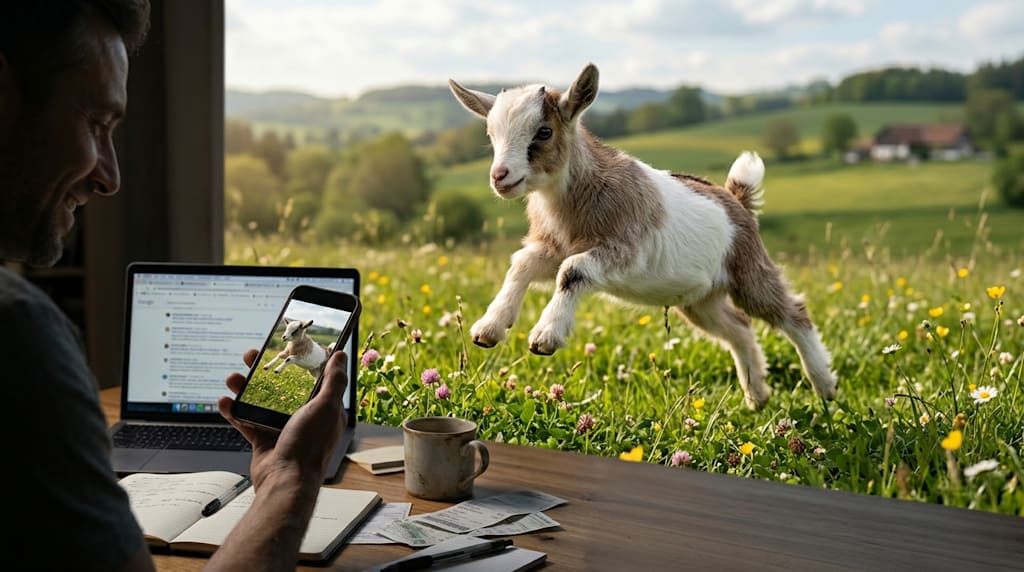
Then, while scrolling with the thumb of someone who has given up, a video appears. A baby goat stands in a field. Nothing threatens it. Nothing provokes it. And for no reason at all, it springs sideways, all four legs leaving the ground at once, as if the earth had briefly offended it.
Thirty seconds later, you’re smiling. The goat has done more for your mood than three motivational podcasts and a productivity planner you never opened.
This is strange when you think about it. Nothing in your life has changed. The emails are still there. The bills haven’t paid themselves. So why does a small animal doing something pointless feel so restorative? Psychology has some interesting answers, and some honest gaps.
The power of kawaii
In 2012, a team at Hiroshima University led by psychologist Hiroshi Nittono took cuteness seriously enough to put it in a lab. Across three experiments with 132 university students, they tested whether looking at cute images changed how people performed on unrelated tasks.
In the first experiment, students played a version of the children’s game Operation, plucking tiny pieces from holes with tweezers. Between rounds, they looked at seven photos, either of puppies and kittens or of adult dogs and cats. Performance improved by about 44% after the baby animals, compared with about 12% after the adult ones. The students who saw puppies also took longer to finish. Cuteness didn’t make them faster or smarter. It made them more deliberate.
The second experiment swapped the tweezers for a visual search task, a test of attention rather than steady hands. Viewing baby animals improved performance by roughly 16%, adult animals by about 1%, and pictures of pleasant food barely moved the needle. So this wasn’t just “nice pictures put people in a good mood.” Cuteness did something that cake did not.
The third experiment offered a possible explanation. People normally process the big picture before the details, a forest-before-trees bias. After seeing baby animals, that big-picture advantage shrank. The researchers interpreted this as a sign that cuteness may narrow attentional focus, perhaps because the emotion is tied to approaching and tending to something small. It’s a plausible reading, not a fully mapped mechanism.
Before you frame this research above your desk, a caveat. These were still photographs, viewed by Japanese university students, measured on task performance. The study shows that cuteness can change attention. It does not show that animal videos improve mood or relieve stress. The authors themselves noted that kawaii is a culturally specific concept that doesn’t map perfectly onto the English word “cute.”
The face that runs your brain
Why would baby animals have this effect at all? In 1943, Austrian ethologist Konrad Lorenz proposed an answer he called Kindchenschema, or baby schema: a set of infantile features, such as a round face and large eyes, that people perceive as cute and that motivate caretaking, with the evolutionary function of helping offspring survive.
For decades this was a persuasive idea with surprisingly little direct testing on real faces. In 2009, Melanie Glocker and colleagues digitally altered photographs of human infants to strengthen or weaken those features. The study recruited 122 undergraduates, with 106 included in the final analyses. Participants rated faces with stronger baby-schema features as cuter and reported greater motivation to care for them.
A follow-up brain-imaging study of 16 women who had never given birth went further. Faces with more baby-schema features produced greater activation in the nucleus accumbens, a region involved in reward and motivation. Two cautions apply. fMRI tracks changes in blood oxygenation, not the release of any particular chemical. And neither study watched anyone actually caring for a baby.
Now look again at that goat: oversized eyes, a rounded head, legs that seem borrowed from a larger animal. Baby animals share many of these features, and a 2014 study found that baby-schema features in both human and animal faces shaped cuteness ratings and attention in children. Still, the brain research concerns human infants, not goats. The phrase “floods your brain with dopamine” belongs to wellness marketing, not to these papers.
Thirty minutes of quokkas
What about stress? The study most often cited here is a small University of Leeds project conducted with Tourism Western Australia. Nineteen participants, most of them students facing exams and the rest stressed staff members, watched a 30-minute montage of cute animal images and videos, including kittens, puppies, baby gorillas, and quokkas.
The university reported that heart rates dropped, that the group’s average blood pressure moved into a healthy range, and that situational anxiety fell, by nearly half for some individuals. Participants described the session as relaxing and enjoyable.
It’s a charming result, and it should be read as exactly what it is. The findings were publicized through university and partner communications rather than a peer-reviewed paper, co-sponsored by a tourism board promoting the very animal on screen. The available account describes no control group, which matters, because thirty quiet minutes away from exam revision might calm anyone, with or without quokkas. The Leeds study is a fascinating hint, not a finding.
A larger, if different, piece of evidence comes from Indiana University’s Jessica Gall Myrick. In a survey of 6,795 internet users, she found that people associated watching cat media with more energy, more positive feelings, and fewer negative emotions, and said their enjoyment outweighed any guilt about procrastinating. But the study relied on people’s own accounts of their experiences, not on measuring mood before and after a viewing session. Many respondents were also recruited through the social media of a famous internet cat, hardly a neutral audience.
It’s plausible that a pleasant, low-stakes image briefly pulls attention away from the loop of worry, like someone tapping your shoulder and pointing out the window. The research makes that explanation reasonable. It hasn’t proven it.
The goat, not the abyss
Every finding above involves a short exposure: seven photographs, a thirty-minute session, a quick break. None of it describes an hour of scrolling at midnight while the email you were avoiding grows teeth.
Myrick’s study captured this tension well. Many people watched cat videos at work or while studying, precisely when they were supposed to be doing something else. The pleasure was real. So was the procrastination. A restorative moment and a compulsive loop can begin with the same goat. The difference lies in what happens next: whether you close the app feeling lighter, or look up to discover that forty minutes have vanished and the goat has been replaced by a man shouting about cryptocurrency.
And not everyone responds the same way. Myrick found that cat owners, and people who described themselves as agreeable, anxious, or shy, were more likely to watch cat videos. Someone bitten by a dog as a child may not find a puppy calming. Someone who recently lost a pet might find a kitten video more heartbreaking than healing. The same clip that delights you on a lazy Sunday might irritate you when a colleague sends it during a crisis. Cuteness is a powerful key, but not every lock is the same.
What the goat knows
So why does the baby goat work? Probably for several reasons at once. Its features echo the infant faces that, the theory goes, our species evolved to notice and protect. Cute images can make our attention narrower and more careful, at least in the lab. And for a few seconds, the goat may crowd out the noise of everything else, offering a small pleasure in a day that gave us few.
The goat, of course, knows none of this. It has never heard of emotional regulation, attentional focus, or the nucleus accumbens. It isn’t trying to help. It is simply alive, in a field, and apparently thrilled by the fact.
Then it jumps sideways again, for no reason anyone can explain.
And somewhere, at the end of a long and complicated day, a tired human briefly forgets the emails and remembers what it feels like to be delighted by nothing at all.
References
Borgi, M., Cogliati-Dezza, I., Brelsford, V., Meints, K., & Cirulli, F. (2014). Baby schema in human and animal faces induces cuteness perception and gaze allocation in children. Frontiers in Psychology, 5, 411. https://doi.org/10.3389/fpsyg.2014.00411
Glocker, M. L., Langleben, D. D., Ruparel, K., Loughead, J. W., Gur, R. C., & Sachser, N. (2009). Baby schema in infant faces induces cuteness perception and motivation for caretaking in adults. Ethology, 115(3), 257–263. https://doi.org/10.1111/j.1439-0310.2008.01603.x
Glocker, M. L., Langleben, D. D., Ruparel, K., Loughead, J. W., Valdez, J. N., Griffin, M. D., Sachser, N., & Gur, R. C. (2009). Baby schema modulates the brain reward system in nulliparous women. Proceedings of the National Academy of Sciences, 106(22), 9115–9119. https://doi.org/10.1073/pnas.0811620106
Myrick, J. G. (2015). Emotion regulation, procrastination, and watching cat videos online: Who watches Internet cats, why, and to what effect? Computers in Human Behavior, 52, 168–176. https://doi.org/10.1016/j.chb.2015.06.001
Nittono, H., Fukushima, M., Yano, A., & Moriya, H. (2012). The power of kawaii: Viewing cute images promotes a careful behavior and narrows attentional focus. PLOS ONE, 7(9), e46362. https://doi.org/10.1371/journal.pone.0046362
University of Leeds. (2020). What are the health benefits of watching cute animals? School of Biomedical Sciences news. Institutional report of preliminary, industry-partnered research; not peer-reviewed. https://biologicalsciences.leeds.ac.uk/site/news/article/273/what-are-the-health-benefits-of-watching-cute-animals
About the Creator
Khali Sollis
Khali Sollis is a writer and independent researcher exploring the science of the human mind and behavior. Her work examines questions at the intersection of neuroscience, psychology, cognition, mental health, and everyday human experience.
Enjoyed the story? Support the Creator.
Subscribe for free to receive all their stories in your feed.
Comments
There are no comments for this story
Be the first to respond and start the conversation.