
Whose Gut Became "Normal"?
A new scientific argument suggests that gut-brain research may have quietly mistaken the biology of one narrow slice of humanity for the biology of all of it.

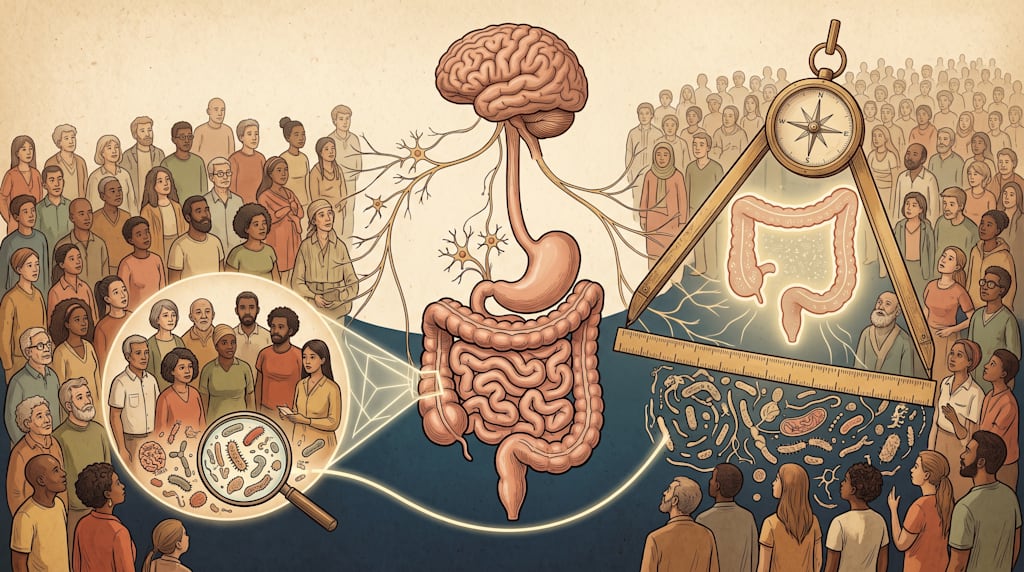
Imagine a team of scientists sets out to define the healthy human gut. They recruit thousands of volunteers, sequence trillions of microbes, and build an elegant statistical portrait of what a "normal" microbiome looks like. There's just one detail worth noticing: nearly everyone in the study lives in a large city, eats food that arrived in a package, has taken antibiotics more than once, drinks treated tap water, rarely touches soil, and has not hosted an intestinal parasite in their life.
Is that portrait a picture of human biology? Or is it a picture of a particular way of living — one that happens to be shared by the people who had the funding, the laboratories, and the institutional proximity to get studied?
This is not a hypothetical. It is, in effect, the situation that a group of microbiome researchers has just described in the pages of Nature Mental Health. And the case they make is more interesting than a simple call for fairness. It's an argument about what science can and cannot know when it keeps looking in the same place.
A frontier built on a narrow foundation
Over the past two decades, the study of the gut-brain relationship has become one of the more genuinely surprising stories in biomedical science. Researchers have mapped an intricate communication network linking the trillions of microorganisms in the intestines to the immune system, the metabolism, the endocrine system, and — through the vagus nerve and other pathways — the brain itself [1]. This network, often called the microbiome-gut-brain axis, is bidirectional: the brain can influence gut physiology and the microbial communities living there, just as gut microbes and their byproducts can influence immune signaling and neural activity [1][2].
It's worth being precise about what that means and doesn't mean. The evidence for this communication system is substantial at the level of mechanism — hormone signaling, short-chain fatty acids produced by gut bacteria, immune messengers, and neural pathways have all been documented, largely through careful animal studies and cell biology [1][3][4][5]. In humans, the picture is more provisional: researchers have found associations between microbial composition and conditions like depression and anxiety, and some plausible biological routes by which those associations might arise [1]. What has not been established, at least not with anything like the certainty implied by the popular phrase "your gut controls your brain," is that manipulating gut bacteria reliably treats or prevents psychiatric illness in humans. Association is not mechanism, and mechanism is not proof of clinical cause. Each of those is a different, harder-won claim, and serious researchers in the field are careful to keep them separate.
The new Perspective, led by bioinformatician Benjamin Valderrama and neuroscientist John Cryan of APC Microbiome Ireland at University College Cork, along with collaborators from Brazil, South Africa, Kenya, and the UK, doesn't dispute any of that. It's a Perspective piece — an argument grounded in existing evidence, not a new experiment or trial. What it argues is something more structural: that the evidence base underlying the entire field has been built from a strikingly unrepresentative slice of the human population, and that this may be distorting the science itself, not merely its fairness [6].
The number that's easy to miss
Here is a fact that puts the argument in concrete terms. A 2022 analysis in PLOS Biology examined nearly 445,000 human microbiome samples deposited in the world's largest genomic repositories. It found that more than 71 percent of samples with a known geographic origin came from Europe, the United States, and Canada — and that samples from the United States alone made up close to half of the total, despite the U.S. accounting for only about 4 percent of the global population [7]. A subsequent effort to integrate more than 168,000 gut microbiome samples into a single global dataset confirmed a similarly lopsided geographic footprint [8].
That imbalance isn't just an accounting problem. It shapes what counts, scientifically, as a baseline. When a field builds its reference points — its sense of what a "typical" or "healthy" microbiome contains — almost entirely from people living in wealthy, industrialized, urban environments, it risks mistaking the biological signature of that lifestyle for the biological signature of the species. Researchers who study the concept of a "healthy microbiome" have pointed out that the very idea may not translate cleanly across environments at all — there may be no single reference state that qualifies as universally normal, independent of the conditions a person actually lives in [9].
Why the sampling problem is a scientific problem, not just a fairness problem
It's tempting to file this under the broader, familiar conversation about diversity in research — the idea that studies should include more kinds of people because it's the right thing to do. That's true, but it undersells the argument. The authors of the Perspective are making a claim about validity, not just representation.
Consider an analogy. If every person in a nutrition study ate almost exactly the same diet, a researcher trying to measure the effect of diet on health would struggle — there wouldn't be enough variation in the data to detect it. Diet's influence would essentially be invisible, camouflaged as background noise, even though it might be doing enormous biological work. Now scale that logic up to everything that shapes the human microbiome: not just diet, but urbanization, sanitation infrastructure, antibiotic exposure, contact with soil and animals, exposure to parasites and other microorganisms, migration, and socioeconomic conditions [10][11]. If the population being studied is homogeneous across most of these variables, their influence becomes very hard to isolate — not because it isn't real, but because there's no contrast in the data to reveal it.
This is the distinction researchers draw between internal validity and generalizability. A study can be rigorously designed, statistically sound, and entirely trustworthy for the population it actually sampled, while still failing to describe humans in general. Both things can be true simultaneously: the finding is real, and the finding is not universal. Recognizing that distinction is not a critique of any individual study. It's a recognition that no single population, however carefully studied, can stand in for the full range of environmental conditions under which human biology expresses itself.
Nature's own experiments
The Perspective's most conceptually interesting move is to reframe global inequality in research access as a scientific opportunity rather than only a deficit to correct. Many low- and middle-income countries are, right now, undergoing rapid shifts in diet, urbanization, sanitation, and lifestyle — often compressed into a single generation, sometimes within a single region or even a single family. Researchers call this kind of setting a "natural experiment": a real-world situation, not designed or controlled by scientists, in which a variable of interest changes in ways that would be difficult or unethical to engineer deliberately in a lab [12][13].
There is already suggestive evidence of what these transitions reveal. A study of gut microbiomes across the process of urbanization in the Brazilian Amazon found measurable shifts in microbial composition tracking the degree of urban contact [14]. Comparable work in South Africa found that urban and rural gut microbiomes differ in ways that don't simply split into two neat categories, but show a more gradual, transitional structure — suggesting the microbiome shifts along a continuum as environments change, rather than snapping between two fixed states [15]. And a landmark 2015 study comparing hunter-gatherer, traditional agriculturalist, and urban-industrialized communities in Peru and the United States found consistent taxonomic and functional differences tracking those lifeways — including the near-total absence, in urban-industrialized guts, of certain bacterial groups that are common in traditional populations [16].
None of this proves that these differences directly shape mental health outcomes — that causal chain, from environment to microbiome to brain, remains an active and still-developing area of research. What it does show is that environmental transitions generate exactly the kind of variation that a field built largely on comparatively similar high-income populations may struggle to detect.
What broader sampling might eventually illuminate
The Perspective's authors are careful — and the underlying literature backs their caution — not to promise cures. But they do sketch a set of scientifically grounded questions that wider sampling could help answer: how differences in microbial exposure relate to stress resilience, and how metabolites produced by gut bacteria might interact with immune signaling and brain function [17][2]. There is early evidence, for instance, that circulating short-chain fatty acids — metabolic byproducts of bacterial fermentation — are associated with depression severity in some human studies [18]. Researchers have also proposed that certain organisms once common across much of humanity, and now largely absent from industrialized guts, may have played immune-regulatory roles worth understanding better — an idea sometimes discussed under the "old friends" hypothesis [11]. None of this is settled science. It's a set of open, testable questions, and the point isn't to catalog every one of them here — it's that a field with a broader evidence base would be far better positioned to pursue them at all.
It's also worth being explicit about what this argument does not claim. It does not claim that traditional or lower-income ways of life are healthier, or that poverty, limited sanitation, or untreated infection are secretly beneficial. Reduced access to clean water and modern medicine causes enormous, well-documented harm [19][20]. The scientific point is narrower and more precise: different environments expose human biology to different variables, and studying that variation is how researchers learn which biological patterns are fundamental to being human and which are artifacts of one particular way of living.
It's equally worth resisting the opposite temptation — treating "the Global South" as a single, uniform place, or its traditional diets and lifeways as a pristine ancestral baseline waiting to be rediscovered. Latin America, Africa, and Asia are not interchangeable, and within each region, urban and rural life, wealth and poverty, coastal and inland, produce wildly different environmental exposures. "Global South" is a geopolitical shorthand, useful for describing a pattern of underrepresentation in research funding and infrastructure, not a description of any single biological or cultural reality [21].
What "normal" actually means in science
There's a deeper thread running underneath all of this, one that reaches well beyond gut bacteria. Science regularly discovers that something it once called a universal feature of human nature was, in fact, a feature of the specific humans it happened to study. This has happened before, in genetics, in psychology, in medicine — fields that built their foundational theories from samples that were disproportionately Western, educated, and drawn from industrialized societies, then had to revisit those theories as more of the world came into view [22].
The interesting question raised by this new argument isn't "are people in different countries biologically different from one another?" — that framing flattens a much richer question into something closer to trivia. The more useful question is how our shared human biology expresses itself differently across the extraordinary range of environments people actually inhabit. That's not a question about difference for its own sake. It's a question about which parts of what we call "normal" are load-bearing biology, and which parts are simply the conditions we happened to be looking at when we wrote the definition down.
Scientific rigor is usually described in terms of controlling variables — clean experimental design, careful statistics, replication. All of that matters. But there's a second, quieter form of rigor that gets less attention: knowing whether the population in front of you captures enough of the variation that actually exists in the world to let you draw a general conclusion at all. A microscope can only resolve what's placed beneath it. If the slide never changes, no amount of magnification will show you what else is out there.
The next genuinely significant discovery about the human gut and the human brain may not depend on a more powerful sequencer or a larger cohort recruited from the same few cities. It may depend on something much simpler and much harder: looking somewhere science has not yet thought to look, and being willing to let what's found there rewrite the definition of "typical."
References
Cryan, J. F. et al. "The microbiota–gut–brain axis." Physiological Reviews 99, 1877–2013 (2019). https://doi.org/10.1152/physrev.00018.2018
Chang, H. et al. "Stress-sensitive neural circuits change the gut microbiome via duodenal glands." Cell 187, 5393–5412 (2024). https://doi.org/10.1016/j.cell.2024.07.019
Nøhr, M. K. et al. "GPR41/FFAR3 and GPR43/FFAR2 as cosensors for short-chain fatty acids in enteroendocrine cells vs FFAR3 in enteric neurons and FFAR2 in enteric leukocytes." Endocrinology 154, 3552–3564 (2013). https://doi.org/10.1210/en.2013-1142
Lal, S., Kirkup, A. J., Brunsden, A. M., Thompson, D. G. & Grundy, D. "Vagal afferent responses to fatty acids of different chain length in the rat." American Journal of Physiology - Gastrointestinal and Liver Physiology 281, G907–G915 (2001). https://doi.org/10.1152/ajpgi.2001.281.4.G907
Erny, D. et al. "Host microbiota constantly control maturation and function of microglia in the CNS." Nature Neuroscience 18, 965–977 (2015). https://doi.org/10.1038/nn.4030
Valderrama, B., Morais, L. H., Lavelle, A. et al. "Global mental health benefits from expanding microbiome–gut–brain axis research to the global south." Nature Mental Health 4, 1207–1215 (2026). https://doi.org/10.1038/s44220-026-00690-w
Abdill, R. J., Adamowicz, E. M. & Blekhman, R. "Public human microbiome data are dominated by highly developed countries." PLOS Biology 20, e3001536 (2022). https://doi.org/10.1371/journal.pbio.3001536
Abdill, R. J. et al. "Integration of 168,000 samples reveals global patterns of the human gut microbiome." Cell 188, 1100–1118 (2025). https://doi.org/10.1016/j.cell.2024.12.017
Joos, R. et al. "Examining the healthy human microbiome concept." Nature Reviews Microbiology 23, 192–205 (2025). https://doi.org/10.1038/s41579-024-01107-0
Chen, Y. et al. "Environmental determinants and demographic influences on global urban microbiomes, antimicrobial resistance and pathogenicity." npj Biofilms and Microbiomes 9, 94 (2023). https://doi.org/10.1038/s41522-023-00459-4
Rook, G. A. W., Raison, C. L. & Lowry, C. A. "Microbial 'old friends', immunoregulation and socioeconomic status." Clinical & Experimental Immunology 177, 1–12 (2014). https://doi.org/10.1111/cei.12269
de Vocht, F. et al. "Conceptualising natural and quasi experiments in public health." BMC Medical Research Methodology 21, 32 (2021). https://doi.org/10.1186/s12874-021-01224-x
Leatherdale, S. T. "Natural experiment methodology for research: a review of how different methods can support real-world research." International Journal of Social Research Methodology 22, 19–35 (2019). https://doi.org/10.1080/13645579.2018.1488449
Schaan, A. P. et al. "The structure of Brazilian Amazonian gut microbiomes in the process of urbanisation." npj Biofilms and Microbiomes 7, 65 (2021). https://doi.org/10.1038/s41522-021-00237-0
Tamburini, F. B. et al. "Short- and long-read metagenomics of urban and rural South African gut microbiomes reveal a transitional composition and undescribed taxa." Nature Communications 13, 926 (2022). https://doi.org/10.1038/s41467-021-27917-x
Obregon-Tito, A. J. et al. "Subsistence strategies in traditional societies distinguish gut microbiomes." Nature Communications 6, 6505 (2015). https://doi.org/10.1038/ncomms7505
Kern, L., Mastandrea, I., Melekhova, A. & Elinav, E. "Mechanisms by which microbiome-derived metabolites exert their impacts on neurodegeneration." Cell Chemical Biology 32, 25–45 (2025). https://doi.org/10.1016/j.chembiol.2024.08.014
Schiweck, C. et al. "Circulating short chain fatty acids are associated with depression severity and predict remission from major depressive disorder." Brain, Behavior, & Immunity - Health 48, 101070 (2025). https://doi.org/10.1016/j.bbih.2025.101070
Naghavi, M. et al. "Global burden associated with 85 pathogens in 2019: a systematic analysis for the Global Burden of Disease Study 2019." Lancet Infectious Diseases 24, 868–895 (2024). https://doi.org/10.1016/S1473-3099(24)00158-0
Vos, T. et al. "Global burden of 369 diseases and injuries in 204 countries and territories, 1990–2019." Lancet 396, 1204–1222 (2020). https://doi.org/10.1016/S0140-6736(20)30925-9
Woelbert, E., Lundell-Smith, K., White, R. & Kemmer, D. "Accounting for mental health research funding: developing a quantitative baseline of global investments." Lancet Psychiatry 8, 250–258 (2021). https://doi.org/10.1016/S2215-0366(20)30469-7
Greely, H. T. "Human genome diversity: what about the other human genome project?" Nature Reviews Genetics 2, 222–227 (2001). https://doi.org/10.1038/35056071
About the Creator
Khali Sollis
Khali Sollis is a writer and independent researcher exploring the science of the human mind and behavior. Her work examines questions at the intersection of neuroscience, psychology, cognition, mental health, and everyday human experience.
Enjoyed the story? Support the Creator.
Subscribe for free to receive all their stories in your feed.
Comments
There are no comments for this story
Be the first to respond and start the conversation.