
When Parents Look Down, Children Feel Left Behind: What Smartphone Distraction Is Doing to Family Bonds
Emerging research reveals how everyday smartphone distractions may quietly reshape children's sense of emotional security.

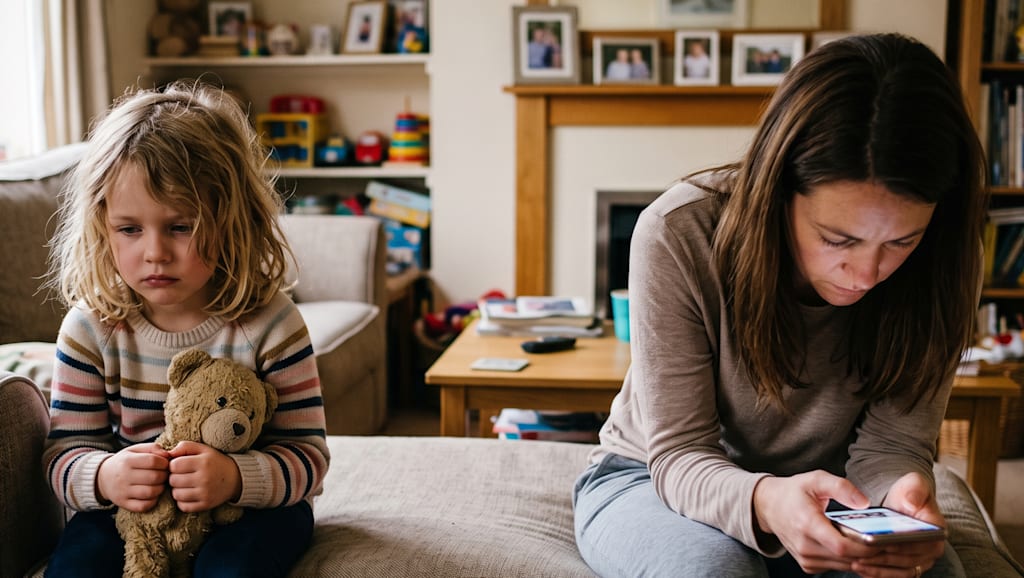
A ten-year-old runs into the kitchen holding a drawing she just finished. Her mother is scrolling through a work email, thumb moving in that particular rhythm of half-attention, and she says "uh-huh, that's great, honey" without looking up. The girl waits a beat, then leaves. Nothing dramatic happens. No one raises their voice. The moment simply passes, unremarked, and is gone.
Multiply that scene by a thousand, by ten thousand, across the years of a childhood, and you start to get at the question a new study has been trying to answer: what happens to a child's sense of security when the person they depend on most is present in body but only partially present in mind?
Consider the scale of the pull involved. A 2026 consumer survey by Reviews.org found that American adults check their phones an average of 186 times a day, or roughly once every five waking minutes, based on self-reported responses from about 1,000 U.S. adults. That figure is a self-report, not a device-measured count, so it should be read as a rough gauge of behavior rather than a precise tally. Independent research that tracks phone use objectively, through screenshots of built-in device logs rather than memory, has found daily pickup counts in a broadly similar range among adolescents, which suggests the general order of magnitude holds up even when the measurement method changes. Whatever the exact number, the takeaway is the same: each of those pickups is a small shift of attention away from whatever, or whoever, was happening in the room. Most parents are not choosing a device over their child in any deliberate sense. They are responding, dozens of times a day, to a piece of technology engineered specifically to demand that response.
That question is not new to parents, who have felt the tug of guilt every time a notification pulls their eyes away from a child's face. But it is relatively new to science. A study published in the journal Frontiers in Psychology has given the phenomenon a name, a measurement tool, and—for the first time—direct evidence linking adolescents' perceptions of parental phone distraction to their attachment security.
The New Study
The research team, led by media psychologist Dr. Don Grant, recruited roughly 600 adolescents between the ages of 12 and 17 from across the United States, aiming for a sample broadly representative of the general population. Rather than relying on existing measures, which were mostly built for younger children or clinical populations, the researchers developed a new instrument specifically for this question: the Device Attachment Interference Scale, or DAIS.
The DAIS asks teenagers to reflect on how often a primary caregiver's device use interferes with attention, emotional availability, and everyday interaction—not just how many hours a parent spends on a phone, but whether that use makes the parent feel less reachable. Each participant identified the caregiver who mattered most to them, most often a mother figure, and completed the DAIS alongside a well-established measure of attachment style, the Experiences in Close Relationships–Relationship Structures scale.
The pattern that emerged was consistent: the higher an adolescent scored on the DAIS, meaning the more they perceived their caregiver as device-distracted, the more anxious and avoidant their attachment tended to be, whether they were describing a mother-like or father-like figure. Researchers involved in the project described the strength and consistency of that association as surprising even to them.
It is worth pausing on what this study can and cannot tell us. It is correlational, not experimental. Teenagers who feel emotionally distant from a caregiver for any number of reasons may also be more inclined to perceive that caregiver as glued to a screen; distraction and disconnection can feed each other in either direction. The researchers themselves note that the findings establish an association, not proof that phone use causes insecure attachment. Still, the size and consistency of the effect, replicated across different attachment figures, gives the finding real weight, and it fits into a much larger body of evidence about how attention shapes relationships.
Attachment, Revisited
To understand why a parent's divided attention might matter this much, it helps to go back to the mid-twentieth century, when the British psychiatrist John Bowlby proposed that infants are biologically wired to seek proximity to a caregiver, not simply for food, but for a felt sense of safety. Children build an internal expectation, Bowlby argued, about whether their caregiver will be available and responsive when needed. That expectation becomes a kind of template for how relationships work.
The developmental psychologist Mary Ainsworth extended this idea with an experimental method called the Strange Situation, which classified infants into attachment styles based on how they responded to brief separations from and reunions with a caregiver. Children who trusted that comfort would come when needed were classified as securely attached. Children who could not predict their caregiver's responsiveness often developed anxious attachment, marked by a kind of hypervigilant clinginess, or avoidant attachment, in which the child learns to suppress the need for connection because expressing it so rarely paid off.
What matters for the new phone study is a detail Bowlby and Ainsworth both emphasized: attachment is not built from a single dramatic event. It accumulates from thousands of ordinary exchanges, in which a child tests, mostly without knowing it, whether the person they depend on is actually there. A parent glancing at a phone during dinner is not a crisis. But a child's nervous system is built to track patterns, not one-off incidents, and a pattern of divided attention can eventually shift what a child expects from the people closest to them.
The Neuroscience of Attention
There is a reason a parent's attention feels so consequential, and it has to do with how deeply social human attention actually is. Unlike most animals, humans rely on subtle facial expressions, sustained eye contact, and finely tuned vocal tone to regulate each other's emotional states, a process developmental researchers call co-regulation. A young child cannot yet manage a wave of fear or frustration on their own; they borrow a parent's calm nervous system to settle their own, largely through eye contact and responsive touch. Some researchers have proposed that mirror neurons, cells that appear to activate both when we perform an action and when we watch someone else perform it, play a role in this kind of social attunement, though their exact function in humans remains debated and should not be overstated.
That borrowing has a physiological signature. Studies of what researchers call social buffering show that a calm, attentive caregiver can measurably lower a child's circulating cortisol, the body's primary stress hormone, more effectively than the child could manage the stress alone. A parent's attuned face and voice appear to signal safety directly to the limbic system, the cluster of brain structures, including the amygdala and hypothalamus, responsible for detecting threat and generating emotional reactions. When that signal arrives reliably, a child's stress response settles more quickly. When it doesn't, the limbic system has less reason to stand down.
It helps to remember that a child is not managing this alone. The prefrontal cortex, the brain region responsible for regulating emotion and impulses, is famously slow to mature, continuing its development into a person's mid-twenties. Children and teenagers lean on a caregiver's more developed capacity for exactly this reason; their own regulatory system is still under construction. Repeated caregiver distraction quietly removes some of that external support at a stage when a young brain still depends on it.
There is also a more finished, tangible piece of biology behind the bond itself. Neuroimaging work by researchers including Lane Strathearn has found that when securely attached mothers view their own infant's face, brain regions tied to reward, notably the ventral striatum, activate alongside the release of oxytocin, a hormone linked to trust and bonding. In effect, connecting with one's child engages some of the same dopamine-based reward circuitry involved in other deeply motivating experiences. Distraction interrupts the very moments that would normally activate that circuitry for both parent and child.
None of this requires a neuroscience degree to summarize simply: children build their expectations of a caregiver through repetition. Every time a child reaches out and gets a response, or doesn't, the brain updates its running sense of how reliable that person is. Cognitive scientists sometimes describe this in more technical terms as predictive processing, the idea that the brain is constantly forecasting what will happen next and revising those forecasts based on experience. Applied here, the concept simply restates something intuitive: a child whose bids for connection are answered inconsistently, sometimes met with full attention and sometimes with a distracted glance, develops a less certain, less trusting picture of that relationship than a child whose caregiver responds predictably.
Physical presence and attentional presence are not the same currency, and few demonstrations make that distinction as vivid as the Still Face Experiment, a procedure developed by psychologist Edward Tronick in the 1970s. In it, a mother plays normally with her infant for a few minutes, then, on cue, suddenly stops responding and holds a blank, expressionless face before resuming normal interaction. Infants confronted with the still face reliably escalate: they smile, point, and vocalize to try to re-engage the parent, and when that fails, many show visible distress, looking away, slumping, or crying, before recovering once the parent responds again. Tronick's experiment involved total, exaggerated withdrawal, not a glance at a phone, and no serious researcher equates the two. But the underlying mechanism it revealed, that an infant's nervous system registers a caregiver's blank, unresponsive face as a kind of small-scale threat, helps explain why a parent scrolling through a phone is not withholding love in any conscious sense. Their nervous system has simply redirected its attention elsewhere, and a child's nervous system, built across development to read exactly that kind of signal, notices.
Technoference
Researchers have a word for the way devices intrude on face-to-face relationships: technoference, a term coined by psychologist Brandon McDaniel, whose research with pediatrician Jenny Radesky has anchored much of what is known about parental device distraction. Studies of this phenomenon predate the new DAIS research by close to a decade and have generally focused on younger children.
One of the earliest and most cited studies in this line of work came from Radesky's team, which sent trained observers into fast-food restaurants to quietly document how caregivers eating with young children used their phones. The researchers found that a large majority of caregivers used a device at some point during the meal, and that a substantial minority were absorbed in their phones for nearly the entire visit. Caregivers who were most engrossed in their devices tended to have flatter, less responsive interactions with their children, and the children in those observations were more likely to act out, seemingly in an escalating bid to recapture attention that a device had claimed.
McDaniel and Radesky later followed hundreds of families over time and found that parents who reported higher levels of technoference, meaning devices repeatedly interrupting parent-child time, also reported more child behavior problems in subsequent months, and that the relationship ran in both directions: a difficult stretch with a child's behavior also predicted more parental phone use afterward, suggesting a feedback loop rather than a single cause and effect. Their work, along with related research from developmental pediatrics, has also connected higher technoference with weaker emotional regulation in young children, more parenting stress, and, in some cohorts, greater child device use later on, as children absorb the divided-attention habits modeled at home. Notably, this research has generally stopped short of directly measuring attachment security itself, since establishing that link required the kind of purpose-built instrument the DAIS team introduced in 2026.
What the new Frontiers in Psychology study adds is evidence that this pattern does not disappear once children reach adolescence. Teenagers still register, and are still shaped by, whether their caregiver's attention is genuinely available. If anything, the stakes may be higher during adolescence, a period in which teens are renegotiating independence while still relying on caregivers as a secure base to return to.
Why Small Interruptions Add Up
None of this hinges on any single interrupted conversation. Attachment security is built from the aggregate: was I heard, most of the time, when I reached out? Did my parent's face turn toward me, or toward a screen, when I needed something? A child does not consciously tally these moments, but something in them is quietly keeping score.
When a phone repeatedly wins that contest, a child's expectations begin to shift. They may learn, gradually and without any single confirming incident, that their bids for attention are unreliable, or that expressing need is not worth the effort. That is the anxious and avoidant pattern the DAIS study picked up: not trauma in any conventional sense, but a slow recalibration of what a child believes they can expect from the person they depend on most.
The Hidden Modeling Effect
Children also learn by watching, a process psychologists call observational learning, and a parent's device habits are among the most visible things a child observes. A child who grows up watching a caregiver reach for a phone during every quiet moment, every meal, every wait in the car, absorbs something about what divided attention looks like and how normal it is. Many of today's teenagers will become parents themselves in a media environment even more saturated with notifications than the one they grew up in, and the habits they inherit, consciously or not, are likely to include whatever model of attention they were shown.
Why Parents Shouldn't Feel Guilty
It would be easy to read all of this as an indictment of individual parents, and that would miss something important. Smartphones are not neutral objects that happen to be hard to put down. They are engineered, deliberately and at enormous expense, to capture and hold attention. Features like variable-ratio notifications, the unpredictable timing of a text or a like, exploit the same reward mechanisms that keep people pulling a slot machine lever, making compulsive checking a predictable outcome of the technology's design rather than a simple failure of willpower.
Parents are also managing more than any single generation before them: remote work that follows them home, caregiving logistics coordinated entirely through apps, a stream of communication that never fully stops. Grant and colleagues involved in this research have been explicit that the goal is not to shame parents but to raise awareness of an environmental pressure most people are navigating without much guidance. Understanding that pull is a foundation for change; guilt on its own rarely produces it.
Practical Ways to Protect Family Connection
The research suggests a few modest, realistic adjustments rather than a wholesale rejection of technology:
Phone-free meals. Even fifteen or twenty minutes of undistracted mealtime conversation gives a child a reliable pocket of a parent's full attention each day.
Phone-free bedtime routines. The last few minutes before sleep are disproportionately meaningful to children, who often use them to bring up what they were reluctant to say earlier.
Responding before checking. When a child initiates contact, finishing that exchange before glancing at a notification signals, in a small but repeated way, that the child's bid for attention outranks the phone's.
Intentional eye contact. Simply looking up and meeting a child's gaze during conversation activates the social and emotional cues that written or half-attentive exchanges do not.
Family tech breaks. Occasional stretches, a Sunday afternoon, a weekly walk, in which everyone's devices are set aside, can recalibrate a household's baseline expectations around attention.
Modeling the behavior you want to see. Because children learn largely by observation, a parent who visibly puts a phone away during connection time is teaching a lesson that no conversation about screen time limits can replace.
None of these require becoming unreachable or abandoning a smartphone altogether. The research points toward consistency in small moments, not perfection.
The Bigger Picture
There is a certain irony in a society that has never been more digitally connected, and yet, by several measures, more socially fragmented. Adolescents today can reach hundreds of people with a single message, and many still describe feeling unseen by the person sitting across the dinner table. The new attachment research suggests that connectivity and connection are not the same thing, and that a family's felt closeness may depend less on constant availability through a device than on whether attention, when it is given, is real.
Children, it turns out, are fairly precise instruments for measuring this. They tend to remember not whether a parent answered every text promptly, but whether that parent looked up when it counted.
Conclusion
Nobody is asking parents to be perfect, and the research does not suggest that occasional distraction leaves any lasting mark. What seems to matter is whether a child, across the accumulated weight of ordinary days, comes to trust that their parent's attention is available when it counts. That trust is built one interruption resisted, one glance up from the screen, one finished conversation at a time.
In a period when digital interruption is nearly constant, choosing to give a child sustained, undivided attention may be one of the more meaningful ways a parent can say, without needing the words: you matter more than whatever is happening on this screen.
Years from now, children are unlikely to remember every conversation they had with their parents. But they will remember whether, when they reached out, someone looked up.
Sources: Grant, D. et al., "Mommy, do you love your phone more than me?": Parental device use and the adolescent-caregiver attachment bond, Frontiers in Psychology (2026); Bowlby, J., Attachment and Loss (1969); Ainsworth, M. et al., Patterns of Attachment (1978); prior technoference literature on parental device use and child outcomes.
About the Creator
Khali Sollis
Khali Sollis is a writer and independent researcher exploring the science of the human mind and behavior. Her work examines questions at the intersection of neuroscience, psychology, cognition, mental health, and everyday human experience.
Enjoyed the story? Support the Creator.
Subscribe for free to receive all their stories in your feed.
Comments
There are no comments for this story
Be the first to respond and start the conversation.