
What Happens to a Child’s Brain When a Screen Replaces the World?
The science of screen time, developing minds, and the everyday experiences that help children learn.

The restaurant is loud in the ordinary way. A server balances three plates along one forearm. At the next table, someone finishes a story and the whole group bursts out laughing; an older man leans back, wiping his eyes. Two booths over, a toddler drops a spoon, and her father pretends, with great theatrical concern, that it has vanished.
At the center of one table sits a three-year-old girl with a tablet propped against the napkin holder. A cartoon plays. She is calm, absorbed, content. Her parents, finally able to finish a sentence, talk quietly across from her.
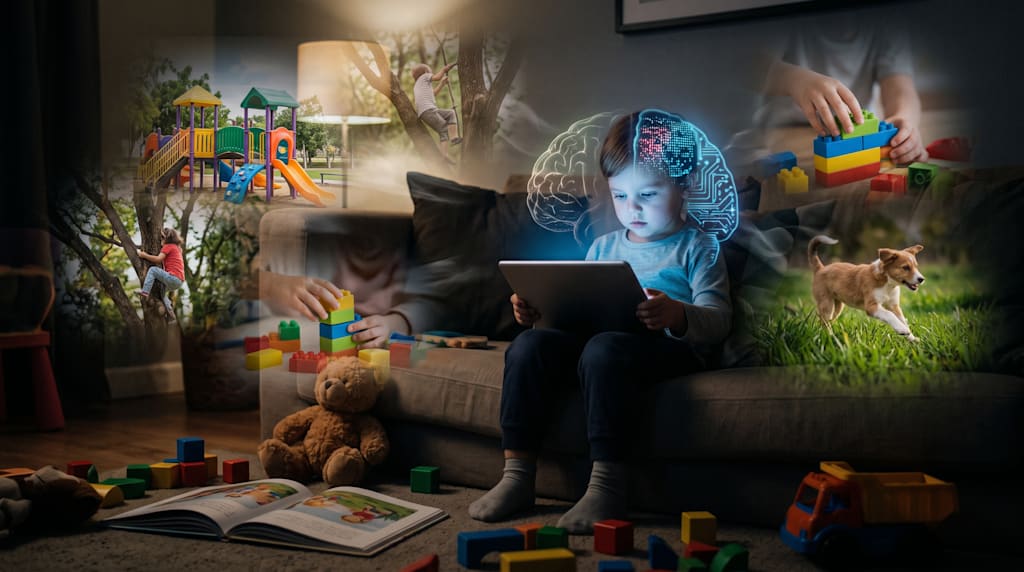
Nothing about this scene is alarming. Most parents have lived some version of it, and many have been grateful for it. Yet it invites a question worth sitting with. A child’s brain is built, in part, from what it encounters. What might it miss when, again and again, the encounter is with a screen rather than with the room around it?
What Developing Brains Need
The early years are a period of extraordinary neural construction. Neuroplasticity, the brain’s capacity to reorganize itself in response to experience, is especially pronounced in early childhood, when connections that are used repeatedly tend to be reinforced and many that go unused are gradually pruned. Developmental scientists describe much of this as experience-dependent learning: the brain arrives prepared to learn, but what it learns depends on what life supplies.
Some of what life supplies is well established as important. Responsive conversation, in which an adult notices a child’s babble or gesture and answers it, is among the most consistently studied predictors of language growth. In one study of 36 children aged four to six, Rachel Romeo and colleagues found that those who experienced more back-and-forth conversational turns at home showed greater activity in a key language region of the brain while listening to stories, independent of how many words they simply heard. It was a small, correlational study, but it suggests that the exchange itself, not just the vocabulary, may matter. Physical exploration, such as stacking, pouring, climbing, or dropping a spoon to see where it goes, gives children a working model of how objects and bodies behave. Pretend play asks children to hold rules in mind, take another’s perspective, and invent. Emotional exchanges with caregivers, including the small repairs after a frustration, help scaffold a child’s own capacity to settle down.
Other ideas are more speculative. It is often said that boredom breeds creativity, or that a child must wait in order to learn patience. These ideas are plausible, but no single stretch of unstructured time is neurologically essential. Development is not a checklist of sacred minutes. It is a pattern, assembled from thousands of ordinary repetitions.
That distinction frames the real question. Screens do not need to be toxic to influence development. They only need to occupy enough of the pattern.
What Science Reveals About Screen Exposure
The research on early screen use is large, and nearly all of it is observational. That is not a flaw to hide; no ethics board would randomly assign toddlers to four hours of daily video. It does mean that every finding must be read with care.
One of the largest recent studies, published by Ippei Takahashi and colleagues in 2023, followed 7,097 mother-child pairs in Japan. Children whose parents reported more screen time at age one were more likely to fall below screening thresholds for communication and problem-solving at ages two and four, and the risk rose with the hours. The pattern was consistent, but screen time was reported by parents and measured only once, and the outcome was a screening questionnaire rather than a clinical diagnosis. Associations seen at age two in fine motor and personal-social skills were no longer present by four.
In Singapore, Evelyn Law and colleagues linked more screen time at twelve months, among 437 children, to weaker attention and executive functioning at age nine, with differences in EEG brain-wave patterns at eighteen months appearing to account for part of the link. Brain measurements are tempting to read as damage, but a different pattern of electrical activity is a difference, not a diagnosis. The authors themselves called for work separating screen use from the family circumstances that tend to accompany it.
Direction is another puzzle. A study of 2,441 Canadian children led by Sheri Madigan found that screen time at two and three predicted lower developmental screening scores a year or two later, but not the reverse. Caroline Fitzpatrick and colleagues, following 315 preschoolers in Canada, found a two-way cycle instead: more tablet use at three and a half predicted more anger and frustration a year later, which in turn predicted more tablet use the year after that. A child who struggles to self-soothe may be handed a device more often, and the device may then cost that child some practice.
This is where a word like “lasting,” which appeared in a recent headline about screens and young brains, deserves scrutiny. A difference observed at four, or even at nine, is a difference measured at that age. It is not proof of irreversible harm, and in some studies early associations faded over time. Developing brains remain responsive to experience for years.
The Overlooked Question: What Are Screens Replacing?
If one idea ties these studies together, it may be less that screens act on the brain like a substance and more that a child’s day is finite. Every hour is spent on something.
Consider the dinner conversation that never begins because everyone at the table is looking at a separate device. The afternoon that might have been spent turning over stones in a backyard, spent instead on a stream of videos. The minute of waiting in a checkout line, uncomfortable but survivable, that becomes an instant of digital relief. The game in which a cardboard box becomes a ship, which never starts because a story is already being told on a screen. Each moment is small. Repeated across a childhood, the pattern may matter.
These are illustrations of a plausible mechanism, not evidence that any single episode causes harm. But some research has tried to measure displacement directly. Mary Brushe and colleagues equipped 220 Australian toddlers with small audio recorders for full days at regular intervals between twelve and thirty-six months. More screen time went along with fewer words spoken by adults, fewer vocalizations from children, and fewer back-and-forth conversational turns. The researchers called it “technoference.” Because the recorders captured electronic sound rather than who was watching, parents’ own screens and background television were part of what they measured.
Displacement is not the whole story. Families differ in income, stress, work schedules, sleep, and support. An exhausted parent may lean on screens more and have less energy for conversation, and a child with an intense temperament or an emerging developmental difference may both seek and be given more screen time. Such factors can create associations without screens being the cause. The honest conclusion is that displacement is a plausible explanation with some direct support, not an established one. The studies discussed here do not establish whether lost conversation or play explains the developmental differences found in other research.
Not All Screen Time Is Equal
“Screen time” is a blunt measure for a varied set of experiences. A toddler watching rapid-fire clips alone is doing something quite different from a five-year-old video-chatting with a grandmother, or reading an e-book with a parent who pauses to ask questions.
The research increasingly reflects this. A 2020 meta-analysis led by Madigan, pooling 42 studies, found that more screen time was associated with weaker language skills, while educational programming, co-viewing with caregivers, and a later start were associated with stronger ones. A 2024 review led by Sumudu Mallawaarachchi, covering 100 studies and more than 176,000 young children, pointed the same way: background television and program viewing were linked to poorer cognitive outcomes, while watching together with a caregiver was linked to better ones. The effects were small to moderate, and almost entirely correlational.
None of this means every app marketed to children is beneficial. An educational label alone does not establish that an app has demonstrated developmental benefits. Recommended limits are useful guidance, not a line where safety ends and damage begins. Age, content, company, timing, and the shape of the rest of the day all help determine what an hour in front of a screen means.
Protecting Childhood Without Fearing Technology
Back at the restaurant, the cartoon ends. The girl looks up, blinks at the noise, and asks for a piece of bread. Her mother tears one in half and hands it over, and for a moment they make faces at each other across the table.
Nothing went wrong here. A tired family got through a meal. Parents raise children amid deadlines, double shifts, illness, financial strain, and the steady exhaustion of being needed all day. A tablet can buy a quiet half hour, connect a child with a faraway relative, or open a door to a language, a song, or a lesson about the ocean floor. Treating every screen as a hazard asks families to meet an impossible standard, and shame rarely improves anyone’s parenting.
What the research suggests is not that screens are poison, but that childhood is built from patterns. The isolated dinner matters far less than whether, across weeks and years, a child still has plenty of the experiences no device can supply: being talked with and listened to, getting muddy, being bored long enough to invent something, being frustrated and then comforted, watching a face change in response to their own.
Perhaps the most important question is not how many hours children spend looking at screens, but how many chances they still have to look at the world, and to discover what happens when the world looks back.
References
Brushe ME, Haag DG, Melhuish EC, Reilly S, Gregory T. Screen Time and Parent-Child Talk When Children Are Aged 12 to 36 Months. JAMA Pediatrics. 2024;178(4):369–375. https://doi.org/10.1001/jamapediatrics.2023.6790
Fitzpatrick C, Pan PM, Lemieux A, Harvey E, de Andrade Rocha F, Garon-Carrier G. Early-Childhood Tablet Use and Outbursts of Anger. JAMA Pediatrics. 2024;178(10):1035–1040. https://doi.org/10.1001/jamapediatrics.2024.2511
Law EC, Han MX, Lai Z, Lim S, Ong ZY, Ng V, Gabard-Durnam LJ, Wilkinson CL, Levin AR, Rifkin-Graboi A, Daniel LM, Gluckman PD, Chong YS, Meaney MJ, Nelson CA. Associations Between Infant Screen Use, Electroencephalography Markers, and Cognitive Outcomes. JAMA Pediatrics. 2023;177(3):311–318. https://doi.org/10.1001/jamapediatrics.2022.5674
Madigan S, Browne D, Racine N, Mori C, Tough S. Association Between Screen Time and Children’s Performance on a Developmental Screening Test. JAMA Pediatrics. 2019;173(3):244–250. https://doi.org/10.1001/jamapediatrics.2018.5056
Madigan S, McArthur BA, Anhorn C, Eirich R, Christakis DA. Associations Between Screen Use and Child Language Skills: A Systematic Review and Meta-analysis. JAMA Pediatrics. 2020;174(7):665–675. https://doi.org/10.1001/jamapediatrics.2020.0327
Mallawaarachchi S, Burley J, Mavilidi M, et al. Early Childhood Screen Use Contexts and Cognitive and Psychosocial Outcomes: A Systematic Review and Meta-analysis. JAMA Pediatrics. 2024;178(10):1017–1026. https://doi.org/10.1001/jamapediatrics.2024.2620
Romeo RR, Leonard JA, Robinson ST, West MR, Mackey AP, Rowe ML, Gabrieli JDE. Beyond the 30-Million-Word Gap: Children’s Conversational Exposure Is Associated With Language-Related Brain Function. Psychological Science. 2018;29(5). https://doi.org/10.1177/0956797617742725
Takahashi I, Obara T, Ishikuro M, et al. Screen Time at Age 1 Year and Communication and Problem-Solving Developmental Delay at 2 and 4 Years. JAMA Pediatrics. 2023;177(10):1039–1046. https://doi.org/10.1001/jamapediatrics.2023.3057
About the Creator
Khali Sollis
Khali Sollis is a writer and independent researcher exploring the science of the human mind and behavior. Her work examines questions at the intersection of neuroscience, psychology, cognition, mental health, and everyday human experience.
Enjoyed the story? Support the Creator.
Subscribe for free to receive all their stories in your feed.
Comments
There are no comments for this story
Be the first to respond and start the conversation.