
The Nursing Home Rule Nobody Says Out Loud
Empty beds, fast turnover, and the residents with no one to check the water cup
Bed Turnover and the Unbefriended in the Western Nursing Home
One bed, two sets of books. In a Western nursing home's ledger, the bed is an asset, the resident is a census number, and the caregiver is a cost.
In the United States alone, about 1.2 million people live in nursing homes. There are roughly 15,000 facilities and about 1.6 million certified beds. Occupancy runs near three-quarters, sometimes lower. Assisted living adds another layer: memory care, board-and-care homes, continuing care retirement communities, life plan communities. The baby boomers keep aging into the system. Every day, about 10,000 Americans turn 65. The 85-plus group grows fastest. Life expectancy is around 79. The beds are not full, but the pressure does not go away.
If beds are empty, the institution should try to keep people. Yet bed turnover still works. Bed turnover was originally an operating metric: how many residents pass through the same bed in a period. The faster the churn, the higher the number. In the hidden version, it means the home finds ways to move out, push out, or persuade out the resident already there, freeing the bed for a new admission.
Many empty beds and fast churn are not contradictory. What is empty is the bed that does not pay. What is turned over is the bed that can be exchanged for one that pays better.
The biggest cost is people. Once the building is built or leased, the largest monthly variable is nursing assistant wages. A resident who can eat and toilet alone, and one who is bedbound, needs turning, feeding, and several brief changes a night, can differ in care hours by several times. The payment side does not differ by several times. The care level is often assessed at admission. As the body declines year by year, the rate is hard to raise. The contract is signed. The family resists. Medicaid reimbursement is lower than private pay. Medicare pays well for short skilled rehab, then stops.
So the rational move is to put several high-acuity residents in one multi-bed room, move them to the far wing, the worse light, the room away from the nurses' station. Call it a care unit, a household, a wing realignment. What is saved is night-shift staffing. Push further, and the family cannot stand it. They ask for discharge. The bed opens. In comes a new admission: short-stay, Medicare, rehab, private pay, still able to walk. The books for that bed look better.
There is also the label. Medicare-certified beds. Medicaid-certified beds. Memory care beds. Ventilator beds. Beds with a higher case-mix payment. The building can be certified for one thing and filled with another. On paper, the unit is for dementia. In the bed, the resident is semi-independent, family visits on Sundays, check clears. The label and the person are two sets of books.
Deposits are another layer. Continuing care retirement communities charge entrance fees, sometimes six figures, sometimes refundable on a scale. Assisted living collects community fees, pet fees, second-person fees, month-to-month surcharges. Nursing homes bill resident trust accounts, beauty shop, cable, phone. When one resident leaves, a refund is processed. When a new one comes, a new entrance fee or deposit arrives. The faster the turnover, the more money sits with the operator. Regulation has tightened in some states: escrow, disclosure, refund schedules, reserve requirements. The deposit side brings less easy money. The care-cost side remains. The urge to churn does not vanish. It finds a quieter form.
Then there is the unbefriended resident. The old phrase "eating the childless" has a Western version: predatory guardianship, estate harvesting, Medicaid estate recovery, the public guardian's caseload, the ward of the state. The pattern is simple. Residents whose families visit often get watched. Meals, room temperature, how long before someone answers the call light, all of it gets checked. Those with no visitors get neglect.
Elder care is hard to inspect even after you buy it. If the food is too salty, if the resident was turned at night, if the brief was changed, the resident may not be able to say. The home will not volunteer it. The only check is the family member who comes. Every visit is an inspection. For a resident with no one coming, the contract is signed but Party A is absent.
Among the unbefriended, many are not paying with their own money. Medicaid pays the room and board. The state pays. The resident lives there. In between, there is no one to go to the administrator about the soup. The payer and the watcher are at two ends. That is the hardest part.
Some elders have a house, a pension, a 401(k), a brokerage account. They are not on Medicaid. They pay privately. What is more dangerous is what happens after incapacity and after death. Western law offers tools: power of attorney, healthcare proxy, living will, POLST, DNR, revocable trust, irrevocable trust, will, probate. Used well, the elder chooses who decides and where the money goes. Signed with the wrong person, an aide, a "friend," a professional guardian, an operator with a conflict, the old phrase returns to its earliest meaning. The estate is drained. The heirs appear after the funeral. The elder dies with a clean room and an empty account.
So the problem is not only bad people. The problem is governance. The supervisory party is absent. If a resident has no family, no guardian, no ombudsman, no social worker, no third-party assessment, he is a name in the chart and a person hard to hear in the hallway.
Staffing cannot support watching either. Nursing assistants quit often. Agency staff fill the gaps. On a night shift, two or three aides may cover forty residents. The minimum staffing mandate is debated in statehouses and in Washington. The payroll is the first line item and the last thing to grow.
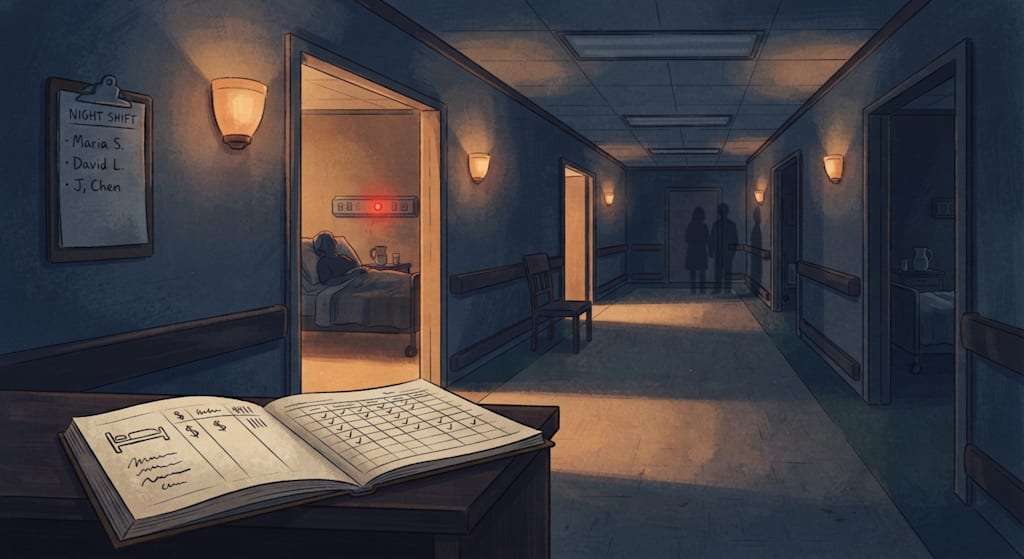
When staff are tight, the aide makes a triage list. Families who complain and speak out are at the front. Residents whose daughters call the director of nursing are at the front. Those with no one coming, who cannot speak, whose words no one hears, are at the back. This is not because aides are cruel. It is triage under scarce attention. How many people are on the night roster determines how long the call light flashes.
On the payment side, there have been patches. Medicare covers skilled nursing after a hospital stay, then ends. Medicaid covers long-term care, but only after spend-down. Long-term care insurance covers some, for some, for a while. Medicare Advantage plans manage more care. PACE programs serve some. The openings are narrow. If Medicaid paid enough for severe disability, the high-acuity resident would no longer be the losing bed on the books. The incentive to move and persuade would shrink. But Medicaid is means-tested, state-run, and attached to estate recovery. The money follows disability level. The supervision must follow the money. Assessments can be gamed. Services can shrink. A resident can be severe on the MDS and left in the hallway.
The checklist for families is familiar. Check the license. Check the state survey results. Check CMS star ratings. Check the care plan. Check the discharge and bed-hold clauses. Check the resident trust fund. Check the staffing ratio. Check the night shift. These are useful. No matter how carefully the contract is read, it is no substitute for going there every few days.
When you go, do not just look at whether the room is clean. Look at the resident's nails, hair, skin, brief, water cup. See whether the aide can call the resident by name. See how many people are on the night shift. See how long before someone answers the call light. Add three more: whether deposits and entrance fees are held in escrow or third-party custody; what the aide-to-resident ratio is on nights and weekends; and what proportion of actual residents are high-acuity. Do not just look at the label "memory care" or "Medicare-certified." Look at who is lying in the bed.
As for those with no one to go for them, what remains are the state survey agency, the long-term care ombudsman, the public guardian, the elder law attorney, the social worker, and money that follows disability level.
In 2025, the baby boomers keep turning 65. The places for the unbefriended will only get tighter.
On the night roster, three aides. The call light is flashing. The bed is empty.
About the Creator
Jin
Writer of reamstories
https://reamstories.com/jin
Enjoyed the story? Support the Creator.
Subscribe for free to receive all their stories in your feed. You could also become a paid subscriber, letting them know you appreciate their work.
Comments
There are no comments for this story
Be the first to respond and start the conversation.