
The Generation We Call Fragile: Are Young People Really Less Resilient?
What psychology reveals about rising youth distress, changing social pressures, and the danger of confusing emotional vulnerability with weakness

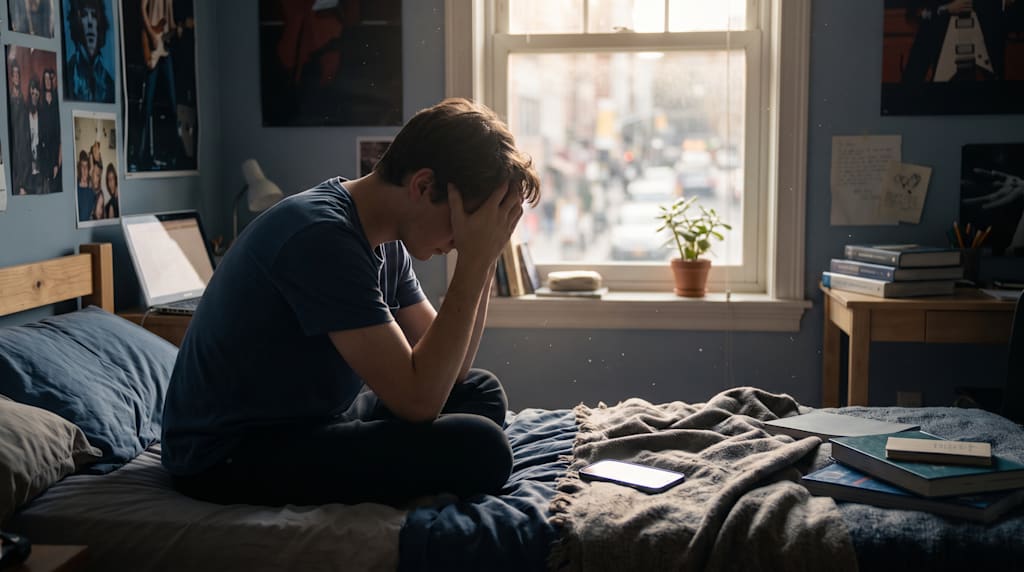
The generation on trial
Sooner or later, every generation is put on trial by the one before it. The current charges are familiar. Young people are too sensitive and too quick to name their feelings. They are too ready to ask for help with things their parents simply endured. "Snowflake" has become shorthand for the verdict.
This October, the clinical psychologist who led England's most extensive recent inquiry into mental health disagreed. Speaking to the BBC ahead of the review's final report, Professor Peter Fonagy rejected the idea of a "snowflake" generation and argued that being young is harder now than it used to be.
A quote does not settle a scientific question, and neither does a review chair's summary. Distress can rise because life has become harder. It can also rise because people describe their experiences differently, or because institutions count them differently. Most likely, several of these are happening at once. So before we decide whether a generation has grown weaker, we should ask a prior question: are we measuring the thing we think we are measuring?
The numbers behind the anxiety
The strongest evidence comes from population surveys, which sample people whether or not they have ever seen a clinician. England's Adult Psychiatric Morbidity Survey uses structured interviews. The review's final report, published October 9, summarizes its findings. The share of adults aged 16 to 64 meeting criteria for a common mental disorder rose from 15.5% in 1993 to 22.6% in 2024. Among 16 to 24 year old it climbed from roughly 1 in 6 to 1 in 4, and young women now report the highest rates of any group.
The review's interim report, published March 31, documented a change in the age pattern. Distress used to be higher in midlife than in early adulthood. Young adults now report more distress than older groups, a shift that began in the early 2010s rather than with the pandemic.
Among children the picture is real but more modest. Diagnostic assessments in the Mental Health of Children and Young People survey put emotional disorders among 5 to 15 year old in England at 4.3% in 1999, 3.9% in 2004 and 5.8% in 2017.
A comparison of two British cohorts born a decade apart, covering more than 19,000 children, adds a developmental detail. In parent reports, emotional problems emerged earlier in children born in 2000–02 than in those born in 1991–92. The gap between cohorts was largest at age 14, and girls in mid-adolescence showed the steepest rise.
What has risen is specific. The interim report found that emotional and peer problems have increased, while conduct problems have stayed flat or fallen in some datasets. Alcohol use among 16 to 24 year old has declined. These patterns complicate the stereotype of a weaker generation: some outwardly visible problem behaviors have declined even as measures of emotional distress have increased. Together, these patterns suggest that some forms of distress may be becoming more visible even as certain outwardly expressed problem behaviors decline.
More diagnoses do not necessarily mean more disorders
The final report puts its central distinction plainly: distress is not disorder, and diagnosis is not need. Those categories can move in different directions.
ADHD shows the gap most clearly. Recorded ADHD among 12 to 17 year old in primary care rose more than fifteenfold between 2000 and 2025, from 0.26% to 3.88%. Population prevalence, meanwhile, appears broadly stable or only modestly higher, although England lacks current survey data. The review stopped short of a verdict. It said the evidence does not show overdiagnosis at scale, but warned that, if present trends continue, the balance of risk is moving toward misdiagnosis and overdiagnosis.
Help-seeking has changed too. According to the interim report, among adults with a common mental disorder, the proportion receiving treatment rose from 24.4% in 2007 to 47.7% in 2023–24.
So is the rise partly an artifact of awareness? Psychologists Lucy Foulkes and Jack Andrews have proposed the "prevalence inflation hypothesis." It holds that awareness efforts improve recognition of genuine problems but may also lead some people to interpret mild distress as a mental health problem, and the authors call for the idea to be tested empirically. It is a serious hypothesis, not yet a finding.
One line of evidence points against awareness as the whole explanation. If lower thresholds were driving the numbers, the people reporting symptoms should be faring better than they used to. A study of three British cohorts, assessed at age 7 in 1965, 1998 and 2008, found the reverse. In more recent cohorts, childhood mental health problems were more strongly associated with social difficulties at 11 and mental health problems at 16, and, among boys, with lower exam results.
The interim report adds more recent household survey data. People with high distress reported greater impact on daily functioning in 2021–24 than in 2009–12. The final report concludes that the rise is real, affects everyday functioning, and cannot be explained by greater awareness alone, while cautioning that impairment is inconsistently recorded.
Greater awareness and greater distress are not rival explanations. Both can be true.
The world in which resilience is expected
Many people assume today's young adults face less hardship than earlier generations, who lived through wars, rationing and deep recessions. The relevant question is narrower. Have the specific pressures on young people's development changed?
The final report groups its answer into four clusters: more uncertainty and insecurity, from finances and housing to unemployment; more evaluation and comparison in school, work and social life; less belonging and more loneliness; and fewer chances for rest and recovery. The language is measured. The review says no single cause explains the rise. It judges education a more significant contributor than for earlier generations, but not the principal cause.
These are synthesized judgments drawn largely from observational data. They describe associations that are consistent across sources, not causal mechanisms demonstrated by experiment.
The social media question
No topic is more prone to confident overstatement than social media.
A widely cited analysis examined three large datasets from the United States and the United Kingdom. Across 355,358 adolescents, it found that digital technology use was negatively associated with well-being, but the association explained at most 0.4% of the variation. That study measured technology use broadly, and the data were correlational.
More targeted work tells a more specific story. In the UK Millennium Cohort Study, among 10,904 fourteen-year-olds, heavier social media use was associated with more depressive symptoms, more strongly in girls than boys. In statistical path models, part of that association was accounted for by online harassment, poor sleep, low self-esteem and poor body image. Because all of these were measured at the same age, the study cannot show which came first or establish cause.
Experiments are rarer. In one randomized trial, deactivating Facebook for four weeks before the 2018 US midterm election increased subjective well-being. The participants were American adults, however, so the result cannot simply be applied to British teenagers.
The final report takes a middle path. It judges that social media can intensify pressures of comparison and serve as a channel for bullying, particularly for young people already living with anxiety, depression or eating disorders. It also credits online spaces with spreading a richer, more accepting language about mental health.
Taken together, the evidence is more consistent with particular experiences mattering, such as harassment and lost sleep, than with screen time as a single cause. Even those pathways, however, remain associations rather than demonstrated causes.
What resilience actually means
In everyday speech, resilience means toughness: taking a blow without complaint. Developmental science defines it differently.
Ann Masten's influential synthesis found that resilience is common and usually arises from ordinary human adaptive systems. The greatest threats to development are those that damage these protective systems. Those systems include caring relationships, competent adults, chances to build skills, and a sense of belonging.
Michael Ungar goes further. He argues that resilience depends heavily on whether a young person's social and physical environments provide the resources needed for positive development. On this view, resilience is not a fixed quantity inside a person. It is a process that happens between a person and the people and places around them.
This matters for the generational question. The population surveys discussed here track symptoms and functioning rather than directly measuring resilience. They therefore cannot establish whether resilience itself has declined across generations. The interim report describes rising items such as loss of confidence as strain on coping capacity, but that is the authors' interpretation of distress questions, not a resilience scale. The data can show that more young people are struggling. They cannot yet tell us whether that reflects weaker coping resources, heavier loads, or both.
The problem with calling a generation fragile
Generational labels flatten real differences. Data in the interim report show distress among young adults rising across all levels of area deprivation, though it remains highest in the most deprived areas. Girls and young women carry a disproportionate share. Some groups remain under-recognized even as diagnoses rise elsewhere.
The "fragile" label invites two opposite mistakes. One is to dismiss genuine suffering as weakness. The other is to treat every hardship as a disorder needing clinical treatment. The final report gives an example of the second: a lonely young person who is not clinically depressed may benefit more from rebuilding social connection than from antidepressants. Both mistakes share an assumption that the problem lives entirely inside the young person.
Perhaps we should change the question
Asking whether young people are less resilient treats them like a material in a stress test, measured by how much load they can bear before they crack. The research suggests a different question: what are they being given to lean on?
If resilience is made of ordinary things, such as relationships, routine, sleep, belonging and a believable future, then those things can also be diminished. When they thin out, the people who notice first will be the people still being formed.
The real choice is not between toughening young people up and protecting them from every difficulty. It is between expecting them to endure conditions and building conditions in which they can grow. Only the second has a chance of producing the resilience we keep asking them to show.
References
Allcott, H., Braghieri, L., Eichmeyer, S., & Gentzkow, M. (2020). The welfare effects of social media. American Economic Review, 110(3), 629–676. https://doi.org/10.1257/aer.20190658
Armitage, J. M., Kwong, A. S. F., Tseliou, F., Sellers, R., Blakey, R., Anthony, R., Rice, F., Thapar, A., & Collishaw, S. (2023). Cross-cohort change in parent-reported emotional problem trajectories across childhood and adolescence in the UK. The Lancet Psychiatry, 10(7), 509–517. https://doi.org/10.1016/S2215-0366(23)00175-X
Department of Health and Social Care. (2026, March 31). Independent review into mental health conditions, ADHD and autism: Interim report (HTML version published June 10, 2026). https://www.gov.uk/government/publications/independent-review-into-mental-health-conditions-adhd-and-autism-interim-report
Department of Health and Social Care. (2026, October 9). Independent review into mental health conditions, ADHD and autism: Final report — executive summary. https://www.gov.uk/government/publications/independent-review-into-mental-health-conditions-adhd-and-autism-final-report/independent-review-into-mental-health-conditions-adhd-and-autism-executive-summary
Foulkes, L., & Andrews, J. L. (2023). Are mental health awareness efforts contributing to the rise in reported mental health problems? A call to test the prevalence inflation hypothesis. New Ideas in Psychology, 69, 101010. https://doi.org/10.1016/j.newideapsych.2023.101010
Kelly, Y., Zilanawala, A., Booker, C., & Sacker, A. (2018). Social media use and adolescent mental health: Findings from the UK Millennium Cohort Study. EClinicalMedicine, 6, 59–68. https://doi.org/10.1016/j.eclinm.2018.12.005
Masten, A. S. (2001). Ordinary magic: Resilience processes in development. American Psychologist, 56(3), 227–238. https://doi.org/10.1037/0003-066X.56.3.227
NHS Digital. (2018). Mental health of children and young people in England, 2017. https://digital.nhs.uk/data-and-information/publications/statistical/mental-health-of-children-and-young-people-in-england/2017/2017
Orben, A., & Przybylski, A. K. (2019). The association between adolescent well-being and digital technology use. Nature Human Behaviour, 3(2), 173–182. https://doi.org/10.1038/s41562-018-0506-1
Sellers, R., Warne, N., Pickles, A., Maughan, B., Thapar, A., & Collishaw, S. (2019). Cross-cohort change in adolescent outcomes for children with mental health problems. Journal of Child Psychology and Psychiatry, 60(7), 813–821. https://doi.org/10.1111/jcpp.13029
Ungar, M. (2011). The social ecology of resilience: Addressing contextual and cultural ambiguity of a nascent construct. American Journal of Orthopsychiatry, 81(1), 1–17. https://doi.org/10.1111/j.1939-0025.2010.01067.x
About the Creator
Khali Sollis
Khali Sollis is a writer and independent researcher exploring the science of the human mind and behavior. Her work examines questions at the intersection of neuroscience, psychology, cognition, mental health, and everyday human experience.
Enjoyed the story? Support the Creator.
Subscribe for free to receive all their stories in your feed.
Comments
There are no comments for this story
Be the first to respond and start the conversation.