
The Evolutionary Mismatch That's Quietly Exhausting Your Brain
Your mind is a village-sized instrument now governing a planet-sized life — and the strain you feel every day may be the sound of that mismatch.

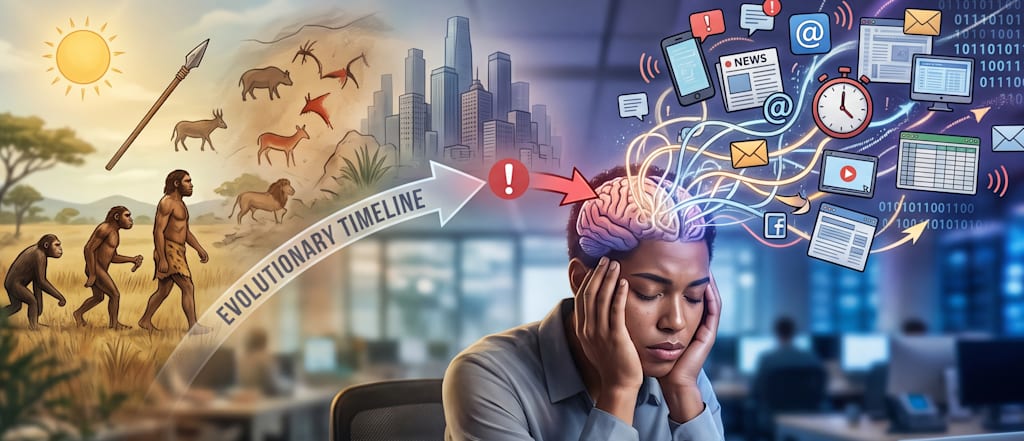
You wake up. Before your feet touch the floor, your thumb has already found your phone. In ninety seconds you've absorbed a headline about a distant conflict, a photo of an acquaintance's vacation, a message flagged urgent, a notification that three strangers liked something you posted last night. You haven't stood up yet, and your brain has already processed more information than a person living two centuries ago might have encountered in a week.
Here is the reason, in a single sentence: evolution moves in millennia, and smartphones conquered the world in about fifteen years. That gap — vast, almost comic in scale — is the quiet engine behind a great deal of what gets called modern exhaustion.
By afternoon, that gap tends to show up as a particular kind of tired that sleep doesn't fix. Not physical exhaustion — something closer to static. A friend calls it brain fog. A doctor might call it burnout. But there's a stranger, more precise possibility worth sitting with: what if nothing has malfunctioned at all? An ancient operating system, remarkably capable in its own right, is trying to keep pace with a world that keeps rewriting the rules around it.
That's the idea at the center of this essay — not a metaphor for effect, but a working model. A village-sized instrument, tuned with extraordinary precision to manage a few dozen relationships, a handful of daily decisions, and threats you could see coming, is now being asked to govern something closer to a planet-sized life. Nothing about that transformation happened slowly enough for the instrument itself to evolve alongside it.
A Familiar Scene
Picture something more specific. You sit down to finish an important report. A message arrives. You ignore it — good discipline. Two minutes later, another notification slides across the screen. Then your smartwatch taps your wrist. None of these individually cost much. But by the time you return your eyes to the report, you've lost the thread of your own reasoning — not the words on the page, but the finer thought you were mid-way through building, the one that doesn't leave a trace once it's interrupted.
That small, maddening reset happens to nearly everyone, multiple times a day, and it isn't a personal failure of discipline. It's what happens when an ancestral neural architecture, built for a world with far fewer competing demands, gets asked to referee a dozen simultaneous claims on its attention.
The Machine Behind the Feeling
To understand why this mismatch produces exhaustion rather than simple inconvenience, it helps to know, in plain terms, what's actually running under the hood.
Deep in the brain sits a small almond-shaped structure called the amygdala, part of an early-warning system that can respond to emotionally significant or unexpected stimuli before conscious evaluation has fully weighed in. It doesn't wait for permission — it can react to an unexpected notification the same way it might react to any sudden, attention-grabbing cue, before the slower, more deliberate parts of the brain get a chance to determine whether the thing actually matters.
Layered on top of that, a network of regions neuroscientists call the salience network constantly scans incoming information, sorting what deserves attention from what doesn't. When something clears that bar, control passes to the executive control network — seated largely in the prefrontal cortex, the brain's newest and slowest-maturing region, responsible for planning, weighing consequences, and holding attention on a single task. It's this network that was, moments ago in our report-writing scene, trying and failing to hold its place against three separate interruptions.
A fourth player is worth naming. The default mode network activates when the mind wanders, replays memories, or drifts toward daydreaming and quiet reflection. In a well-regulated brain, these systems take turns: the salience network flags what's worth noticing, the executive network locks in and does the work, and the default mode network gets its moment when nothing urgent is competing for attention.
Compared with today's digitally saturated environment, earlier human life likely offered far more uninterrupted periods during which this kind of internally directed thought could unfold undisturbed — walking, foraging, sitting by a fire. Modern life offers vastly fewer of them, though exactly how much this shift matters for long-term wellbeing is still an area of active research rather than settled fact.
What is better established is this: each ping, alert, and badge recruits the salience network, which in turn briefly pulls the prefrontal cortex away from whatever it was doing. Many of the brain's attentional systems appear to treat a notification and a genuine threat as similarly worth checking — not identical in intensity or consequence, but similar enough, in that first split second, that both get flagged for further evaluation before the mind sorts out which one actually matters.
There's a dopamine system underneath all of this, too — built not for pleasure, as popular language often implies, but for prediction. Dopamine spikes most reliably not when a reward arrives, but when a reward might arrive and its timing is uncertain, which happens to be the exact structure of a notification feed. Nobody, including your own reward circuitry, knows when the next interesting message will appear. That uncertainty is the engine, not a side effect.
The Arithmetic of Comparison
Here's where the mismatch stops being abstract and starts being personal. Anthropologists differ on exact numbers, but the broad picture is consistent: ancestral social life likely revolved around a relatively small, stable group of familiar people — a few dozen faces, seen and re-seen across a lifetime, in a network small enough to actually track. Open an app today, and you may scroll past several hundred faces before lunch. Not deliberately, and rarely consciously — just by letting decades-old circuitry do what it has always done: scan for relative standing, for who's doing better, for where you rank.
This ancient cognitive system hasn't updated its sample size. It still treats each face it processes as though it might belong to someone who matters to your survival — a rival, an ally, a potential mate, a threat to your standing within the only group that ever existed. There's no obvious neural category for stranger, algorithmically inserted to maximize engagement. Social importance and algorithmic importance appear to register through overlapping circuitry, at least in that first pass — a confusion our inherited brain has had no evolutionary opportunity to resolve.
Is this convenient framing, or genuine biology? Probably some of both — but the pattern it describes is hard to miss once you start looking for it.
The Weight You Don't See
A further cost rarely gets named, and it isn't just about attention — it's about capacity. Working memory, the mental workspace that holds information you're actively using, has famously narrow limits. Every open notification, every half-answered message, every browser tab you meant to return to doesn't just interrupt you in the moment — it appears to occupy a small, persistent slot in that workspace, because unfinished tasks tend to linger mentally in a way finished ones don't — a phenomenon psychologists have long observed in what's known as the Zeigarnik effect. Multiply that by the dozens of small loops a modern day leaves open, and mental clutter stops being a metaphor. It becomes something closer to a physiological state: a mind quietly taxed by everything it hasn't yet closed out, whether or not you're consciously thinking about any of it.
The One Idea Worth Understanding
Faced with all this, the instinct is to reach for a list — sleep more, exercise, meditate, unplug. None of that is wrong, but a list undersells what's actually possible here, so it's worth going deep on one idea instead of wide across five.
Attention is trainable in a very literal, structural sense. Practicing sustained, undistracted focus — genuinely holding attention on one thing while competing signals try to interrupt — doesn't just build concentration in some vague motivational sense. Evidence from cognitive neuroscience suggests it can, over time, strengthen the functional relationship between the prefrontal cortex and the amygdala, so that the alarm system that once hijacked attention for every ping gradually loses some of its ability to do so. This is neuroplasticity in concrete form: not vague adaptability, but a specific, repeatable strengthening of the connection between the part of the brain that decides what matters and the part that decides what to do about it.
Think about the last time you became completely absorbed in writing, painting, repairing something, gardening, or solving a difficult problem. An hour passed almost unnoticed, yet afterward your mind felt clearer rather than more depleted.
That single mechanism may explain why deep, protected focus feels so disproportionately restorative compared with almost anything else you can do in a day. It isn't rest, exactly. Think of it as physical therapy for the exact circuit modern life strains hardest. Evolution can't rebuild that circuit across generations. A single lifetime, though, seems to be enough to rewire it somewhat — which is a far more useful fact than any individual tip about screen time.
A Question Bigger Than Any One Person
A harder question follows from all this, one no personal habit can fully answer. If the mismatch is structural, how much should really rest on individuals to compensate through willpower and self-optimization, versus on the environments generating the mismatch in the first place? Some researchers now argue this question extends well beyond personal psychology, into how cities are built and how digital platforms are designed, toward environments engineered to lower the sense of constant competition rather than manufacture it. Whether that constitutes a genuine design failure of modern life, or simply the ordinary friction of a species outrunning its own biology, remains open — and probably should stay that way for now.
What the Brain Actually Achieves
The remarkable thing isn't that our brains struggle with modern life. It's that, despite inhabiting an environment they never evolved to handle, they continue to learn, adapt, and search for meaning inside it anyway — rewiring attention circuits, forming new habits, creating stretches of quiet in a world engineered against quiet.
So the real question isn't whether our brains can keep up with the modern world. It's whether we'll choose to build a modern world worthy of the brains we inherited.
Further Reading
Daniel Kahneman — Thinking, Fast and Slow (on the two systems underlying judgment and decision-making)
Robin Dunbar — research on the cognitive limits of human social networks and group size
Michael I. Posner — foundational work on the brain's attention networks
Marcus Raichle — the discovery and study of the Default Mode Network
Earl K. Miller — research on working memory and the prefrontal cortex's role in cognitive control
About the Creator
Khali Sollis
Khali Sollis is a writer and independent researcher exploring the science of the human mind and behavior. Her work examines questions at the intersection of neuroscience, psychology, cognition, mental health, and everyday human experience.
Enjoyed the story? Support the Creator.
Subscribe for free to receive all their stories in your feed.
Comments
There are no comments for this story
Be the first to respond and start the conversation.