
The Architecture of Apathy: How Cognitive Overload Shrinks Our Capacity for Compassion
When stress consumes our mental bandwidth, empathy is often the first thing to disappear—not because we stop caring, but because the brain reaches its limits.

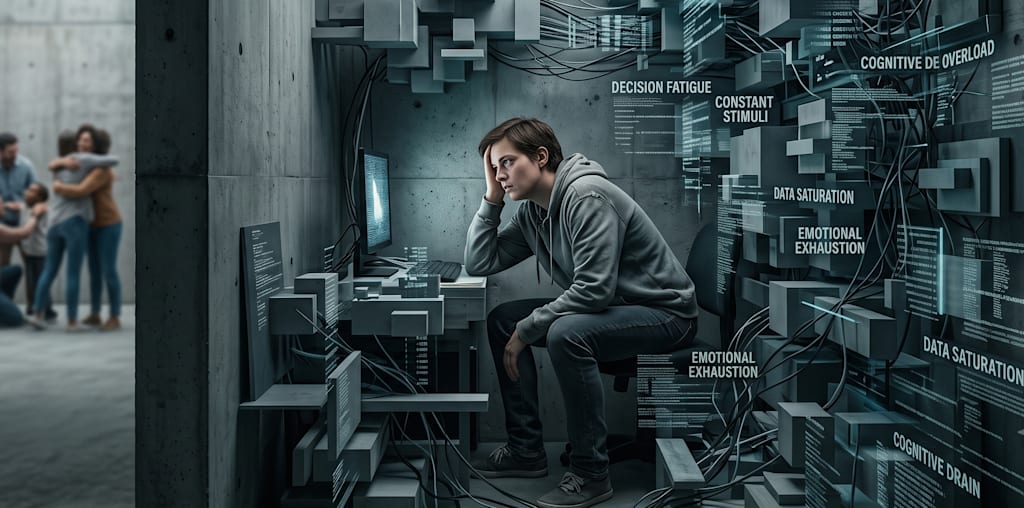
Why do overwhelmed people seem to stop caring? Neuroscience and classic psychology research reveal it's about brain capacity, not character.
We have all been there. You are staring at an exploding inbox, juggling a shifting deadline, or trying to keep a fragile project from falling apart, and someone walks up to your desk to vent about a problem of their own. Objectively, you know you should care. But subjectively, your brain feels like a laptop trying to render a video while installing a system update: fans spinning, everything running hot, and completely unresponsive to anything new being asked of it.
This is not a character flaw, and it is not a sign that busy people are becoming colder or less moral. It is, at least in part, a predictable response of an overloaded nervous system. When the brain is already consumed with managing its own workload, its own stress, or its own survival, something has to give. Increasingly, researchers across psychology, neuroscience, and behavioral science are converging on an uncomfortable answer: compassion is often the first thing to go.
This article explores why that happens, drawing on three complementary threads: what busy professionals say about their own shrinking capacity to care, what neuroscience tells us about the biological cost of empathy, and a decades-old psychology experiment that still shapes how researchers think about helping behavior today. Along the way, it is worth being honest about what the science can and cannot tell us. Some of these findings are well-replicated and widely cited. Others are more preliminary, or point toward a plausible mechanism rather than a proven one. Both kinds of evidence are useful, as long as we are clear about which is which.
Why Overload Changes How We Respond to Other People
Before getting into the research, it helps to define a term that comes up constantly in this conversation: cognitive load. In plain terms, cognitive load is the amount of mental effort your working memory is using at any given moment. Reading a text message while driving adds load. Holding a phone number in your head while searching for a pen adds load. Managing a demanding job, a strained relationship, or a financial crisis adds a great deal of load, and it rarely switches off at the end of the workday.
The human brain, for all its remarkable capabilities, has limits on how much it can process at once. When those limits are approached, the brain does not simply get slower at everything in equal measure. Instead, it tends to prioritize. Tasks tied to immediate survival, self-preservation, or an urgent deadline get resources first. Tasks that feel optional, even ones as fundamentally human as noticing someone else's distress, get deprioritized. This is not a conscious decision so much as a background triage system that most of us never notice is running.
Understanding apathy through this lens changes the conversation. Instead of asking "why don't they care anymore," it becomes more useful to ask "what is competing for the mental resources that caring would require." That reframing matters, because the two questions lead to very different solutions.
Compassion Under Pressure: What Busy Professionals Report
Some of the clearest evidence for this pattern comes not from a lab, but from the accounts of people living inside high-pressure work environments. Researchers who study workplace behavior have interviewed professionals in demanding, fast-moving jobs about how they experience empathy on their most overloaded days, and a consistent theme emerges: under sustained pressure, people describe a shift in how they relate to the problems of others.
From Feeling to Managing
Rather than emotionally engaging with a colleague's frustration or a client's setback, overloaded professionals often describe processing it the way they would process any other task on their list: something to be triaged, delegated, or handled efficiently, rather than something to be felt. Compassion, in these accounts, does not disappear because the person stops valuing it. It gets reclassified, moving from an instinctive emotional response to another item of "management," slotted in alongside deadlines and deliverables.
This shift appears to serve a protective function. When someone is already stretched thin, fully absorbing another person's emotional experience can feel like it threatens their ability to keep functioning at all, and empathy starts to feel less like a natural impulse and more like an expense the system cannot currently afford.
It is worth being cautious here about how far this evidence reaches. Findings like these are typically drawn from self-report and observational research, which is genuinely useful for understanding lived experience, but it describes a pattern rather than proving a fixed biological rule that applies to everyone in every context. Still, the consistency of the pattern across different high-stress occupations is notable, and it lines up closely with what neuroscience shows happening inside the brain itself.
The Brain's Empathy Circuit and Its Hidden Cost
To understand why compassion seems to be the first casualty of an overloaded mind, it helps to look at what is actually happening in the brain when we empathize with someone else in the first place.
What Empathy Looks Like in the Brain
Empathy is often talked about as though it were a purely abstract, intellectual act: you think about what someone else might be feeling, and you arrive at an understanding. But neuroscience suggests something more visceral is going on. Research led by neuroscientist Tania Singer and colleagues at the Max Planck Society has used brain imaging to examine what happens when people witness someone else in pain <cite index="0-4">(Bernhardt & Singer, 2012)</cite>. One influential study found that watching another person experience pain activates overlapping regions involved in processing our own pain, including the anterior insula and part of the anterior cingulate cortex <cite index="0-7">(Singer et al., 2004)</cite>.
In everyday language, the anterior insula is a region involved in registering internal bodily states, from a racing heart to a knot in your stomach, while the anterior cingulate cortex plays a role in detecting errors, regulating emotion, and processing the unpleasantness of pain. Neither region "belongs" exclusively to empathy; both do a great deal of other work in the brain. What the research suggests is that these regions show meaningfully overlapping activity, whether the pain is our own or something we are simply witnessing in someone else <cite index="0-4">(Bernhardt & Singer, 2012)</cite>. It is worth being precise about the strength of that claim: this is shared or overlapping activation, not literal identical processing, and researchers continue to debate exactly how much of firsthand and vicarious pain relies on the same underlying mechanisms.
Even with that caveat, the implication is striking. Empathy is not simply a thought about someone else's situation. On some level, it appears to be a partial re-creation of it inside our own nervous system.
Why That Makes Empathy Expensive
If empathy genuinely involves the brain simulating another person's distress using some of the same circuitry it uses for its own distress, then it follows that empathizing is not free. It draws on real neural and physiological resources, particularly under conditions of what researchers call allostatic load, the cumulative wear and tear on the body that builds up from chronic stress over time.
This is where the theory, and it is important to be honest that this next step is more theoretical than the well-established imaging findings above, becomes genuinely useful for explaining apathy. If a person's system is already running hard just to manage their own stress and workload, the theory holds that they will have less spare capacity available to simulate someone else's suffering on top of it. Some researchers describe this as a form of empathy fatigue: not a permanent loss of the capacity to care, but a temporary narrowing of it, driven by how much bandwidth the brain has left to spend. This is a plausible and increasingly well-supported explanation, but it is still an area of active research rather than a settled fact, and individual differences in how people respond to stress are considerable.
The Good Samaritan Experiment: A Classic Study in Situational Pressure
Long before brain imaging existed, psychologists were already documenting how overload changes helping behavior, and one study in particular has become a touchstone for this entire field of research.
The Setup
In 1973, psychologists John Darley and C. Daniel Batson designed what became known as the Good Samaritan experiment, named after the biblical parable of the same name <cite index="0-9,0-10">(Darley & Batson, 1973)</cite>. Their subjects were seminary students, people who, by virtue of their training, had spent years immersed in moral, ethical, and religious study. If anyone could be expected to stop and help a stranger in distress, the researchers reasoned, it would be this group.
Each student was asked to walk across campus to deliver a short talk. Some were told they had plenty of time to get there. Others were told they were already running behind and needed to hurry. Along the route, the researchers had planted an actor who appeared to be in genuine distress, slumped in a doorway, coughing and groaning as the students passed by.
What the Results Revealed
The results were not what most people would predict. The strongest single predictor of whether a student stopped to help had little to do with their religious devotion, their personal values, or how they described the importance of compassion in interviews. It came down almost entirely to how much of a hurry they were in <cite index="0-9,0-10">(Darley & Batson, 1973)</cite>.
Students who believed they had time to spare were far more likely to stop. Students who believed they were late were far more likely to walk past the person in obvious need, sometimes literally stepping over them on the way to a talk about, in one of the study's memorable ironies, the parable of the Good Samaritan itself.
What is especially important about this finding is what it suggests was happening psychologically. The researchers did not conclude that the hurried students coldly weighed the cost of stopping and decided the stranger was not worth their time. The more compelling interpretation is that time pressure narrowed their attention so sharply that many of them simply did not fully register the person in the doorway as a situation requiring a response. Their cognitive resources were so tightly focused on the immediate task of getting to their destination that an unplanned obstacle, even a person in visible distress, struggled to break through.
This experiment has been cited thousands of times in the decades since, not because it proved that people are indifferent by nature, but because it offered some of the earliest evidence that situational pressure, not fixed character traits, often determines whether people act on their values in the moment.
From Malice to Management: Rethinking Apathy in Overwhelmed Systems
Taken together, these three strands of evidence, workplace research on empathy under pressure, neuroscience research on the shared cost of empathy, and decades-old behavioral research on helping under time constraints, point toward a consistent picture. When people appear cold, distant, or indifferent during periods of intense strain, that behavior is often less about who they are and more about what their nervous system is currently able to process.
This does not mean cognitive overload excuses every instance of unkindness, and it would be an overstatement to suggest that busy people bear no responsibility for how they treat others. But it does suggest that the common assumption, that indifference reflects a person's true character, deserves more scrutiny. A colleague who seems unusually short-tempered during a demanding quarter, a partner who seems distracted and unresponsive during a stressful move, or a new parent who snaps at a well-meaning question in the middle of a sleepless week with an infant may not be revealing new information about their values. They may simply be operating a system that is currently allocating its limited resources elsewhere.
None of this implies that every instance of indifference reflects cognitive overload. People can also become emotionally disengaged for other reasons, including burnout, depression, chronic conflict, or personality differences, and those causes call for different kinds of attention entirely. The research reviewed here argues for caution against assuming character from isolated moments of apparent apathy, not that situational overload explains every case. A friend who is briefly short with you during a chaotic week is a different matter from a friend who has been withdrawn for months; the first may be a capacity problem, while the second deserves a more direct conversation.
What This Pattern Suggests About Workplaces and Relationships
If overload genuinely narrows the brain's capacity for empathy, the research points toward a fairly specific implication: reducing unnecessary strain on people's attention and time may do more to preserve compassion in a workplace or a relationship than repeated appeals to be kinder ever could. Trying to talk someone into caring more while leaving the underlying pressure untouched is, based on the mechanisms described above, unlikely to work particularly well. The bottleneck is not motivation. It is capacity.
That distinction has practical relevance well beyond any single office. It shows up in how hospitals think about clinician burnout, in how schools think about overextended teachers, and in how families navigate periods of financial or health-related stress, including the adult child who has become the primary caregiver for an aging parent and finds their patience for everything else quietly draining away. In each of these settings, the same basic pattern tends to appear: people do not stop valuing connection because they have changed as people. They stop being able to access it as easily, because something else is consuming the mental resources connection would require.
Conclusion: Capacity, Not Character
The research explored here does not offer a tidy or fully settled explanation for every instance of apathy, and it would be a mistake to treat cognitive load as the single cause of every moment of human coldness. People are complicated, and motivation, mood, and personal history all play a role alongside the mechanisms described above. But the evidence, from workplace studies to brain imaging to the seminary students who stepped past a stranger in distress, converges on a genuinely useful reframe: much of what looks like indifference is, at least in part, a system running at capacity.
As work and daily life continue to accelerate, and as always-on communication keeps expanding what any one person is expected to track and respond to, this distinction is likely to matter more, not less. Understanding apathy as a matter of bandwidth rather than character will not, on its own, ease anyone's workload. But it may change the question we reach for first. Sometimes the most compassionate question is not "Why don't they care?" but "How much weight are they already carrying?"
References
Bernhardt, B. C., & Singer, T. (2012). The neural basis of empathy. Annual Review of Neuroscience, 35(1), 1–23. https://doi.org/10.1146/annurev-neuro-062111-150536
Darley, J. M., & Batson, C. D. (1973). "From Jerusalem to Jericho": A study of situational and dispositional variables in helping behavior. Journal of Personality and Social Psychology, 27(1), 100–108. https://doi.org/10.1037/h0034449
Singer, T., Seymour, B., O'Doherty, J., Kaube, H., Dolan, R. J., & Frith, C. D. (2004). Empathy for pain involves the affective but not sensory components of pain. Science, 303(5661), 1157–1162. https://doi.org/10.1126/science.1093535
About the Creator
Khali Sollis
Khali Sollis is a writer and independent researcher exploring the science of the human mind and behavior. Her work examines questions at the intersection of neuroscience, psychology, cognition, mental health, and everyday human experience.
Enjoyed the story? Support the Creator.
Subscribe for free to receive all their stories in your feed.
Comments
There are no comments for this story
Be the first to respond and start the conversation.