
I Paid $28 for One Scoop of Gelato. Then I Saw the Frozen Milk Base.
Mr. Wildman’s founder says he brought the industry price down. By the time the buy-one-get-one sign came on, I was doing different math.
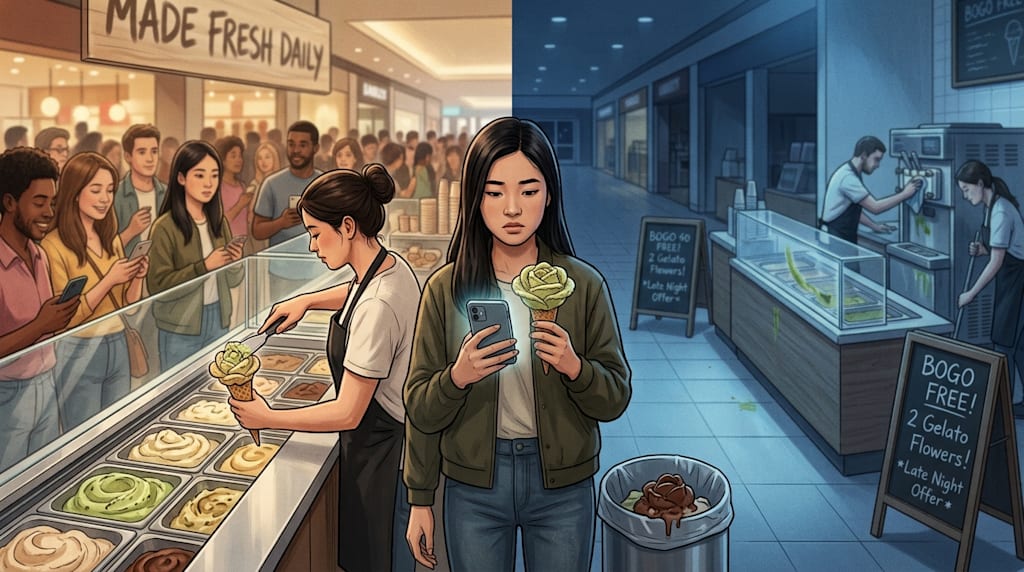
On a weekend in July 2026, Lin Zhao walked into Mr. Wildman for the first time.
The line started at the counter and curved past the Chagee next door. Ahead of her stood a couple. The man held his phone up to photograph the menu. The woman asked, "Is there any pistachio left?" A clerk called out, "Last scoop of pistachio." Someone in line sighed.
Lin Zhao waited seventeen minutes. She ordered one scoop of pistachio for 28 yuan. The clerk scraped it from the tub with a flat spatula, curled it into a flower, and handed it over. "Best eaten within five minutes," he said.
She took a bite.
It was velvety. Not the sugary heaviness of industrial ice cream, but a light richness with nut oil in it. The pistachio pieces still had a little grain. They crunched when she bit down. She stood in the middle of the mall aisle holding the flower and thought 28 yuan was not expensive. It was the first time an ice cream had felt worth that price.
Two weeks later she went back with a colleague. They ordered two flavors for 36 yuan. After two bites, the colleague said, "It's okay. DQ is just as good." Lin Zhao said nothing. DQ did not have that pistachio flavor.
That night she saw a post on Xiaohongshu.
The photo showed a pouch of frozen milk base. The silver package had "Mr. Wildman" printed on it. The shelf-life column read "6 months." The post was titled: "Guess what Mr. Wildman uses in its kitchen?"
The comments exploded.
"So 'freshly made' means freshly opening a bag?"
"28 yuan for a bag of milk base."
"I always felt something was off."
Others defended the brand: "Central factory delivery is normal. You think every store starts by milking a cow?"
Lin Zhao zoomed in. There was a production date in small print. The pouch had left the factory nearly two months earlier.
She remembered what the clerk had said the first time: "Best eaten within five minutes." Back then she thought it meant the gelato would melt. Now she was not sure.
In January 2026, Mr. Wildman's founder, Cui Jianwei, had said, "We brought the industry price down."
His math: traditional gelato sold one scoop of about 80 grams for 30 to 40 yuan. Mr. Wildman sold about 130 grams for 28 yuan. By price per gram, traditional gelato cost 0.375 to 0.5 yuan; Mr. Wildman cost 0.215 yuan.
Within the gelato category, that was true. Mr. Wildman was cheaper than Venchi, whose cups started at 59 yuan, than Häagen-Dazs at 47 to 49 yuan per scoop, and than Starbucks ice cream cups at 35 to 45 yuan.
Lin Zhao did different math.
For 28 yuan she could buy two Chagee Geelato, or one Heytea Xiladuo with a topping, or five Mixue sundaes. She also knew the survey number: 93.1 percent of consumers would only pay below 20 yuan for ice cream.
And she thought about the pouch with the six-month shelf life.
After the pouch was exposed, Cui Jianwei responded.
He said Mr. Wildman used "central factory pretreatment plus in-store final production." The factory turned pasteurized fresh milk into frozen milk base, shipped it cold to stores, where staff thawed it, added fresh fruit and nuts, and finished it in a specialized machine. He said frozen milk base was healthier than milk powder, non-dairy creamer, or shelf-stable milk base, and that most of it was used within a month.
That was reasonable. A chain with a thousand stores cannot make everything from scratch in each shop. McDonald's uses preformed beef patties. Starbucks uses syrup. Heytea uses tea bases. Frozen milk base is better than non-dairy creamer, and the turnover is fast.
But when Lin Zhao read it, something snagged.
The snag was the phrase "made fresh daily."
The sign in Mr. Wildman stores said "Made fresh daily, no overnight." To her, that meant starting with fresh milk, from zero, by hand. When she saw the pouch with the six-month shelf life, she understood the chain logic. She still felt the word "fresh" had shifted under her.
This was not only Mr. Wildman's problem. Yuanji Cloud Dumplings faced similar questions when its ingredients turned out to be frozen. It did not crash, because the dumplings really were wrapped in-store. Mr. Wildman's case was similar. Its method could be called not handmade enough. It could not be called fake. The milk base was made from pasteurized fresh milk, not milk powder. That line kept it from a Zhong Xue Gao-style collapse.
But Lin Zhao did not go back.
On September 12, 2026, Luo Yonghao posted on Weibo.
He said he tried Mr. Wildman at the airport and found it very average. "Considering the price, it could even be called bad-tasting." He added: "It felt much worse than Zhong Xue Gao. I miss Zhong Xue Gao."
The post trended. The comments did not divide into camps. They filled with one phrase: "Do not answer." The joke came from Xibei, which had fought Luo Yonghao and then came under business pressure.
Mr. Wildman did not respond.
Cui Jianwei did not respond either.
That night Lin Zhao passed the Mr. Wildman on the basement level. At nine, the buy-one-get-one-free sign still stood by the door. No one was at the counter. Two clerks wiped the ice cream machine's dispenser. They wiped slowly.
She stood there. Half the tubs in the case were empty. The pistachio tub still had a green streak on its wall. She remembered the first visit: the clerk calling out "Last scoop of pistachio," the sigh in line.
Now no one sighed. No one was in line.
By September 2026, Mr. Wildman had more than 1,700 stores.
Franchising opened at the end of 2023. It added 244 stores in 2024 and 916 in 2025. In two years the count grew thirteenfold. Only DQ, in China for thirty-four years, had more.
That growth meant Mr. Wildman had given up more than ninety percent of ice cream consumers from the start. iiMedia Research found that 93.1 percent of consumers would only accept ice cream below 20 yuan. Only 6.9 percent would go above 20. Mr. Wildman was aiming at that small group willing to pay for quality and experience.
The strategy worked commercially. The 1,700 stores were the market's answer.
Lin Zhao was no longer in that 6.9 percent.
When she passed Mr. Wildman, she glanced at the counter. Sometimes there was a line. Sometimes not. After nine, the buy-one-get-one-free sign was always out. With the deal, one scoop cost 14 yuan. She could accept that.
She still did not go in.
She could not name what she was waiting for. A different sign, maybe. An admission of the gap between "central factory pretreatment" and "made fresh daily." Or simply time, enough for the pouch to fade from memory.
Mr. Wildman began as Wildman Pasture in 2011 in Wudaokou, Beijing. Cui Jianwei had an MBA from Peking University's Guanghua School of Management. Before 2024, Wildman Pasture ran for more than a decade with about 100 stores, all directly operated.
In 2015 he started making gelato. He insisted on no jam, no water, no flavoring. He promoted "made fresh daily, sold in small batches through the day." Back then, Lin Zhao would take the subway just to eat there.
After franchising opened in late 2023, everything sped up.
Cui Jianwei attributed the boom to timing. New tea drinks had spent ten years teaching consumers to buy on impulse in malls. As tea competition turned to stock, fresh ice cream took over the mall traffic and franchisee resources.
That logic held. It also created a contradiction. Was Mr. Wildman's price serving customers or franchisees?
A store cost at least 500,000 yuan to open. Franchised stores made up more than 80 percent of the chain. Franchisees needed high gross margins and fast payback. A 60 percent gross margin and a 12-month payback were the selling points. If Mr. Wildman dropped below 20 yuan, food cost would stay the same. Equipment depreciation would stay the same. Rent would stay the same. Gross margin would shrink. Payback would stretch. Expansion would slow.
The 28-yuan price was a franchisee strategy as much as a customer strategy. It kept a high anchor so franchisees could see profit. The nine p.m. buy-one-get-one-free deal, the 36-yuan two-flavor combo, and the 25.9-yuan choose-any set on Dianping gave price-sensitive customers a way in without breaking the anchor.
Many new tea brands did the same. The problem is that long promotions teach customers to treat the promo price as the real price. When buy-one-get-one-free becomes normal, 28 yuan stops meaning anything.
Lin Zhao went to Mr. Wildman for the last time on an evening in October 2026.
She had worked overtime until 9:30. Passing the mall, she saw the lights still on. The buy-one-get-one-free sign stood at the door. One clerk was behind the counter. She walked over. The clerk looked up. "Buy one get one free, last half hour."
She ordered pistachio and chocolate. The clerk curled both scoops into flowers, put them in a paper box, and handed it over. Lin Zhao stood in the mall aisle and bit into the pistachio.
Still velvety. Still the same taste.
She finished it. Then she threw the chocolate flower into the trash.
She was not sure why. The chocolate was too sweet. She had really wanted only pistachio. Or the buy-one-get-one-free itself made the flower feel less than 28 yuan.
Walking out, she looked back. The sign was still lit. "Made Fresh Daily" glowed warm in the dark. The clerk wiped the counter slowly.
She remembered the first visit. The line curved from the counter. The man photographed the menu. The woman asked if there was pistachio left. The clerk called out, "Last scoop of pistachio." Someone sighed.
Now no one was in line.
She turned and left. The photo of the milk-base pouch was still on her phone. She had not deleted it. She did not know if she would go back. Maybe one night, after working until 9:30, she would pass the mall, see the buy-one-get-one-free sign, and walk in.
Maybe not.
About the Creator
Jin
Writer of reamstories
https://reamstories.com/jin
Enjoyed the story? Support the Creator.
Subscribe for free to receive all their stories in your feed. You could also become a paid subscriber, letting them know you appreciate their work.
Comments
There are no comments for this story
Be the first to respond and start the conversation.