
Borrowed Thinking
What adolescent cannabis research and the rise of AI reveal about a generation learning when to think—and when to outsource it

A sixteen-year-old in 2026 can ask a chatbot to outline an essay, explain a scientific paper, compare two universities, rehearse a difficult conversation with a parent, or suggest what to do about a friend who has stopped replying. This is no longer a fringe behavior. In a Pew Research Center survey conducted in fall 2025, 54 percent of U.S. teenagers aged 13 to 17 said they had used AI chatbots for help with schoolwork, and one in ten said they do all or most of their schoolwork with that help.
In April of this year, researchers published one of the most carefully measured studies to date on how adolescent cannabis use tracks with cognitive development. Its central finding, that young people who began using cannabis showed slower cognitive gains than their peers, has circulated under the phrase "flattened cognitive development."
These look like unrelated stories, and in most respects they are. One concerns a psychoactive drug acting on a maturing nervous system. The other concerns a technology that changes which mental tasks a person has to perform at all. No study has examined the two together, and nothing in the current evidence suggests they combine to produce some new form of impairment.
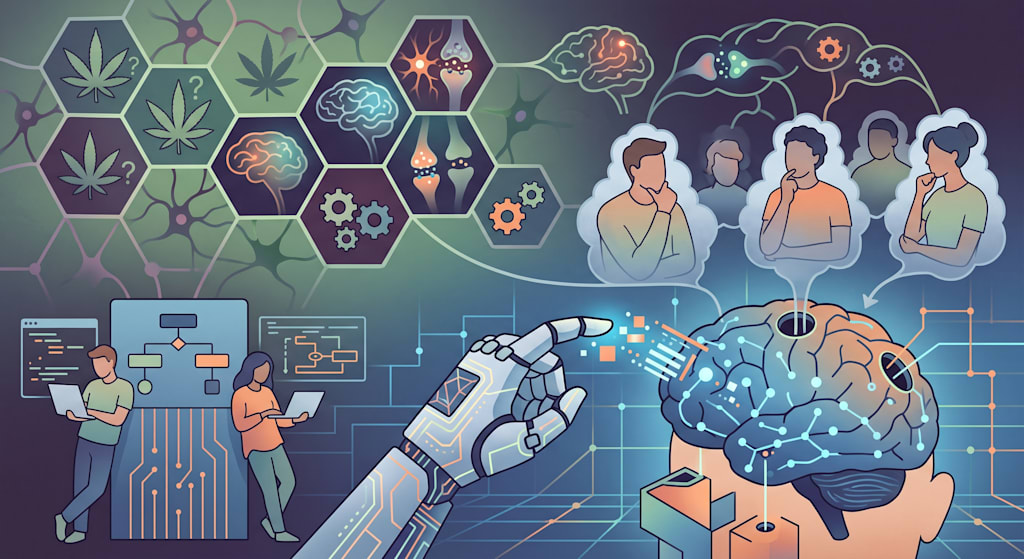
Yet placed next to each other, they raise a question neither literature can answer on its own: what happens when a brain that is still building its capacity for judgment grows up in a world where more and more of the work of thinking can be handed to something else?
What the cannabis study measured
The study, led by Natasha Wade of the University of California, San Diego, and published in Neuropsychopharmacology, drew on the Adolescent Brain Cognitive Development (ABCD) Study. ABCD recruited nearly 12,000 children aged 9 and 10 at 21 sites across the United States between 2016 and 2018 and has followed them since. The new analysis included up to 11,036 participants between ages 9 and 17, with the number varying by task.
What sets the study apart is how it identified cannabis use. Most research relies on self-report, which adolescents have obvious reasons to shade. Wade's team paired annual interviews with toxicology from hair, urine, breath, and oral fluid samples. A participant moved into the cannabis group the first time they reported more than a single puff or taste, or tested positive, and remained there for the rest of the study regardless of how often they used afterward.
About 2,200 young people were classified this way. Self-report identified 67 percent of them; roughly a third were identified only by other means, chiefly toxicology. A self-report-only design would have counted them as abstainers.
Every other year, participants completed a battery of cognitive tasks covering working memory, inhibitory control, episodic memory, processing speed, receptive vocabulary, oral reading, visuospatial reasoning, and immediate and delayed verbal recall.
What "flattened" means, and what it doesn't
The headline word is easy to misread. The young people who would later use cannabis did not start out behind. At ages 9 to 11 they scored slightly higher than their peers on most tasks, a pattern the authors describe as a likely pre-existing advantage.
Both groups generally kept improving through adolescence, as developing brains do. The difference was in the slope. Non-using youth improved at a steady, age-typical pace, while youth who initiated cannabis use improved more slowly. By the mid-to-late teens the lines had crossed on most measures, and the cannabis group scored lower.
The size of the difference varied by domain. The authors classified most effects as small. Episodic memory showed a medium effect and working memory a large one, although the working-memory gap appeared late: the groups did not differ at ages 15 and 16, and the cannabis group scored lower only at 17.
A secondary analysis examined 645 participants whose hair was tested repeatedly between roughly ages 12 and 16. Because hair testing mainly detects regular use, this subgroup likely reflects heavier exposure. Youth with THC in their hair showed slower improvement in episodic memory than those with no cannabinoids, and no difference on the other tasks examined. The 21 youth with CBD did not differ from controls, a null result the authors warn against reading as evidence of safety.
The researchers adjusted for many factors, including parental education, family history of substance-use problems, prenatal exposure, emotional and behavioral problems at ages 9 to 10, and use of alcohol, nicotine, and other drugs. Even so, they state plainly that the design cannot establish cause. Cannabis may directly affect development, or a shared vulnerability may make some young people both likelier to use it and less likely to keep pace cognitively. The authors name earlier maturation as one candidate, note that unusually high early scores tend to drift toward the average, and acknowledge that residual confounding cannot be excluded.
The defensible reading is therefore narrower than a headline allows. In a large, carefully measured cohort, starting cannabis use during adolescence was associated with smaller cognitive gains, mostly modest, with the clearest signal in memory. The authors argue that even modest differences can matter in real settings such as school performance and driving. That is a reason for caution and for delaying use. It is not a verdict on a generation.
Why the adolescent window matters
Adolescence is not a smaller version of adulthood. During these years the brain refines the association cortices that support executive functions: holding information in mind, overriding an impulse, planning, weighing one option against another. Neuroscientists Bart Larsen and Beatriz Luna have proposed that adolescence works as a critical period for this kind of higher-order cognition, a window in which experience helps stabilize the circuitry that adult reasoning will depend on.
Two implications follow from that model. Biological influences during the window may matter more than the same influences later, which is one reason researchers study cannabinoids acting on a still-developing endocannabinoid system. And experience matters more, too. Experience and practice are among the influences that shape developing cognitive capacities.
That second implication is where the other story begins.
The oldest habit in human cognition
Psychologists call it cognitive offloading: using a physical action or an external resource to reduce the mental demands of a task. In an influential 2016 review, Evan Risko and Sam Gilbert showed how ordinary it is, from shopping lists to phone reminders. People tend to offload when they judge it more efficient than relying on their own abilities, and they are often right.
Anxiety about offloading is ancient. In Plato's Phaedrus, Socrates recounts a myth in which the invention of writing is criticized for breeding forgetfulness and the appearance of wisdom rather than wisdom itself. Writing did not end human memory. It made libraries, science, and long-form argument possible. Later worries about calculators, television, search engines, and smartphones followed a similar arc, and many proved overstated.
Not all of them, though. Experimental research on offloading points to a recurring trade between performance now and learning later. In a 2021 series of experiments, Sandra Grinschgl and colleagues found that offloading improved how well people performed a task but reduced how much they remembered of it afterward. In a study of 50 regular drivers, Louisa Dahmani and Véronique Bohbot found that heavier lifetime GPS users had poorer spatial memory when navigating on their own. The samples were modest, but the pattern fits a simple principle: skills rarely exercised tend not to be maintained.
What distinguishes generative AI from a navigation app is scope. GPS takes over wayfinding. A language model can take over drafting, summarizing, comparing arguments, and recommending a course of action. Those tasks sit much closer to the core of reasoning itself.
What the early AI research shows
The evidence on generative AI and cognition is young, and most of it involves adults. Several findings still stand out.
In a survey of 319 knowledge workers presented at the CHI 2025 conference, researchers from Microsoft Research and Carnegie Mellon University found that people with more confidence in generative AI reported doing less critical thinking when they used it. People with more confidence in their own abilities reported doing more. Participants described their effort shifting away from gathering information and solving problems, and toward verifying, integrating, and overseeing what the AI produced. The data are self-reported and cross-sectional, so they cannot show that AI use reduces critical thinking, but they suggest its form changes and that the user's stance matters.
The clearest experimental evidence involving teenagers comes from a randomized trial of nearly 1,000 high school math students in Turkey, published in PNAS in 2025. One group practiced with a standard chat interface built on GPT-4. A second used a version prompted with teacher input to offer hints rather than answers. A control group used only textbooks and notes. During practice, the standard interface raised scores by 48 percent and the hint-giving tutor by 127 percent. When the AI was taken away for an exam, students who had used the standard interface scored 17 percent lower than the control group. Students who had used the tutor version scored about the same as controls. Chat logs showed that most students using the standard interface had simply asked for answers.
The same underlying model, configured differently, produced opposite learning outcomes. That is the study's most important lesson, and it is often lost when the 17 percent figure travels alone.
A 2026 study in Computers in Human Behavior adds a metacognitive dimension. Participants who solved logical-reasoning problems with an AI assistant outperformed those who worked alone, but they substantially overestimated how well they had done. Those with greater AI literacy were, if anything, less accurate in judging their own performance. The authors' title summarizes the finding: AI made people smarter, but none the wiser.
None of this is entirely new. Human-factors researchers have documented automation bias for decades: the tendency to accept an automated recommendation without adequate scrutiny, seen in novices and experts alike across aviation, medicine, and industrial control. Generative AI presents a new version of an old problem. Its output is fluent and confident, and fluency invites deference.
On adolescents specifically, high-quality evidence remains thin. Two 2024 studies of Swedish adolescents, one with 385 participants averaging age 14 and the other with 359 averaging age 17, found that teenagers who reported more difficulty with executive functions such as planning and inhibition rated generative AI as more useful for schoolwork, particularly for completing assignments. Both designs were cross-sectional, so they cannot tell us whether AI use weakens executive function or whether students who already struggle with planning find the tool more valuable. Long-term studies following how adolescents' AI use relates to the development of their reasoning are still largely missing.
Think for me, or help me think
This does not make AI inherently corrosive. A 2025 randomized trial with 194 Harvard physics students found that an AI tutor deliberately built around teaching best practices produced more learning, in less time, than an in-class active-learning lesson. The authors are careful to say this will not hold in every context. Taken together with the Turkish math trial, it suggests the effect of AI on learning depends heavily on what the AI is asked to do and what it leaves for the learner.
That difference can be captured as a distinction between two kinds of request.
The first is cognitive substitution: think for me. "What should I believe about this?" "Write my argument." "Which option should I choose?"
The second is cognitive augmentation: help me think better. "Here is my reasoning. Find its weak points. Give me the strongest counterargument. Tell me which assumptions I'm making without noticing, and what evidence would change my conclusion."
The same system can answer both. But the work left to the human is radically different. In the first case, a person receives a conclusion. In the second, they must state a position, confront its weaknesses, and revise it, which are the very operations through which judgment is built.
Researchers have tested designs that push people toward the second mode. In a 2021 experiment with 199 participants, Harvard researchers used "cognitive forcing functions," such as asking people to commit to their own decision before seeing the AI's recommendation. These designs reduced overreliance on the AI compared with simpler approaches, though they did not eliminate it. There was a revealing trade-off: participants gave the least favorable ratings to the designs that reduced overreliance the most.
That tension sits at the center of the problem. Augmentation is effortful, and effort is precisely what most tools are designed to remove.
Two literatures, one question
Here the two threads have to be held carefully.
There is currently no evidence that cannabis use and AI reliance interact. No published study has measured both in the same adolescents, and nothing suggests that a teenager who uses cannabis and also uses a chatbot faces a compounded deficit. The two are not equivalent mechanisms, either. Cannabis is a pharmacological exposure that may act directly on developing neural systems, although even there, causation remains unresolved. AI is an environmental and behavioral factor. It changes which tasks a person practices, not the tissue doing the practicing.
What they share is structural. Both bear on the conditions under which cognitive capacities develop, during a window when those capacities are still being built. The cannabis findings, read cautiously, are a reminder that adolescent cognitive trajectories are not fixed; they can diverge depending on what happens along the way. The offloading research suggests that practice is one of the things that happens along the way, and that tools can quietly redistribute it.
That leads to a hypothesis, not a finding. If adolescence is a period when judgment is consolidated partly through use, then the habits young people form around delegation (what they hand off, and what they keep for themselves) may matter more than the same habits formed in adulthood. As far as I can find, no one has tested this. It deserves testing.
What judgment actually requires
It is tempting to define good thinking as knowing things or producing correct answers. Machines now do both cheaply. Judgment looks different. It involves recognizing what you don't know, holding confidence in proportion to evidence, comparing competing explanations, noticing your own biases, and owning a decision after you make it.
The research above suggests where AI puts pressure on those capacities: performance coming apart from self-knowledge, fluent recommendations accepted too readily, and trust in the tool displacing scrutiny of it.
If that picture holds, the skill that matters most may not be remembering information or generating answers. It may be a set of judgments about thinking:
when to think independently, and when to use AI
when to distrust what it produces
how to verify an answer rather than recognize it as plausible
how to tell confident output from certain output
how to compare competing explanations
how to catch one's own biases, including the wish to be agreed with
how to keep responsibility for a decision even when an AI helped make it
These skills are not new. What is new is that they can no longer be left implicit.
What school might teach when answers are nearly free
The Turkish math trial offers one practical lesson: design and structure change what students practice. A tool structured around hints avoided the learning penalty observed with unrestricted access. Classrooms can build similar structure. Students can attempt a problem before consulting AI, be assessed on their reasoning as well as their result, and practice using AI adversarially: asking it to attack their argument rather than write it, then deciding which criticisms hold.
These are reasonable inferences from the evidence, not tested curricula. They also place real demands on teachers and on the designers of the tools themselves.
The question that stays open
It would be easy to end on a warning. The evidence doesn't support one.
It doesn't show that adolescents are being cognitively diminished by AI. It doesn't show that cannabis and AI combine to impair anyone. It shows something more modest and more interesting: cognitive trajectories in adolescence can diverge, and the way people use powerful tools shapes what they learn from using them.
That leaves room for a hopeful possibility as well as a worrying one. A generation raised alongside AI could become exceptionally capable thinkers, if young people learn to treat it as a sparring partner that tests their reasoning rather than a replacement that does the reasoning for them. Teenagers who routinely ask a machine to find the flaws in their arguments might develop sharper judgment than any previous generation had the means to practice. Or the path of least resistance might win.
We don't yet know which. The issue is not whether the next generation will have access to intelligence. They will have more of it at their fingertips than any generation before them. The question is whether they will learn when to borrow intelligence from a machine, and when they must exercise their own.
References
Bastani, H., Bastani, O., Sungu, A., Ge, H., Kabakcı, Ö., & Mariman, R. (2025). Generative AI without guardrails can harm learning: Evidence from high school mathematics. Proceedings of the National Academy of Sciences, 122(26), e2422633122. https://doi.org/10.1073/pnas.2422633122
Buçinca, Z., Malaya, M. B., & Gajos, K. Z. (2021). To trust or to think: Cognitive forcing functions can reduce overreliance on AI in AI-assisted decision-making. Proceedings of the ACM on Human-Computer Interaction, 5(CSCW1), Article 188. https://doi.org/10.1145/3449287
Dahmani, L., & Bohbot, V. D. (2020). Habitual use of GPS negatively impacts spatial memory during self-guided navigation. Scientific Reports, 10, 6310. https://doi.org/10.1038/s41598-020-62877-0
Fernandes, D., Villa, S., Nicholls, S., Haavisto, O., Buschek, D., Schmidt, A., Kosch, T., Shen, C., & Welsch, R. (2026). AI makes you smarter but none the wiser: The disconnect between performance and metacognition. Computers in Human Behavior, 175, 108779. https://doi.org/10.1016/j.chb.2025.108779
Grinschgl, S., Papenmeier, F., & Meyerhoff, H. S. (2021). Consequences of cognitive offloading: Boosting performance but diminishing memory. Quarterly Journal of Experimental Psychology, 74(9), 1477–1496. https://doi.org/10.1177/17470218211008060
Kestin, G., Miller, K., Klales, A., Milbourne, T., & Ponti, G. (2025). AI tutoring outperforms in-class active learning: An RCT introducing a novel research-based design in an authentic educational setting. Scientific Reports, 15, 17458. https://doi.org/10.1038/s41598-025-97652-6
Klarin, J., Hoff, E., Larsson, A., & Daukantaitė, D. (2024). Adolescents' use and perceived usefulness of generative AI for schoolwork: Exploring their relationships with executive functioning and academic achievement. Frontiers in Artificial Intelligence, 7, 1415782. https://doi.org/10.3389/frai.2024.1415782
Larsen, B., & Luna, B. (2018). Adolescence as a neurobiological critical period for the development of higher-order cognition. Neuroscience & Biobehavioral Reviews, 94, 179–195. https://doi.org/10.1016/j.neubiorev.2018.09.005
Lee, H.-P., Sarkar, A., Tankelevitch, L., Drosos, I., Rintel, S., Banks, R., & Wilson, N. (2025). The impact of generative AI on critical thinking: Self-reported reductions in cognitive effort and confidence effects from a survey of knowledge workers. In Proceedings of the 2025 CHI Conference on Human Factors in Computing Systems (CHI '25). https://doi.org/10.1145/3706598.3713778
Parasuraman, R., & Manzey, D. H. (2010). Complacency and bias in human use of automation: An attentional integration. Human Factors, 52(3), 381–410. https://doi.org/10.1177/0018720810376055
Pew Research Center. (2026, February 24). How teens use and view AI. https://www.pewresearch.org/internet/2026/02/24/how-teens-use-and-view-ai/
Risko, E. F., & Gilbert, S. J. (2016). Cognitive offloading. Trends in Cognitive Sciences, 20(9), 676–688. https://doi.org/10.1016/j.tics.2016.07.002
Wade, N. E., Sullivan, R. M., Wallace, A. L., Visontay, R., Szpak, V., Lisdahl, K. M., Huestis, M. A., Dib Gonçalves, P., Byrne, H., Mewton, L., Jacobus, J., & Tapert, S. F. (2026). Longitudinal neurocognitive trajectories in a large cohort of youth who use cannabis: Combining self-report and toxicology. Neuropsychopharmacology, 51(9), 1546–1555. https://doi.org/10.1038/s41386-026-02395-1
About the Creator
Khali Sollis
Khali Sollis is a writer and independent researcher exploring the science of the human mind and behavior. Her work examines questions at the intersection of neuroscience, psychology, cognition, mental health, and everyday human experience.
Enjoyed the story? Support the Creator.
Subscribe for free to receive all their stories in your feed.
Comments
There are no comments for this story
Be the first to respond and start the conversation.