
The love story in Blossoms Shanghai is hidden in menus, keys, and teacups
Wong Kar-wai turns romance into a business deal, then makes you feel every line nobody says.
1. Lingzi's Night Tokyo begins with a menu torn apart
On the day Lingzi splits from Bao Zong, there is no fight.
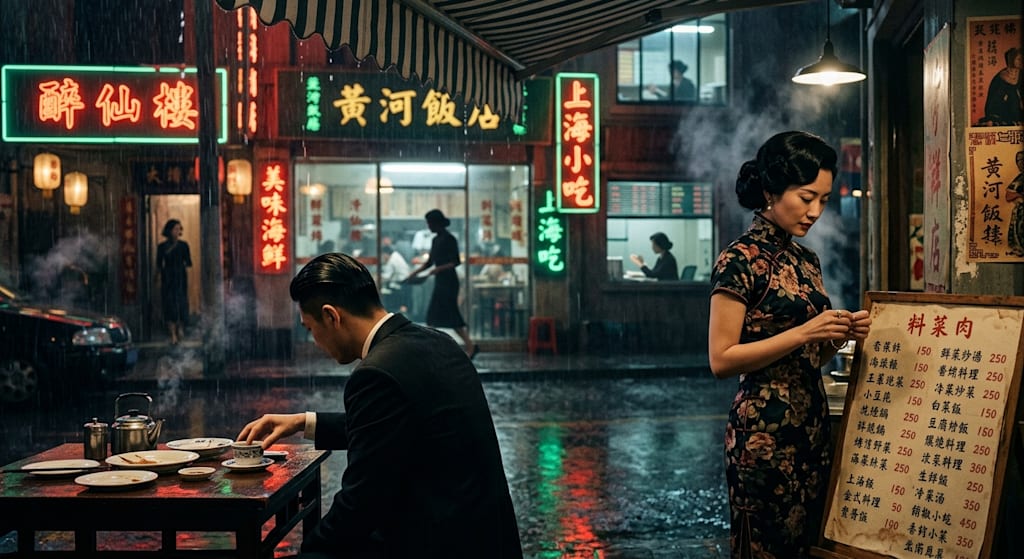
She changes the menu at Night Tokyo. The old menu served Shanghainese food: braised pork, sweet-and-sour ribs, salted pork and bamboo shoot soup. Bao Zong liked those dishes. The new menu has paofan, pickles, fermented bean curd, and a dish still called "Bao Zong's paofan." Same name. Different recipe. Saltier.
Bao Zong takes a bite. "Too salty."
Lingzi says, "If it's too salty, don't eat it."
No line says "I don't love you" or "I've had enough." Every viewer understands: she is renovating herself.
Later, when Night Tokyo reopens, Lingzi gets rid of the old things. A spare key Bao Zong left at the restaurant goes into the back of a drawer. She doesn't throw it away. She doesn't return it. The camera catches it. Bao Zong doesn't.
Blossoms Shanghai writes love this way: it hides feeling in a menu, a key, the saltiness of a bowl of paofan.
2. Wong Kar-wai's camera never shoots love
A review in The Paper put it well: "Blossoms Shanghai is less about love than about missing each other."
But "missing" is too polite. Wong Kar-wai films something harder. Everyone handles love the way they handle business.
Lingzi and Bao Zong's relationship is a business from start to finish. She runs Night Tokyo for him. He gives her shares. She asks him for money. He gives it. She asks him for the person. He doesn't.
Miss Wang and Bao Zong's relationship is also a business. She is at No. 27, holding quotas. He is outside, needing quotas. They need each other and complete each other, but the accounts are never clear. That unclear account is the space Wong Kar-wai leaves for love.
Li Li and Bao Zong's relationship looks most like business. When Zhizhen Garden opens, Bao Zong comes to show support and sends a flower basket. Li Li says, "Bao Zong, a flower basket is less useful than something practical." Bao Zong says, "You don't lack practical things." Li Li smiles and doesn't answer.
In this scene, both are testing, both are quoting a price, both are waiting for the other to show their cards first. Neither does. The moment one does, the deal is done and the feeling is broken.
Wong Kar-wai turns love into business war and business war into love. In the end you can't tell whether Lingzi wants Bao Zong's money or Bao Zong himself, whether Miss Wang wants Bao Zong's orders or Bao Zong's promise.
Call it ambiguity if you want. It is the logic of that era.
3. bell hooks wrote a line about all of us
bell hooks wrote in All About Love: "Women can discuss the desire for power, but not the desire for love."
Put that line inside Blossoms Shanghai, and you have the fate of Lingzi, Miss Wang, and Li Li.
Lingzi can discuss Night Tokyo's shares, menu, renovation, table turnover. She cannot discuss "Bao Zong, do you want me or not?" The moment she says it, she loses. She is no longer the Lingzi who "knows what's what." She becomes another woman on Huanghe Road waiting for Bao Zong to marry her.
Miss Wang can discuss No. 27's quotas, foreign trade procedures, her plan to start her own company. She cannot discuss "Bao Zong, why didn't you come?" The moment she says it, she becomes the girl who waited and waited in the pork chop and rice cake shop. Not "my own dock."
Li Li can discuss Zhizhen Garden's cash flow, the layout of Huanghe Road, the accounts between her and Bao Zong. She cannot discuss "Are you coming?" The moment she says it, she becomes a woman pushed along by fate. Not the woman who came from Shenzhen to Shanghai with secrets and ambition to start over.
bell hooks was not describing only women's predicament. She was describing everyone's. In an age that treats career as the only hard currency, admitting "I want love" equals admitting "I am not strong enough."
Bao Zong is the same. He says "Too salty" to Lingzi, "I know" to Miss Wang, "Next time" to Li Li. He never says "I want." If he does, he is no longer Bao Zong. He is A Bao from Caoyang New Village again.
4. Wong Kar-wai uses "bu xiang" to kill every love line
Jin Yucheng repeats the word bu xiang throughout the novel. In Shanghainese, it means not answering, not taking the bait, not declaring, neither admitting nor denying.
Wong Kar-wai turns it into the grammar of the whole series.
Lingzi asks Bao Zong, "Is it real or fake with me?" Bao Zong bu xiang.
Miss Wang asks Bao Zong, "Will you come?" Bao Zong bu xiang.
Li Li asks Bao Zong, "You and me, is it business or something else?" Bao Zong bu xiang.
Bu xiang is not no answer. Bu xiang is too many answers, so many they cannot be spoken. If Bao Zong says "real" to Lingzi, he must say "fake" to Miss Wang. If he says "real" to Miss Wang, he must say "fake" to Li Li. He can't. So he chooses bu xiang.
Wong Kar-wai's brilliance is that he doesn't let Bao Zong alone bu xiang. He lets everyone bu xiang.
Lingzi says, "If it's too salty, don't eat it," and leaves. Miss Wang says, "I am my own dock," and leaves. Li Li says, "I'm becoming a nun," and leaves.
They use bu xiang to make the loudest declaration.
5. One scene lifts the whole series' card
After Miss Wang starts her business, she runs into Bao Zong at Zhizhen Garden.
She is there with a client. Bao Zong sits at the next table. They don't look at each other. The camera gives us Miss Wang's hand under the table, clutching a tissue, tight.
Then Bao Zong gets up, passes her table, pauses. He reaches out and turns the teacup in front of Miss Wang so the handle faces her.
Then he leaves.
No dialogue.
This is Blossoms Shanghai's view of love: I don't say I love you. I turn your teacup. You know that I know that you know.
After this scene, Miss Wang cries. Wong Kar-wai doesn't show her crying. The camera cuts to the night view of Huanghe Road, to the neon of Zhizhen Garden, to a kitchen worker frying rice. When it returns to Miss Wang, she is already negotiating the next deal with her client.
The tears are cut. What remains is the teacup turned.
6. None of them married Bao Zong, but they all married themselves
The cruelest thing about Blossoms Shanghai is that it lets three women complete arcs of growth while Bao Zong stands still.
Lingzi goes from depending on Bao Zong to running her own place. Miss Wang goes from the system to starting her own business. Li Li goes from debt to renunciation. Each confirms her own subjectivity. Their growth is more obvious than Bao Zong's.
And Bao Zong? He is still the bu xiang Bao Zong. Still moving between Caoyang New Village and the Peace Hotel. Still the man who can move among women but never deliver himself.
Wong Kar-wai doesn't let Bao Zong rise. He doesn't even let Bao Zong "realize" anything. At the end, Bao Zong is still Bao Zong, except all the women around him have left.
Career doesn't win. Love was never put on the table to be weighed in the first place.
7. Blossoms fall, each sees the world
Back to bell hooks.
In All About Love she also says: "When we choose the will to love over the will to power, we begin to know love."
Blossoms Shanghai does not give us that choice. It gives us that era itself: an era when the will to power crushed everything, when bu xiang was safer than "I love you," when everyone handled feelings with the logic of business.
Wong Kar-wai doesn't shut the door completely. He leaves one thing at the end. Bao Zong walks alone on Huanghe Road, passing Night Tokyo, passing Zhizhen Garden, passing Miss Wang's old office. He pauses, then keeps walking.
He doesn't go in.
This is the last stroke of Blossoms Shanghai: bu xiang.
Blossoms bloom and fall. Each sees the world. When the blossoms are gone, you know the taste of life. All the love that was never spoken becomes a neon light on Huanghe Road. It was lit, then it went out.
About the Creator
Jin
Writer of reamstories
https://reamstories.com/jin
Enjoyed the story? Support the Creator.
Subscribe for free to receive all their stories in your feed. You could also become a paid subscriber, letting them know you appreciate their work.
Comments
There are no comments for this story
Be the first to respond and start the conversation.