Ancient
The History of Egyptian Hieroglyphs
Egyptian hieroglyphs, often referred to as "sacred carvings" from the Greek term *hieroglyphikos*, represent one of the world's oldest writing systems. These pictorial symbols, known to the ancient Egyptians as *mdw.w-nṯr* or "words of the gods," combined logographic, phonetic, and determinative elements to convey language. Emerging around 3200 BCE during the Naqada III period, hieroglyphs evolved from proto-literate symbols used in the Early Bronze Age, marking a pivotal advancement in human communication.
By jahidul Islam Sifat4 months ago in History
The Epic Love Story of Inanna and Dumuzi: The World’s Oldest Romance of Passion, Power, and Renewal
In the cradle of civilization, along the fertile banks of the Tigris and Euphrates rivers more than 4,000 years ago, the ancient Sumerians told stories that still resonate today. Among the most powerful and enduring is the love story of Inanna, the Queen of Heaven and Earth, and Dumuzi (also known as Dumuzid or later Tammuz), the shepherd-king. This tale, preserved on clay tablets in cuneiform script, combines erotic passion, divine politics, sacred ritual, tragic loss, and cyclical renewal. It is often called one of the world’s first epic love stories—tender, sensual, shocking, and profound.
By jahidul Islam Sifat4 months ago in History
Tailtiu's Last Gift: The Woman Behind Lughnasadh
When August arrives and the first grain is cut, most people who observe Lughnasadh speak the name of Lugh — the shining god, the one for whom the festival is named. But there is an older name beneath his, one the land itself carries. The town of Teltown in County Meath still whispers it. The festival was born from it. She is Tailtiu, and without her death, there would be no harvest to celebrate.
By The Celtic Spirit- A modern Guide to Celtic Belief and Practice5 months ago in History
Why the World Still Remembers the Justice of Omar ibn al-Khattab
The city of Madinah slept under a blanket of silence. The stars shimmered softly in the dark sky, and a cool breeze moved gently through the narrow streets. Most people were resting after a long day—but not the leader of the المسلمين.
By Nasibullah Temor5 months ago in History
Was Moses Known to Egypt as Senenmut?. AI-Generated.
A question raised by the surviving Egyptian record Off The Kirb Ministries recently released a video titled “This New Moses Information is Hard to Ignore...” The video explores a question that is simple on the surface but heavy once the evidence is laid out: was Moses known in Egypt by another name, and could that name have been Senenmut? The video credits the Armstrong Institute of Biblical Archaeology, Christopher Eames, and Scotty Roberts for the research that inspired the argument. The claim presented is not built around a single similarity, a vague resemblance, or a desire to force the Exodus story into Egyptian history. It is built around a pattern of chronology, names, royal access, authority, disappearance, and damaged memory.
By Peter Thwing - Host of the FST Podcast5 months ago in History
“The Rise of Nazi Germany Under Adolf Hitler”
The Rise and Fall of Adolf Hitler: A Dark Chapter in History The early 20th century was a time of uncertainty, fear, and change in Europe. In the aftermath of World War I, Germany was left weakened, humiliated, and struggling under the heavy terms of the Treaty of Versailles. Economic hardship, political instability, and widespread frustration created an environment where extreme ideas could take root. It was during this troubled period that a man named Adolf Hitler rose from obscurity to become one of the most powerful—and destructive—leaders in history.
By waqas durrani5 months ago in History
The Architect of Ruin
History is rarely a clean arc of progress; occasionally, it is a sudden, violent swerve into the abyss. The story of Adolf Hitler is not merely a biography of a dictator, but a chilling study in how a sophisticated nation can be seduced by rhetoric, paralyzed by economic desperation, and ultimately led into the fires of self-destruction. To understand the rise and fall of the Third Reich, one must look at the intersection of a broken society and a man who understood how to weaponize its deepest insecurities.
By shahid khan5 months ago in History
Judas Betrayed Jesus for the Price of a Slave
A Savior for the "Price of a Slave" According to three of the Gospels in the Bible, Judas Iscariot received 30 pieces of silver for pointing Jesus out to his enemies by betraying him with a kiss. This is why you might hear someone say of another that they gave a Judas kiss.
By Cheryl E Preston5 months ago in History
The New World Order
The New World Order The term “New World Order” (NWO) has become one of the most controversial and widely discussed ideas in modern politics and conspiracy theories. Some people believe it simply refers to changes in global politics and international cooperation, while others claim it represents a secret plan by powerful elites to establish a one-world government. Over the decades, the phrase has appeared in political speeches, historical documents, conspiracy books, and popular culture, creating fear, debate, and fascination around the world.
By Wings of Time 5 months ago in History
The Yew and the Grave
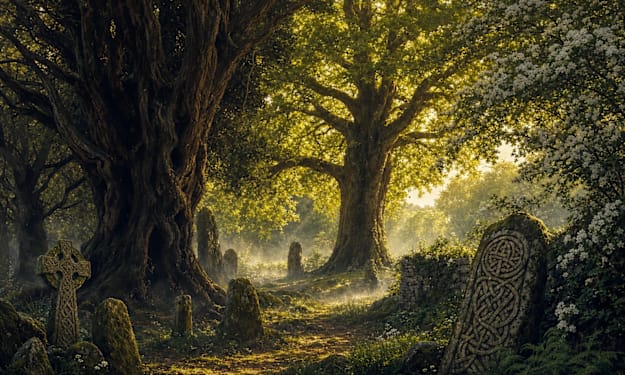
Trees held a special place in Celtic tradition. They were not only sources of shelter, fuel, and tools, but also markers of sacred space, memory, and passage between worlds. In myth and folklore, certain trees gathered meanings so deep that they became almost like living beings in their own right. Summer, especially, brings this symbolism into focus. At the height of the growing season, the oak stands in full strength, the hawthorn flowers along boundaries and hedges, and the yew reminds the living that death is never far from life. Together, these trees show that Celtic tradition did not divide the world neatly into life and death, safety and danger, human and divine. Trees stood at those borders.
By The Celtic Spirit- A modern Guide to Celtic Belief and Practice5 months ago in History
The Yew and the Hero
Of all the journeys in Irish mythology, the one Oisín takes across the sea to the Land of Youth is perhaps the most beloved and the most heartbreaking — because it is a story about what we lose when we try to hold onto summer forever. Oisín leaves Ireland in the bright heat of his heroic life and returns as an old man who can no longer touch the ground, and in that fall from his horse, centuries of time arrive all at once.
By The Celtic Spirit- A modern Guide to Celtic Belief and Practice5 months ago in History