
The Yew and the Grave
Celtic Tree Lore of Summer
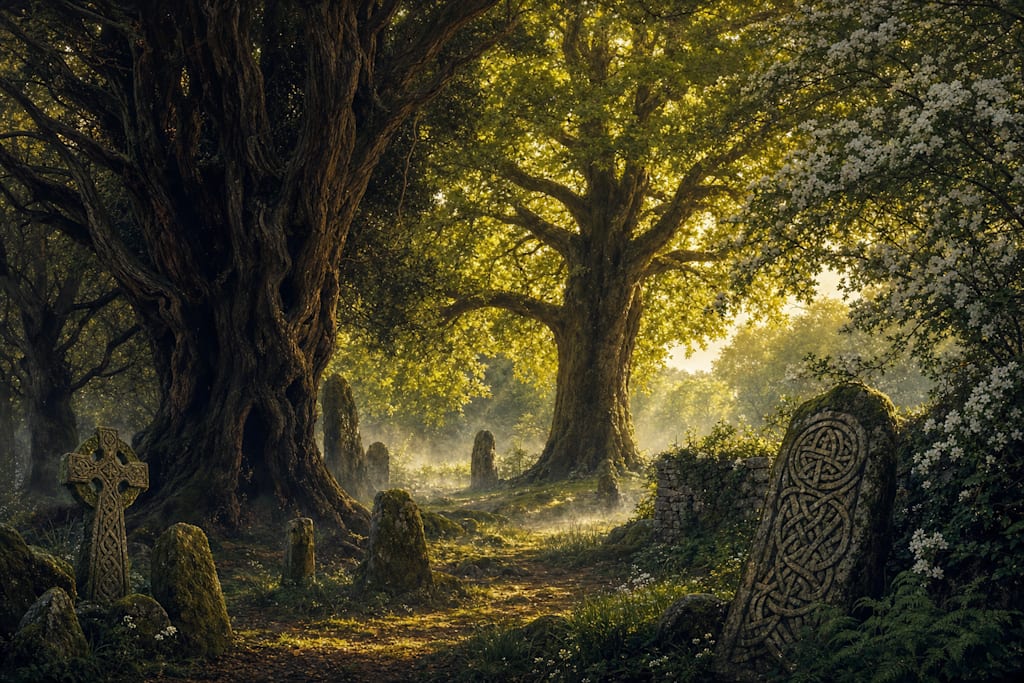
Trees held a special place in Celtic tradition. They were not only sources of shelter, fuel, and tools, but also markers of sacred space, memory, and passage between worlds. In myth and folklore, certain trees gathered meanings so deep that they became almost like living beings in their own right. Summer, especially, brings this symbolism into focus. At the height of the growing season, the oak stands in full strength, the hawthorn flowers along boundaries and hedges, and the yew reminds the living that death is never far from life. Together, these trees show that Celtic tradition did not divide the world neatly into life and death, safety and danger, human and divine. Trees stood at those borders.
Yew: tree of death and endurance
The yew is one of the most striking trees in Celtic and later British and Irish tradition because it is so often found near graveyards, sacred sites, and ancient places of burial. Its reputation comes partly from its unusual nature. Yews can live for astonishing lengths of time, outlasting generations of the people who gather beneath them. At the same time, much of the tree is poisonous. That combination — long life joined to hidden danger — made it a powerful symbol.
In tree lore, the yew becomes a tree of death, ancestry, and endurance. It is associated not simply with an ending, but with the kind of continuity that survives death. A yew may stand beside the graves of the dead for centuries, growing slowly while human lives pass beneath it. Because of that, it often feels less like a tree of destruction than a tree of memory. It reminds the living that death is part of a larger cycle, and that what is buried is not always gone.
This is one reason the yew can also symbolize rebirth or immortality. It is a tree that appears to belong to both worlds at once: rooted in the ground of the dead, yet still alive, dark, and enduring. In a summer landscape filled with visible growth, the yew stands as a quieter presence — a reminder that life’s fullness is always accompanied by time, loss, and ancestral shadow.
Oak: kingly strength at midsummer
If the yew belongs to graveyards and ancient memory, the oak belongs to visible strength. In Celtic tradition the oak is often treated as a kingly tree, associated with endurance, nobility, sacred power, and public life. At midsummer, when the oak is in full leaf, it seems to embody the season at its height: strong, expanded, and complete.
The oak is also important because groves of oak and other great trees could function as sacred gathering places. Before stone temples became dominant in many parts of the ancient world, sacred groves served as ritual spaces, places where human beings encountered the divine in living form. In a Celtic context, the idea of the grove as sacred survives strongly enough that later generations continued to imagine great trees as witnesses to assemblies, agreements, and moments of ritual importance.
Later folklore and modern pagan tradition sometimes speak of the **Oak King** and **Holly King**, figures who represent the waxing and waning halves of the year. That seasonal battle is not clearly preserved as an ancient Celtic myth in the early sources, but it has become a meaningful symbolic way of describing the turning of the seasons. In that framework, midsummer belongs to the oak: the king of the bright half of the year standing in his fullest power before decline begins.
Whether through ancient reverence or later symbolism, the oak carries the feeling of rule. It is the tree of standing tall, of shelter, of visible authority. In summer, it represents the strength of life at its peak.
Hawthorn: hedge, blossom, and threshold
If oak stands in the open as a sign of strength, hawthorn belongs to edges and thresholds. In Irish and broader Celtic folklore, hawthorn is deeply tied to fairy belief, boundary places, and seasonal danger. It often grows in hedges, field edges, and liminal spaces between one kind of ground and another. In spring and early summer, its white blossoms can make it appear almost enchanted.
Hawthorn became especially associated with fairy paths, sacred boundaries, and the unseen powers of the land. Lone hawthorn trees, in particular, were often treated with caution. In folklore they were not to be cut down casually, and many stories tell of misfortune following anyone who damaged such a tree. The belief was not merely about respect for nature in a general sense. It was about recognizing that some places belong partly to another order of being.
This makes hawthorn one of the clearest examples of a boundary tree. It marks the line between cultivated and uncultivated land, between road and field, between human control and otherworldly presence. Its blossoms belong to the season of May and early summer, linking it to beauty and fertility, but also to caution. Like many things in Celtic tradition, it is lovely without being harmless.
Trees as living sanctuaries
When these trees are taken together — yew, oak, and hawthorn — they reveal a larger pattern in Celtic tree lore. Trees did not merely symbolize abstract ideas. They shaped sacred space. A grove, a mound-side hawthorn, or a yew beside a burial place could become a kind of natural sanctuary, a place where the ordinary world felt thinner and older meanings gathered close.
This helps explain the idea of the **nemeton**, often understood as a sacred grove or natural sanctuary in Celtic religion. A nemeton was not simply a patch of trees. It was a consecrated landscape, a place where ritual, nature, and divine presence met. In such a setting, trees were not background scenery. Each species could carry its own weight of meaning: oak for strength and sacred authority, yew for death and endurance, hawthorn for threshold and hidden presence.
To stand in a grove at midsummer, then, would not have been only an experience of shade and beauty. It would have been a way of entering a living temple. The trees themselves marked the kind of world one had stepped into: a world where the dead remained near, where the powers of growth were at their height, and where the boundary between human life and the Otherworld could never be taken for granted.
Summer between life and death
What makes summer tree lore so powerful is that it refuses to separate fullness from fragility. The oak is at its strongest. The hawthorn is flowering. The land is alive. And yet the yew remains there too, dark and enduring, holding memory and death inside the season of light. This is a deeply Celtic way of seeing. Summer is not only celebration. It is also awareness: that the bright half of the year is already carrying the shadow of what will come after.
That is why these trees matter. They do not just decorate the season. They interpret it. Oak, hawthorn, and yew together tell the story of summer as the Celts might have understood it: a sacred balance of kingship and bloom, threshold and danger, life and the grave. In their branches, midsummer is not only alive. It is holy.
About the Creator
The Celtic Spirit- A modern Guide to Celtic Belief and Practice
explaining Celtic mythology, druid practice, and reconstructions of paganism for modern readers
Enjoyed the story? Support the Creator.
Subscribe for free to receive all their stories in your feed. You could also become a paid subscriber, letting them know you appreciate their work.
Comments
There are no comments for this story
Be the first to respond and start the conversation.