
Tailtiu's Last Gift: The Woman Behind Lughnasadh
The Woman Who Fed a Nation and Was Forgotten
When August arrives and the first grain is cut, most people who observe Lughnasadh speak the name of Lugh — the shining god, the one for whom the festival is named. But there is an older name beneath his, one the land itself carries. The town of Teltown in County Meath still whispers it. The festival was born from it. She is Tailtiu, and without her death, there would be no harvest to celebrate.
A Queen at the Crossroads of Worlds
Tailtiu stands at the meeting point of divine races and eras. She was the wife of Eochaid mac Eirc, the last High King of the Fir Bolg — the older race who held Ireland before the arrival of the Tuatha Dé Danann. Her father was said to be Mag Mor, a name meaning the Great Plain: a title that links her, from the very first breath of her myth, to the body of the land itself. She was not merely born of the earth. She was its daughter.
When the Tuatha Dé Danann defeated the Fir Bolg at the First Battle of Mag Tuired, Tailtiu's husband was killed and the old order passed. In the aftermath, Cian of the Tuatha Dé gave his son Lugh into her keeping. She was a queen of a conquered people, a woman who had lost her world. She opened her arms and raised him as her own. She loved him, and he loved her back in the way that shapes a person long after childhood ends.
The Work That Killed Her
The story of Tailtiu's great labor is recorded in the Lebor Gabála Érenn — the Book of Invasions — and echoed in the Metrical Dindshenchas, the medieval Irish place-name poems that preserve so much of the old sacred landscape:
"Great that deed that was done with the axe's help by Taltiu, the reclaiming of meadowland from the even wood by Taltiu daughter of Magmor."
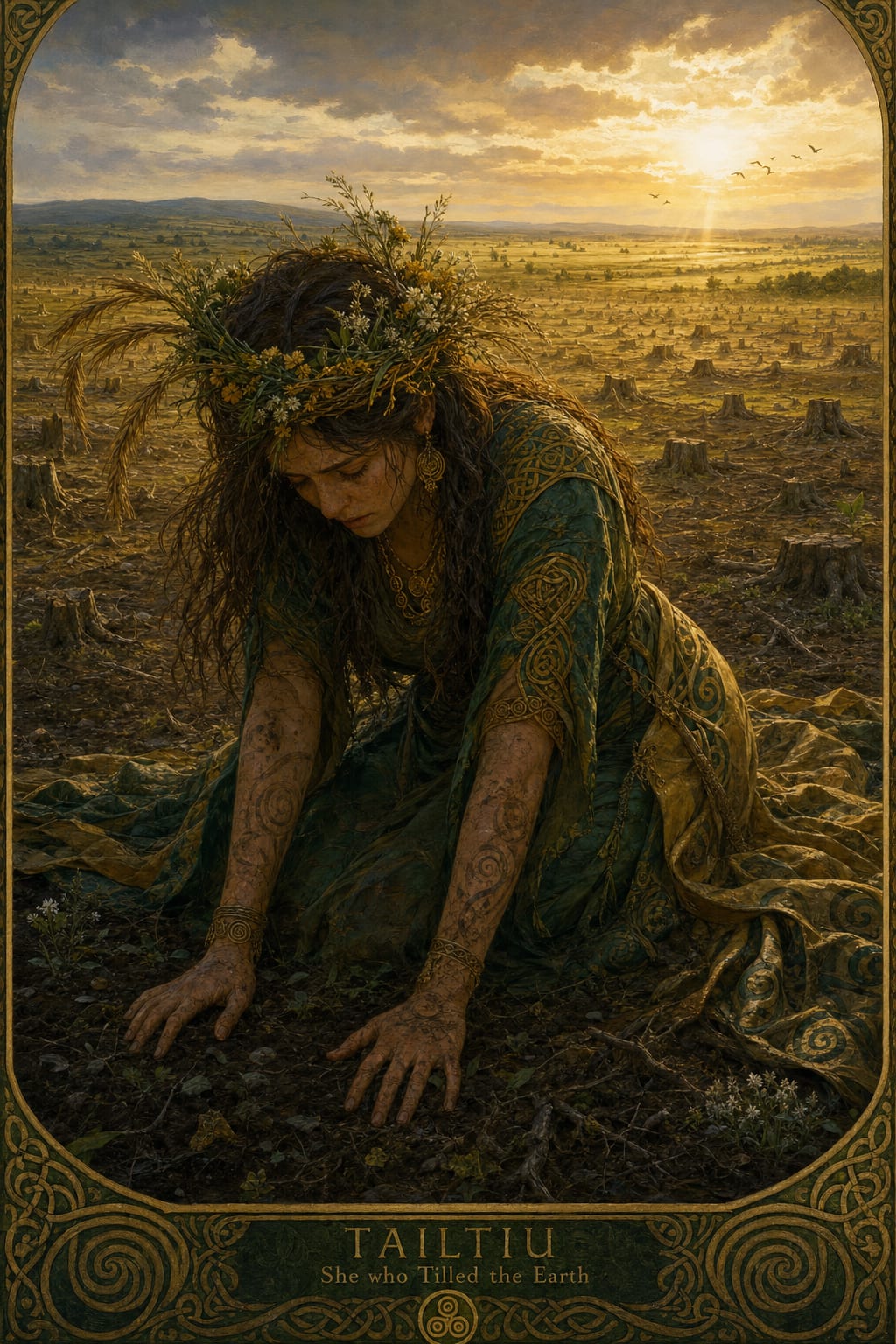
Tailtiu cleared the forests of Ireland. Not a grove, not a field's edge — the dense woodland of Breg, the ancient forested plain that would become County Meath, was felled so the land could be opened to the plow. She undertook this labor while carrying the weight of grief: a widow, a queen in bondage to a new order, raising another woman's son as her own. Within a year, what had been dense forest was a plain blossoming with clover.
And then she lay down and did not rise.
Tailtiu died of exhaustion from the labor. She gave everything her body had, and her body — daughter of the Great Plain — returned to the plain she had made. There is no triumphant ending here, no divine rescue. She simply worked until she could not continue, and then she was gone. Before she died, she asked that funeral games be held in her name.
Lugh's Grief and the Birth of a Festival
Lugh honored that request. He buried her beneath a great mound at Teltown — the place that already carried her name — and instituted the Óenach Tailteann, the Assembly of Tailtiu, to be held every first of August. He sang her death-lament himself, year after year. One tradition holds that Tailtiu prophesied on her deathbed: as long as the games in her name were held, there would always be music in Ireland.
What Lugh built was not a simple harvest fair. It was a memorial. The games he established — horse races, chariot races, feats of strength, athletic contests scholars have compared to the ancient Olympics — were funeral games first, held in honor of a woman who died so that others might eat. The assembly also included the proclamation of laws, the settling of disputes, and the making of contracts. The Annals of the Four Masters record the Óenach Tailteann as observed yearly for many centuries. Teltown was one of the great assembly sites of ancient Ireland, a place of communal life gathered at the site of a sacred death.
The Harvest Is Her Last Gift
Here is what is easy to miss when the baskets are full and the fires are lit: the abundance of August is not simply a gift of sun and rain. In the mythic logic underlying Lughnasadh, it is the direct result of a woman's sacrifice. Tailtiu did not die at war or of old age. She died of labor — the specific, bodily labor of making the land ready to sustain life. She gave her strength to the soil, and the soil gave back grain.
Her name is thought to mean Great One of the Earth. The forest she cleared is now County Meath, a landscape thick with sacred sites — Tara, Newgrange, Knowth — all sitting in the opened land she made possible. The clover that covered her cleared plain became emblematic of Ireland itself. The site at Teltown still stands near the River Blackwater, its ancient mounds worn but enduring; rock art there suggests ritual activity stretching back to the second millennium BCE. The land remembers, even when we do not.
Lughnasadh bears Lugh's name because grief made him build something that would outlast them both. He knew what most of us forget: that the harvest is paid for. Every field that feeds a family was once a forest. Something gave way. In the mythology of this festival, it was Tailtiu — deliberately, completely, with full knowledge of the cost.
She was a queen of an older world. She was the foster mother of a god. She was a woman who did what had to be done and did not survive the doing of it. She asked only to be remembered.
Every first fruit of August carries her answer. Say her name.
About the Creator
The Celtic Spirit- A modern Guide to Celtic Belief and Practice
explaining Celtic mythology, druid practice, and reconstructions of paganism for modern readers
Enjoyed the story? Support the Creator.
Subscribe for free to receive all their stories in your feed. You could also become a paid subscriber, letting them know you appreciate their work.
Comments
There are no comments for this story
Be the first to respond and start the conversation.