
The Bible and aliens.
They visited us in ancient times.


While the Bible does not explicitly mention extraterrestrials from other planets, certain passages have been heavily analyzed by ancient astronaut theorists and UFO enthusiasts as potential accounts of alien visitations. These interpretations typically reframe divine encounters or supernatural phenomena as technological events that were misunderstood or misinterpreted with no words or frame of reference to explain them, like rocket, spaceship, astronaut, laser beams.
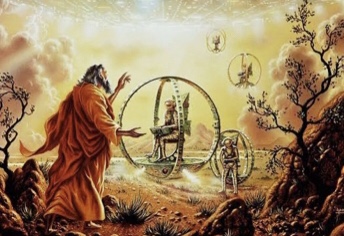
1. Ezekiel’s Chariot Vision (Ezekiel 1)The Account: The prophet Ezekiel describes a massive storm cloud approaching from the north, filled with fire and flashing lightning. He witnesses four living creatures with wings, alongside complex structures described as "a wheel intersecting a wheel" that could move in any direction, with rims "full of eyes".Alien Interpretation: In the 1970s, NASA scientist Josef Blumrich published The Spaceships of Ezekiel, theorizing that the detailed descriptions of wheels, fire, and metallic sounds were actually observations of an extraterrestrial landing craft.

2. Elijah’s Ascent (2 Kings 2:1-12)The Account: As the prophet Elijah is walking with his successor Elisha, suddenly a "chariot of fire" and "horses of fire" appear, separating the two men. Elijah is then carried up into heaven in a violent whirlwind.Alien Interpretation: Proponents of ancient alien theories suggest that the "chariot of fire" and the "whirlwind" describe a spacecraft using propulsion and thrusters to take off, rather than a spiritual or purely miraculous event.
3. The Nephilim (Genesis 6:1-4)The Account: This passage mentions that the "sons of God" saw that the "daughters of men" were beautiful and took them as wives. This union resulted in the "Nephilim," described as heroes and mighty men of renown who lived on the earth.Alien Interpretation: Extraterrestrial theorists often interpret the "sons of God" as alien visitors who interbred with early humans to create a hybrid race.
4. The Flying Scroll (Zechariah 5:1-2)The Account: The prophet Zechariah sees a vision of a scroll flying through the air, measuring 20 cubits long and 10 cubits wide.Alien Interpretation: Skeptics and theologians view the scroll symbolically, but UFO researchers point to it as one of the few literal descriptions in the text of an unidentified flying object cruising through the sky.
5. The Star of Bethlehem (Matthew 2)The Account: The Gospel of Matthew describes a "star" that guided the Wise Men from the East to the birthplace of Jesus. It is said to have moved and eventually stopped directly over the location of the house.Alien Interpretation: Because stars do not typically move in erratic paths or hover precisely over single buildings, some theorists argue this was an artificial light source, such as a UFO, rather than a natural astronomical phenomenon.
Mainstream and Theological PerspectivesMainstream theologians and biblical scholars view these interpretations as anachronistic. In historical context, these accounts were written to describe divine intervention, the literal presence of God, or the work of angels—not extraterrestrial technology.
For decades, independent scholars have suggested that several narratives in the Bible offer evidence of ancient UFOs and extraterrestrial visitations. The idea was made famous by Erich Anton Paul von Däniken (b. 1935), in his best-selling Chariots of the Gods (1968).While von Däniken and other such scholars were once discounted as “fringe,” the increasing number of recent UFO sightings has forced scholars to revisit the question.
In keeping with the approach of “Torah study informed by academic scholarship and science,” I turned to AI technology to weigh in on the question. The answer is unequivocal; the alien hypothesis has been confirmed. Now for the first time ever, we can reconstruct these biblical encounters in ultra high definition.
1. Ezekiel’s Vision of the Merkava
Ezekiel’s chariot is the most famous biblical UFO sighting, and has been written about by NASA scientist Josef Blumrich (1913–2002) in The Spaceships of Ezekiel among others.
2. Elijah’s Fiery Chariot
As long suspected, the “fiery chariot” that helped Elijah ascend into the sky is a technologically advanced spacecraft.
3. The Nephilim
The Nephilim who took human women, bringing on Noah’s Flood,(Gen 6:4) are indeed “skyfallers” from a distant planet. We have also learned that the corruption of the antediluvian world included cavorting in nightclubs.
4. The Tower of Babel
Apparently, the mysterious high-rise tower, which reached the clouds, was an extraterrestrial landing pad and cellphone tower.
10. Moses’ Glowing Face at Sinai
After contact with the aliens, who provided him with the tablets, Moses’ DNA became mutated, rendering his skin metallic, and thus too reflective for people to look at (Exod 34:35).
11. The Pillar of Fire
The “pillar of fire” over the Tabernacle was in fact a beam of energy emanating from the mothership, no doubt the same one that killed Nadab and Abihu (Lev 10) when they burned “alien incense,” accidentally triggering a deadly energy pulse. I further theorize that the “pillar of cloud” (Num 9:15) was the craft’s exhaust fumes.
12. The Scouts’ Grasshoppers
The scouts’ episode describes Nephilim as so large that the Israelites are the size of grasshoppers in comparison.Through the help of AI reconstruction, however, the “grasshopper” reference is revealed to be not about size but species. We therefore can correctly emend the biblical text from וַנ ”we looked like grasshoppers to ourselves,” to וַיִּהthey looked like grasshoppers to us.”
The Torah’s Concern for Aliens
Science has finally confirmed what the Torah has known all along: Extraterrestrial beings have visited Earth and played a vital role in our formative traditions. The evidence was right there all along, but both mainstream academia and Orthodoxy could not see past their respective interpretations.
Had they just read the Torah’s words literally, they would have seen that the Torah explicitly admonishes us to be kind to aliens:
Leviticus 19:33 – “When an alien lives with you in your land, do not mistreat him.”
Deuteronomy 27:19 – “Cursed is the man who withholds justice from the alien… and let us say: Amen.”
Well anyway, that’s the conclusion AI makes, for what it’s worth.
Ezekiel describes not only a flying saucer, but sveral of them. He actually describes the beings that are inside of the craft. He also describes them as they exit the multiple crafts that are within the others.. also Ezekiel also describes the way they move in sequence with one another, as if they are of one mind.
It is truly remarkable.
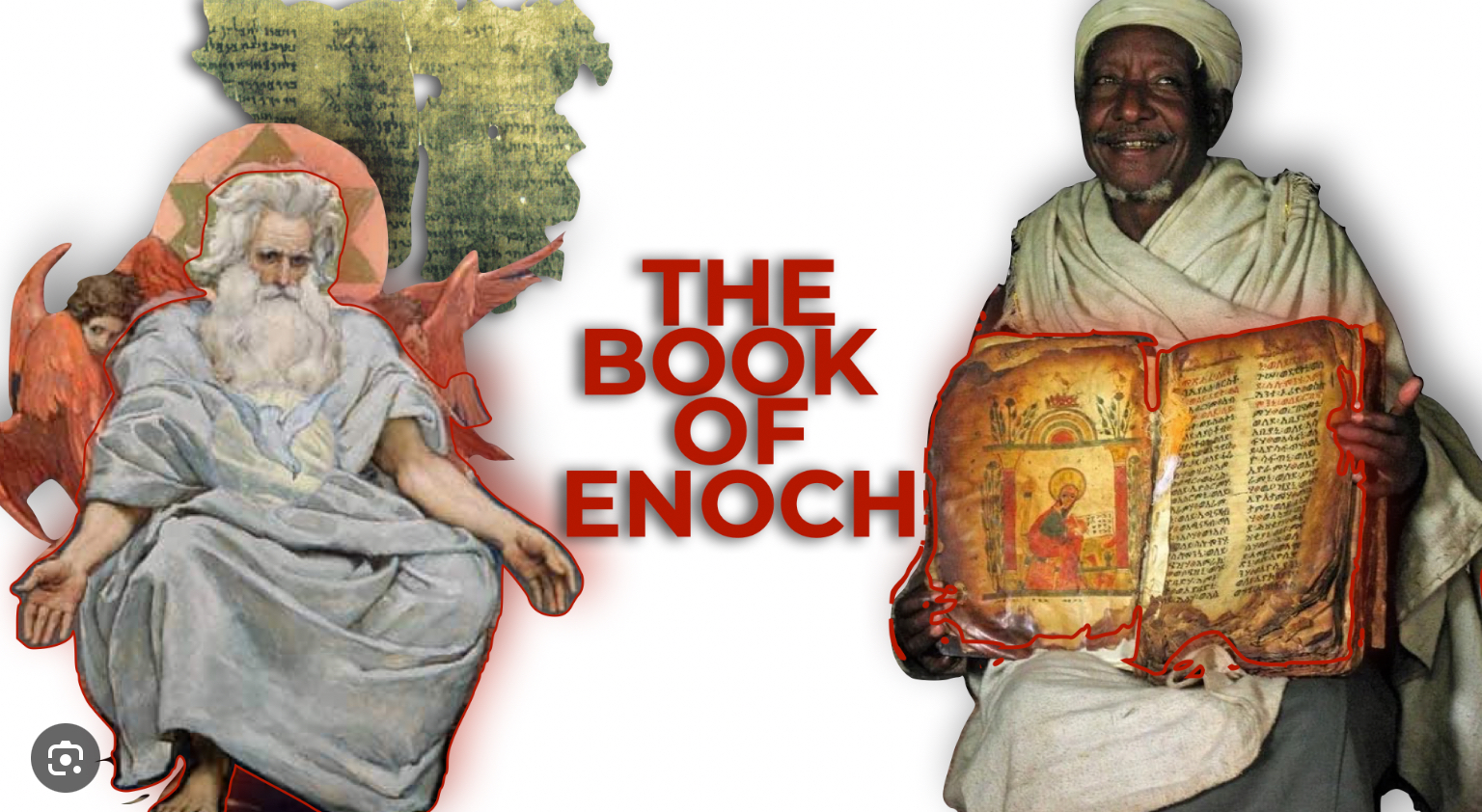
The Book of Enoch (also 1 Enoch; is an ancient Jewish apocalyptic religious text, ascribed by tradition to the patriarch Enoch who was the father of Methuselah and the great-grandfather of Noah. The Book of Enoch contains unique material on the origins of demons and Nephilim, why some angels fell from heaven, an explanation of why the Genesis flood was morally necessary, and a prophetic exposition of the thousand-year reign of the Messiah. Three books are traditionally attributed to Enoch, including the distinct works 2 Enoch and 3 Enoch.
Start of the Ethiopic Enoch in a 16th-century Ge’ez manuscript
Author
Unknown
Language
Aramaic or Hebrew
Period
c. 300–200 BC (Book of Parables c. 100 BC)
1 Enoch is not considered to be canonical scripture by most movements of Judaism or branches of Christianity, although it is part of the biblical canon used by the Ethiopian Jewish community Beta Israel, as well as the Ethiopian Orthodox Tewahedo Church and Eritrean Orthodox Tewahedo Church.
The older sections of 1 Enoch are estimated to date to c. 300–200 BC, and the latest part (Book of Parables) is probably from c. 100 BC. Scholars believe Enoch was originally written in either Aramaic or Hebrew, the languages first used for Jewish texts. Ephraim Isaac suggests that the Book of Enoch, like the Book of Daniel, was composed partially in Aramaic and partially in Hebrew. No Hebrew version is known to have survived. Copies of the earlier sections of 1 Enoch were preserved in Aramaic among the Dead Sea Scrolls in the Qumran Caves.
Authors of the New Testament were also familiar with some content of the book. A short section of 1 Enoch is cited in the Epistle of Jude, being attributed to "Enoch, the Seventh from Adam" (1 Enoch 60:8). The full Book of Enoch survives in its entirety only in the Geʽez translation
Why is the book of Enoch not included in the Bible ...The Book of Enoch reveals secret, mystical history not fully detailed in the standard biblical canon. It uncovers the origin of demons and giants (the Nephilim), the fall of the angels (the Watchers), detailed workings of the cosmos and the sun, and vivid, apocalyptic visions of the Messiah.
The text is a compilation of different writings (primarily known as 1 Enoch). Its core revelations include:
The Fall of the Watchers: It explains Genesis 6:1-4, detailing how 200 heavenly beings called "Watchers" (led by figures like Azazel) descended to Earth, took human wives, and taught mankind forbidden knowledge like metallurgy, cosmetics, and warfare.
The Origin of Demons and Giants: The unnatural union of angels and humans produced the Nephilim—giant, bloodthirsty creatures. When these giants died, their disembodied spirits were left to roam the earth as demons.
Cosmology and the Calendar: Enoch is taken on heavenly journeys where he is shown the precise workings of the sun, moon, stars, and the four seasons. This revealed a specific 364-day solar calendar that was famously used by the Essene community at Qumran.
The "Son of Man": It provides profound messianic prophecies, referring to the future savior as the "Son of Man" and the "Elect One," which deeply influenced New Testament theology.
Cosmic Judgment: It details heavenly courts, the Book of Life, and the final judgment, including the Lake of Fire, emphasizing that the fallen angels and the wicked would face eternal punishment.
While not widely accepted as scripture in mainstream Judaism or Western Christianity, it is recognized as canonical by the Ethiopian Orthodox Church. Its historical importance and ancient origins were further solidified by the discovery of fragments among the Dead Sea Scrolls.
The Bible does not explicitly describe "alien technology" in a modern sci-fi sense. However, ancient astronaut theorists and UFO enthusiasts frequently reinterpret several vivid, supernatural visions as advanced spacecraft or otherworldly machinery.The most popular biblical passages reinterpreted as technological descriptions include:Ezekiel’s Vision (Ezekiel 1): The wheels sparkled like chrysolite, and all four looked alike. Each appeared to be made like a wheel intersecting a wheel. As they moved, they would go in any of the four directions the creatures faced; the wheels did not pivot as the creatures went.” (Ezekiel 1:16-17)
Ezekiel’s Vision
The prophet Ezekiel was one of the captives of the Babylonian conquest in 606 B.C. As the book opens, it is the thirtieth year (probably the thirtieth year of his own life) and the prophet is in Babylon by the river Chebar. The “heavens were opened” and, the prophet declares, “I saw visions of God.”
As the dramatic scenes began to unfold, Ezekiel saw the likeness of four living creatures. They were similar in appearance to men, except that they had four faces—one like a man, one like a lion, one like an ox, and one like an eagle (v. 10).
They had hands like men, but feet as calves (vv. 7-8); and each creature had four wings—two of which covered the body (v. 11) and two of which stretched upward supporting “the likeness of a firmament” (vv. 22-23). Their appearance also was like burning coals of fire and their movements appeared as flashes of lightening (vv. 13-14).
Beneath these four living creatures were four wheels. Each wheel was fashioned as “a wheel within a wheel” and it could move in four directions without turning. Moreover, the rims of the wheels were “full of eyes” (vv. 15-18).
Above all of this was a throne upon which sat one who had the “appearance of a man” and who was surrounded by a fiery and glorious brightness (vv. 26-28).
Overpowered by the spectacle, Ezekiel fell upon his face.
The prophet describes a storm cloud approaching from the north containing glowing metal, fire, and four winged creatures. He details "a wheel within a wheel" that sparkled like chrysolite, could move in any direction without turning, and were "full of eyes all around." Theorists like Josef Blumrich have argued this is a detailed description of an extraterrestrial landing craft.Elijah’s Chariot of Fire (2 Kings 2:11): Instead of a spiritual ascension, the fiery chariot and horses that suddenly appear to take the prophet Elijah into the sky are sometimes re-imagined by proponents as a beam of light or an alien transport craft.The Ark of the Covenant (Exodus 25): Interpreted by some (most famously in Erich von Daniken's Chariots of the Gods) as a piece of advanced communication technology or a radioactive capacitor that allowed Moses to communicate with an extraterrestrial intelligence.The Pillar of Cloud and Fire (Exodus 13:21): The phenomena that guided the Israelites through the desert are compared by UFO theorists to the clouds, smoke, and exhaust associated with a hovering mothership or spacecraft.Mainstream biblical scholars and theologians, however, strongly disagree with these technological interpretations. They classify these passages as theophanies—highly symbolic, apocalyptic literature designed to describe spiritual realities, the presence of God, and angelic hosts rather than physical, extra-planetary machinery.
Thanks to James McGrath’s blog, I recently came upon an interpretation of the story of Jonah and the whale that I had never heard before—namely, that the “whale” was some sort of technologically advanced submarine. Ancient Origins, the website promoting this idea, appears to be a website that deals in conspiracy theories about the origins of the earth, drawing on archeology and mythology to do so. Still, I found this interpretation fascinating—I’ll explain why in a moment.
Assuming that the references in the Bible are not ‘fairy tales’ and are based on true events, it is obvious that no one could survive inside a whale for three full days, causing many to assume the ‘whale’ was some kind of technologically advanced craft. Could it have been a spacecraft, even a submarine? Let us travel back thousands of years to a time when there was no technology and ask ourselves how an advanced, modern vehicle would have been perceived and described using the limited terms and references the civilization had. Is it not obvious that an airplane would have been perceived as a shiny, metallic bird, or a perhaps a chariot of fire? Similarly, isn’t it possible that a submarine would have been perceived as a whale, since whales, even then, were the largest mammals in the sea?
The author of the article posited not only that Jonah’s whale was an advanced technological submarine but also that the “chariot of fire” in which God took people up to heaven in the Old Testament was some sort of airplane.
Here’s whats fascinating: fundamentalist and conservative evangelical Christians would completely balk at these interpretations—Jonah’s whale was a whale and the chariot of fire was a chariot of fire—but the reality is that they do the same thing. They, too, read into obscure or odd passages the things that they want to see.
Consider the behemoth and the leviathan, for example. As explained by Answers in Genesis, a prominent young earth creationist organization:
Two great creatures, behemoth and leviathan, are described by God in Job. Some commentators have suggested behemoth was an elephant or hippo but the description simply doesn’t match (e.g. behemoth “moves his “tail like a cedar”). It’s appears God is describing a sauropod dinosaur and a fearsome now-extinct sea creature.
The Bible does not say these creatures were dinosaurs. Nowhere does the Bible mention dinosaurs. As Answers in Genesis notes, the traditional assumption has been that the behemoth was an elephant or a hippo, or some similar creature.
Have a look at Job’s description of the behemoth:
Job 40: 15-24
15 “Behold, Behemoth,
which I made as I made you;
he eats grass like an ox.
16 Behold, his strength in his loins,
and his power in the muscles of his belly.
17 He makes his tail stiff like a cedar;
the sinews of his thighs are knit together.
18 His bones are tubes of bronze,
his limbs like bars of iron.
19 “He is the first of the works of God;
let him who made him bring near his sword!
20 For the mountains yield food for him
where all the wild beasts play.
21 Under the lotus plants he lies,
in the shelter of the reeds and in the marsh.
22 For his shade the lotus trees cover him;
the willows of the brook surround him.
23 Behold, if the river is turbulent he is not frightened;
he is confident though Jordan rushes against his mouth.
24 Can one take him by his eyes,
or pierce his nose with a snare?
Young earth creationists read into the passage when they conclude that the behemoth was a sauropod. Why do they do this? They do this because they believe that dinosaurs and man coexisted. Because they believe that, they see dinosaurs even in passages that seemingly have nothing to do with dinosaurs, because they are looking for dinosaurs.
Like those at Answers in Genesis with their predisposition to believe in the coexistence of humans and dinosaurs, those at Ancient Origins and the History Channel (which also promoted the theory of whale as submarine) are often predisposed to believe in aliens, and in their possible interventions on earth both now and in earth’s history. The result is that when they look at ancient writings, including the books of the Old Testament, they see alien submarines and airplanes.
In some sense, each of these groups is peddling in science fiction—young earth creationists with their ideas about dinosaurs and humans coexisting, technologically advanced prehistoric civilizations, global floods, towers, and languages and so forth, and ancient history alien theory believers with their ideas about aliens communicating with ancient cultures.
So it comes down to you deciding what you want to believe.
About the Creator
Guy lynn
I’m interested in history, space travel and the possibilities, Americana,( where I live now), Africa (Southern Africa, where I was born and raised), and I write about things that interest me ( bead history) and I hope will interest you.
Enjoyed the story? Support the Creator.
Subscribe for free to receive all their stories in your feed.
Comments
There are no comments for this story
Be the first to respond and start the conversation.