
Pakistan Army in Global Perspective
A detailed comparison of strength, strategy, and military capability

Pakistan Army in Global Perspective
The Pakistan Army is widely regarded as one of the most capable armed forces in the developing world. While it may not rival the scale and technological dominance of superpowers, it has built a reputation for efficiency, resilience, and operational effectiveness. To understand its true standing, it is essential to compare it with other major militaries such as those of the United States, China, Russia, and India.
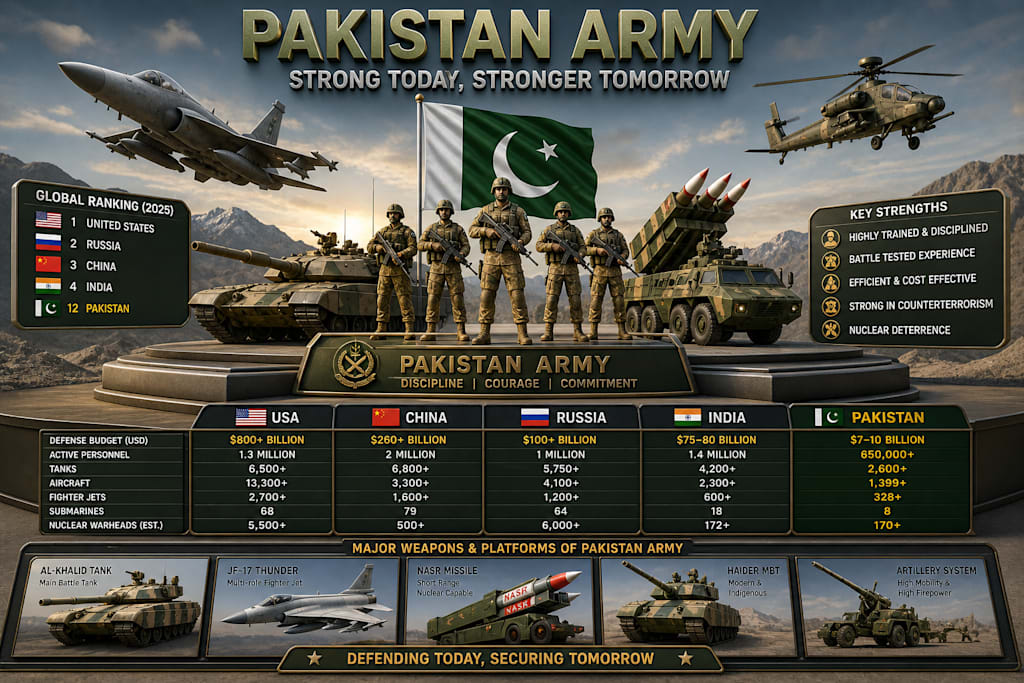
Globally, Pakistan consistently ranks among the top 15 military powers, a notable achievement considering its relatively modest economy. In contrast, the United States holds the number one position, supported by unmatched global reach and cutting-edge technology. China and Russia follow closely, leveraging massive manpower and advanced weapon systems, while India continues to strengthen its military through modernization and expansion.
One of the most striking differences lies in defense spending. The United States allocates over $800 billion annually to its military, far exceeding any other nation. China follows with more than $250 billion, and India spends around $75–80 billion. Pakistan, by comparison, operates with a budget of approximately $7–10 billion. Despite this limitation, Pakistan has managed to maintain a credible and capable force, demonstrating a high level of efficiency in resource utilization.
In terms of manpower, China leads with around two million active personnel, followed by India and the United States with over one million each. Pakistan maintains approximately 650,000 active troops, supplemented by a large paramilitary force. While smaller in size, the Pakistan Army compensates with rigorous training and extensive combat experience, particularly in counterterrorism and unconventional warfare.
The air power comparison reveals another layer of contrast. Pakistan’s air force operates a mix of modern and cost-effective aircraft, including the JF-17 Thunder, F-16 Fighting Falcon, and J-10C fighters. These platforms provide a balanced combination of affordability and capability. However, the United States dominates the skies with advanced stealth aircraft such as the F-22 and F-35, while China rapidly expands its fleet with indigenous fifth-generation jets. India also fields a diverse air force, including Rafale and Su-30MKI fighters.
On land, the Pakistan Army maintains a strong armored force with over 2,600 tanks, including indigenous models like the Al-Khalid and upgraded systems such as the Al-Zarrar. While this is fewer than China’s or Russia’s tank inventories, Pakistan’s strength lies in its mobility and tactical deployment. Its forces are particularly skilled in mountain warfare, a critical advantage given the region’s geography.
Naval power remains one of Pakistan’s weaker areas. The Pakistan Navy is primarily focused on regional defense and operates a modest fleet, including submarines that are being modernized with Chinese assistance. In contrast, the United States commands a global navy with aircraft carriers and worldwide presence, while China is rapidly building a blue-water navy capable of projecting power far beyond its shores. India also maintains a strong regional naval presence with aircraft carriers and advanced warships.
A key element that elevates Pakistan’s strategic position is its nuclear capability. With an estimated arsenal of around 170 nuclear warheads, Pakistan maintains a doctrine of “full spectrum deterrence.” This capability ensures strategic balance in the region, particularly in relation to India. While the United States and Russia possess far larger arsenals, Pakistan’s nuclear force plays a crucial role in maintaining regional stability.
Overall, the Pakistan Army’s strengths lie in its discipline, combat experience, and efficient use of limited resources. It has proven its effectiveness in challenging environments and continues to adapt to modern warfare requirements. However, limitations remain in terms of budget constraints, technological advancement, and global power projection.
In conclusion, the Pakistan Army may not be the most powerful military in the world, but it stands out as a highly capable and strategically significant force. Its ability to maintain strong defense capabilities despite financial constraints highlights its resilience and professionalism. In the evolving landscape of global military power, Pakistan remains a key player, particularly within its region.
🌍 Global Military Ranking (2025)
According to global defense indexes:
United States → #1
Russia → #2
China → #3
India → #4
Pakistan → #12
👉 Pakistan is a Top 15 military power globally, which is significant given its economy size.
💰 Defense Budget Comparison
Country Annual Defense Budget
USA ~$800+ billion
China ~$260+ billion
Russia ~$100+ billion (approx.)
India ~$75–80 billion
Pakistan ~$7–10 billion
Pakistan’s budget (~$7.6B) is far smaller than China’s (~$266B)
Yet Pakistan maintains strong capabilities through efficiency and strategic partnerships
👉 Key insight: Pakistan achieves high military impact with limited budget
👨✈️ Manpower Comparison
Country Active Personnel
China ~2 million
USA ~1.3 million
India ~1.4 million
Pakistan ~650,000
Pakistan has smaller manpower, but still among top globally
Strong paramilitary forces (~500,000) boost internal security capacity
✈️ Air Force Power
Pakistan
~1,399 aircraft
~328 fighter jets
Key platforms:
JF-17 Thunder (indigenous)
F-16 Fighting Falcon
J-10C (Chinese advanced jet)
Comparison
China: ~3,300 aircraft
USA: world’s most advanced stealth fleet (F-22, F-35)
India: Rafale + Su-30MKI mix
👉 Pakistan’s strength:
Cost-effective fighters
Strong pilot training
Combat-tested systems (e.g., J-10C usage)
🚜 Land Forces (Army Power)
Pakistan Army
~2,600+ tanks
Major tanks:
Al-Khalid (indigenous)
Al-Zarrar
VT-4 (Chinese)
Comparison
China: ~6,800 tanks
India: ~4,200 tanks
Russia: among world leaders in armor
👉 Strength:
Strong mobile artillery & tactical deployment
High experience in mountain warfare & counterterrorism
🚢 Naval Power
Pakistan Navy
Smaller “green-water navy”
~8 submarines (expanding with Chinese support)
Comparison
USA: aircraft carriers + global navy dominance
China: rapidly expanding blue-water navy
India: aircraft carriers + strong regional navy
👉 Weak area for Pakistan:
Limited global naval reach
☢️ Nuclear Capability (Important Factor)
Pakistan: ~270 nuclear warheads (estimated)
India: similar range
USA/Russia: thousands
👉 Pakistan doctrine:
“Full Spectrum Deterrence”
Tactical nuclear systems (e.g., Nasr missile)
⚔️ Strengths of Pakistan Army
✔ Highly trained and disciplined
✔ Strong in asymmetric warfare & counterterrorism
✔ Effective use of limited resources
✔ Strategic alliance with China (weapons & tech)
✔ Nuclear deterrence capability
⚠️ Limitations
✖ Smaller budget limits modernization
✖ Less advanced technology vs USA/China
✖ Weaker navy and global projection
✖ Dependence on foreign equipment (China/US)
🧠 Final Verdict
The Pakistan Army is:
Regionally powerful
Globally competitive (Top 15)
Highly efficient per dollar spent
However:
It cannot match superpowers like the United States or China in technology, scale, or budget.
🔍 Simple Summary
🇵🇰 Pakistan = Efficient, battle-tested, nuclear-capable
🇺🇸 USA = Technological superpower
🇨🇳 China = Massive + rapidly modernizing
🇷🇺 Russia = Heavy firepower & nuclear strength
🇮🇳 India = Large force + growing modernization
About the Creator
Wings of Time
I'm Wings of Time—a storyteller from Swat, Pakistan. I write immersive, researched tales of war, aviation, and history that bring the past roaring back to life
Enjoyed the story? Support the Creator.
Subscribe for free to receive all their stories in your feed.
Comments
There are no comments for this story
Be the first to respond and start the conversation.