
Alliances, Betrayals, and Power in Early Islamic History
A deeper look at political realities, agreements, and conflicts in the time of Prophet Muhammad (PBUH)

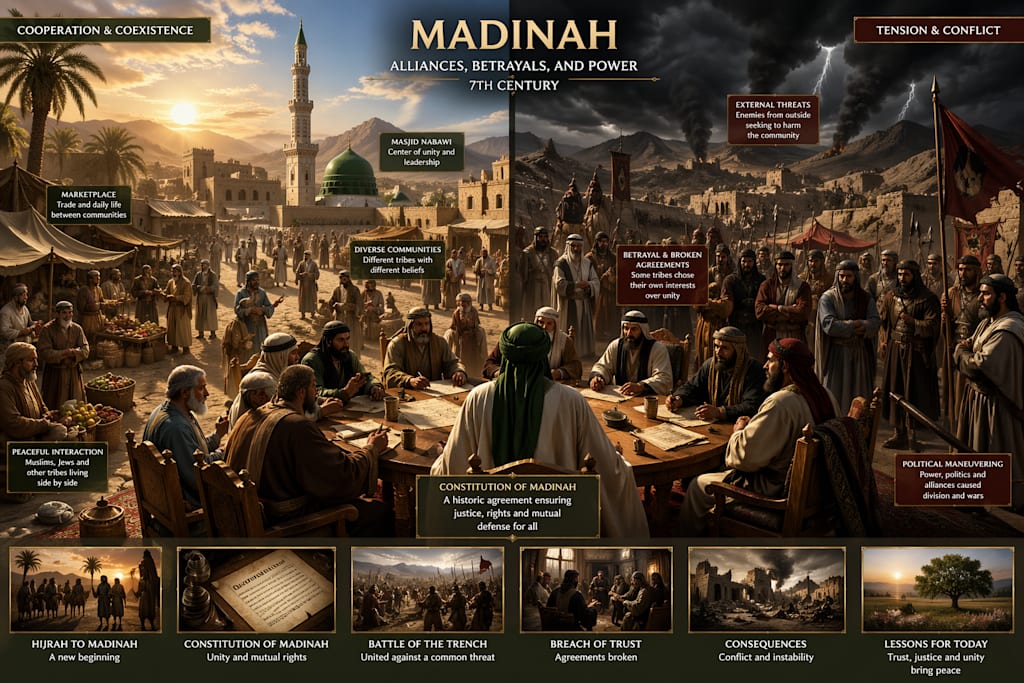
Alliances, Betrayals, and Power in Early Islamic History
History is not a simple story of loyalty or betrayal—it is a complex record of human decisions shaped by survival, politics, and shifting alliances. The era of Prophet Muhammad (peace be upon him) in Madinah provides one of the clearest examples of how diverse communities attempted to live together under a unified system, yet struggled when trust and agreements were challenged.
When the Prophet (PBUH) migrated to Madinah, he did not establish a society based solely on one group. Instead, he introduced a remarkable political framework known as the Constitution of Madinah. This agreement included Muslims, Jewish tribes, and other communities, recognizing them as part of a single political entity. It ensured religious freedom, mutual defense, and social cooperation. At its core, it was a vision of unity in diversity—rare for its time.
However, maintaining unity in a politically tense environment was not easy. Madinah was surrounded by external threats, particularly from the Quraysh of Makkah, who were determined to eliminate the growing Muslim community. In such a situation, internal stability became extremely important. Any sign of disloyalty or shifting alliances could endanger the entire المدينة.
Some tribes honored their agreements and remained loyal to the pact. Others, however, became involved in political strategies that created tension. These actions were often influenced by fear, power dynamics, or alliances with external forces. It is essential to understand that these were not random acts but calculated decisions made in a highly pressured environment.
For example, during times of conflict such as the Battle of the Trench (Khandaq), the المدينة was under severe threat. In such critical moments, unity was necessary for survival. Any breach of agreement was seen not just as political disagreement but as a direct risk to the safety of the entire المجتمع.
The conflicts that followed were tied to these circumstances. They were responses to specific situations involving particular groups and decisions—not a reflection of any entire religion or people. History consistently shows that during times of war, groups act based on their interests, alliances, and survival strategies. This pattern can be seen across all civilizations, not just in one place or time.
As Islamic civilization expanded, relations between Muslims and Jews varied widely across different regions and eras. In some periods, such as in parts of Muslim Spain, cooperation and intellectual exchange flourished. Jewish scholars contributed significantly to science, medicine, and philosophy under Muslim rule. These periods highlight that coexistence was not only possible but highly productive.
In other periods, political conflicts, territorial disputes, and power struggles led to tension. These situations were shaped by leadership, governance, and external pressures rather than purely religious differences. This demonstrates that history is never one-dimensional—it evolves with context.
The key lesson from early Islamic history is the importance of trust, agreements, and accountability. Societies thrive when commitments are honored and justice is upheld. When agreements are broken, instability and conflict often follow. This principle applies universally, across all times and cultures.
For modern audiences, especially those creating content, it is important to present history with responsibility and depth. Simplifying complex events into generalized narratives may attract attention, but it often distorts truth. A more impactful approach is to focus on real events, explain their causes, and draw meaningful lessons.
Understanding history requires separating facts from assumptions. It demands critical thinking, fairness, and awareness of context. Only then can we truly learn from the past and apply its lessons to the present.
In the end, history is not about blaming entire groups—it is about understanding human behavior, decisions, and consequences. The story of Madinah teaches us that unity is possible, but it depends on trust, justice, and the willingness to uphold agreements even in difficult times.
About the Creator
Wings of Time
I'm Wings of Time—a storyteller from Swat, Pakistan. I write immersive, researched tales of war, aviation, and history that bring the past roaring back to life
Enjoyed the story? Support the Creator.
Subscribe for free to receive all their stories in your feed.
Comments
There are no comments for this story
Be the first to respond and start the conversation.