Young Adult
Beneath the Moonlit Sky
The small coastal town of Bellmere was known for its sun-kissed shores, cobblestone streets, and the lighthouse that stood like a silent guardian over the sea. It was here, amidst the rhythm of the waves and the scent of salt and jasmine, that two hearts found each other.
By NIAZ Muhammadabout a year ago in Fiction
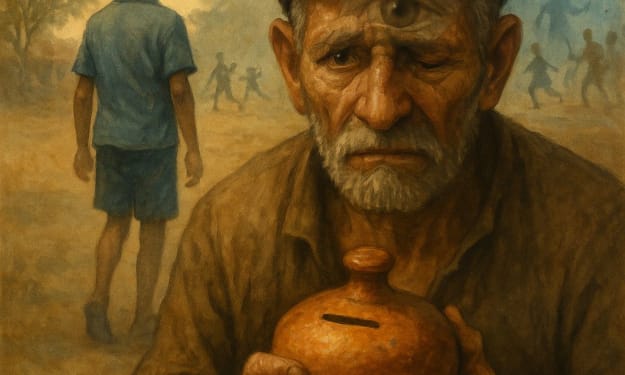
The Eye That Loved Too Much
In the quiet village of Srirangpur, there lived a poor laborer named Ignat. He was a hardworking man, though life had not been kind to his appearance—he was missing one eye, and his face bore the marks of hardship. Despite this, he did his best to provide for his wife, Sharda, and their young son, Raju. Raju was their only child, and Ignat loved him dearly. But as Raju grew older, he began to resent his father. The other children in the village would whisper and laugh whenever Ignat was around. "Your father looks scary!" they would taunt Raju, refusing to let him play with them. One afternoon, as Raju tried to join a game of Gilli Danda, the boys shoved him away. "Get out of here! We don’t want you near us!" one of them sneered. Raju ran home, tears burning his eyes. "Why do you have to look like that?" he shouted at Ignat later. "Nobody likes me because of you!" Sharda scolded him, but the damage was done. Raju refused to eat dinner and stormed off to bed, leaving Ignat sitting silently in the dim light of their small hut. That night, as Sharda counted the coins in their savings jar, she sighed. "How much have we saved now? 100 rupees?" Ignat shook his head. "Almost 200. But this money isn’t for me," he said softly. "It’s for Raju’s education. If he studies hard, he can become a doctor—maybe even fix my eye one day." Sharda wiped her eyes. "He doesn’t understand. He hates you, and it breaks my heart." Ignat only smiled sadly. "He’s just a boy. When he grows up, he’ll see things differently." But Raju’s resentment only grew. The next morning, he refused to let Ignat walk him to school. "If my friends see you, they’ll make fun of me again!" he snapped, running off before his father could protest. Later, when Ignat brought his forgotten tiffin to school, Raju’s face burned with shame. "Never come here again!" he hissed, snatching the food and turning away. Years passed, and Raju left for college in the nearby town. Ignat and Sharda, hoping to be closer to him, moved as well, taking up work in the city. One evening, Ignat mustered the courage to visit Raju’s shared apartment. But when Raju saw him at the door, his expression darkened. "Why did you come here?" he muttered. "I told you—I don’t want my friends knowing about you." Ignat’s heart ached, but he only nodded. "I just wanted to see you, son. Your mother worries." Raju shut the door without another word. After college, Raju took a job in Mumbai and cut all ties with his parents. Five long years passed without a single letter or visit. Sharda wept often, wondering if their son was even alive. Ignat, though heartbroken, never stopped hoping. "He’ll come back one day," he assured her. But that day never came for him. One afternoon, while returning from work, Ignat bumped into Suresh, an old friend of Raju’s. "Sir!" Suresh exclaimed. "You’re Raju’s father, aren’t you?" Ignat’s eyes lit up. "You know my son? How is he?" Suresh hesitated. "He—he lives here in town, sir. He’s married now, with a three-year-old daughter." Ignat staggered back as if struck. "He never told us," he whispered. Suresh, pity in his eyes, led him to Raju’s house. Ignat stood at the gate, trembling. When Raju’s little daughter spotted him, she screamed, "Monster! Go away!" Raju rushed out, his face twisting in anger. "What are you doing here?" he demanded. "You’re scaring my child!" Ignat’s voice broke. "I just wanted to see you, Raju. Your mother misses you." Raju’s jaw tightened. "Leave. And don’t come back." Ignat returned home that night, his spirit shattered. A week later, he passed away quietly in his sleep. Sharda, now alone, carried out the funeral rites herself, with no son by her side. Months later, guilt finally drove Raju to his mother’s doorstep. "How are you, Ma?" he asked awkwardly. Sharda’s eyes filled with tears. "You have a daughter now. Why didn’t you bring her?" Raju looked away. "I... I didn’t think you’d want to see me." Sharda’s voice turned steely. "Where is your father, Raju? Do you even care?" Raju flinched. "I—I don’t know." Sharda’s next words struck like lightning. "He’s dead. He died a week after you turned him away from your home. And do you know why he lost that eye you hated so much?" Raju froze as she continued, her voice trembling. "When you were three, a Gilli Danda hit your eye. The doctors said you’d never see again—unless someone donated their own. Your father gave you his eye, Raju. He never told you because he didn’t want you to carry that guilt." Raju collapsed to his knees, sobbing. All the years of hatred, the cruel words, and the missed chances—flooded his mind. "I didn’t know," he choked out. "Oh God, what have I done?" Sharda placed a hand on his shoulder. "It’s not too late for me, beta. But your father... he waited for you until his last breath." That day, Raju took his mother home, vowing to honor the man who’d given him everything—even his sight—while asking for nothing in return.
By Alice Talesabout a year ago in Fiction
The Echoes of the Yellow Scarf
When Mira stepped off the subway at 14th Street, the crowd swept around her like waves. It was the same platform, same train, same morning routine—but today, something was different. Clutched in her hand was a yellow scarf. Not hers. She had found it on the park bench she always sat on before heading to work. It was soft, handmade, and slightly frayed at the edges, with initials stitched in the corner: S.H. She hesitated before picking it up earlier that morning. Normally, she'd ignore lost items, let someone else deal with them. But something about this scarf felt… personal. Like it was meant for her to find. By the time she reached her office on the 22nd floor of a glass-paneled building, she couldn’t stop thinking about the initials. Who was S.H.? Why did it feel like more than just a lost scarf? She Googled the initials with “yellow scarf” and “New York”—of course, nothing. A thousand meaningless results. But then came the dreams. That night, Mira dreamt of a girl in a yellow scarf standing under a streetlamp, eyes full of sorrow. She said nothing. Just stood. Watching. Silent. The next night, she returned. This time, Mira spoke. “Who are you?” The girl looked up. “Help me find home.” Mira jolted awake. The scarf was on the chair beside her bed—right where she’d left it. But it looked newer. Less worn. As if time had reversed. In the days that followed, the dreams grew more vivid. The girl—always in that yellow scarf—stood by a bench, her back to Mira, facing a lake Mira had never seen before. And every time, she'd whisper, “Almost there.” Mira started drawing the scenes. She was no artist, but the urge was uncontrollable. She filled pages with images of the girl, the lake, the scarf fluttering like a whisper caught in wind. Her friends thought she was spiraling. “You need sleep,” they said. “You’re obsessing over nothing.” But she couldn't stop. One rainy Sunday, Mira walked aimlessly through Central Park, the scarf wrapped around her neck, the dreams echoing in her thoughts. And then—she saw it. The bench. Not just any bench. The bench. The one from her dreams. It faced a small, quiet lake. Willow trees bowed along the edges. A streetlamp flickered nearby. It was all real. She sat. A soft breeze passed. Leaves rustled. The scarf lifted slightly. And then, across the lake, stood the girl. Real. Flesh and bone. Same yellow scarf. Same solemn eyes. Mira stood. “Who are you?” The girl smiled faintly. “You found me.” Mira stepped forward, breath caught in her throat. But before she could speak again, the girl turned and walked toward the trees—fading like mist in morning light. Gone. Mira looked down. The scarf had vanished. In its place, on the bench, was a note. “Thank you. I’m home now. – S.H.” That was three years ago. Since then, Mira walks the park every Sunday. She never saw the girl again, but sometimes, when the breeze picks up just right, she feels a soft warmth on her neck—as if a scarf, unseen, still lingers. She doesn’t tell many people the story. Who would believe her? But if you ever find a yellow scarf where it shouldn't be… Hold on to it. Someone might be waiting.
By Arshad khanabout a year ago in Fiction
The Rain in Her Bones
Mira was born during a monsoon. Her mother used to say it rained for seven days and seven nights, as if the clouds themselves were crying — not from sorrow, but from a fierce, wild joy. Or maybe it was a warning. The kind of warning only nature could give, heavy and relentless.
By Abuzar khanabout a year ago in Fiction
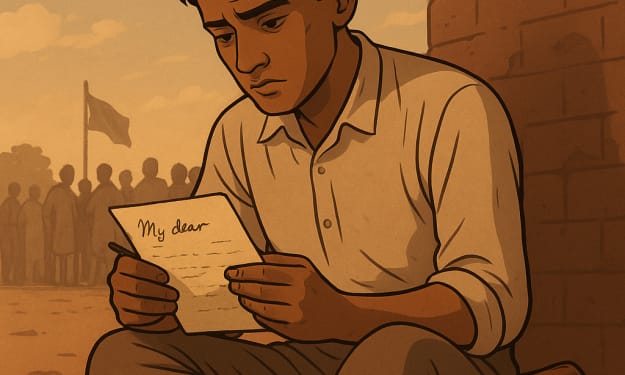
The Letter from Jallianwala
April 13, 1919 — Amritsar, Punjab The sun was unforgiving that afternoon, but it was Baisakhi — the harvest festival. Thousands had gathered in Jallianwala Bagh to celebrate, to protest peacefully against the Rowlatt Act, to listen, to breathe freely for a moment in their own country.
By Waqif Khanabout a year ago in Fiction
Between Our Cups of Tea
She placed the teacup in front of me, just like she always did — handle turned exactly to the right, the way I liked it. No sugar. No milk. Just like our mornings now. Bland. Quiet. Ritualistic. “Thanks,” I said, my voice low but audible. She didn’t answer. She never really did these days. She took her seat across from me, the chair creaking slightly under her, and lifted her own cup without a glance. The steam rose between us like a ghost — thin, silent, vanishing quickly. We sipped. Two strangers in a house we once called home. --- There was a time when mornings meant laughter. When she’d lean over the table, teasing me about my uncombed hair. When I’d kiss her forehead while the kettle boiled. When we’d talk — really talk — about dreams, books, movies, and silly ideas that only mattered to us. Now, we sip in silence. --- “What time are you heading out?” she finally asked, eyes still on her tea. “Around ten,” I replied. “You?” “Maybe earlier. I have to stop by the pharmacy.” I nodded. Another ordinary exchange. Another moment with nothing in it. --- It wasn't always like this. We used to touch each other without thinking — fingers brushing while reaching for the same spoon. We used to giggle like teenagers, even after five years of marriage. We used to sit on the floor instead of the couch, just because it felt cozier. We used to say “I love you” before falling asleep — even when tired, even when angry. I can't remember the last time we said that. I can't remember the last time I looked at her and saw her — the girl I fell in love with. Now, I just see a quiet woman in a bathrobe, pouring tea. And maybe she sees just a man behind a newspaper — not the boy who once chased her in the rain. --- “I’ve been thinking,” she said, suddenly. I looked up. “About?” She hesitated, then shook her head. “It’s nothing.” Say it, I wanted to tell her. Scream it if you have to. Tell me you’re unhappy. Tell me you miss me. Tell me you want to leave. Anything. Just don’t sip tea and pretend this is normal. --- I remember the night I first met her. She was at a bookstore, reading the back cover of a poetry collection. She had no makeup on. Just jeans, a plain blue shirt, and hair tied in a messy bun. She looked up, caught me staring, and smiled like I was already forgiven. We spoke for two hours that night. We didn’t even buy the book. Now, the same woman won’t speak to me for more than two minutes unless it’s about bills or groceries. --- I reached across the table and touched her hand. She didn’t pull away. But she didn’t hold it either. Just let it sit there — like my touch was something to tolerate, not treasure. “I miss us,” I said. She blinked. Once. Twice. And then quietly replied, “I know.” --- Silence again. Not heavy. Not angry. Just... empty. --- She stood, collected her cup, rinsed it in the sink. I watched her movements. Precise. Mechanical. Distant. I wanted to say so many things. Like how I still remember the way she laughed with her eyes. Like how I still sleep on the edge of the bed because that’s how she likes it. Like how I don’t want to lose her but don’t know how to keep her. But I said nothing. Because we both had gotten used to saying nothing. --- As she dried her hands on a towel, I asked: “Do you think we’ll ever be okay again?” She didn’t turn around. After a pause, she said: > “I think... we’ve been trying not to break. But maybe we already did. Quietly. Without noticing.” --- I stood up. Walked to the door. Picked up my coat. “I’m going for a walk,” I said. She only nodded. No “be careful.” No “come back soon.” Just a nod — like I was a neighbor borrowing sugar, not her husband. --- Outside, the air was colder than I expected. I shoved my hands into my pockets, thinking about how two people can share a house, a bed, a life — and still feel miles apart. --- When I returned an hour later, she was gone. But on the table, next to my empty teacup, was a note. > I made you a fresh cup. I don’t know if it changes anything, but… it still matters to me that you drink it warm. —M ---
By Muhammad Usamaabout a year ago in Fiction
Tethered by Fate
Chapter 1: The Stranger in the Rain The rain came down in a soft whisper, tracing silver trails on the windowpane of Aira’s tiny apartment in Montmartre, Paris. She sipped on lukewarm coffee, staring out blankly, her mind wrapped in fog heavier than the clouds outside. It had been six years since she’d lost both her parents in a car crash, and since then, her world had existed in shades of grey.
By Arched In Proseabout a year ago in Fiction